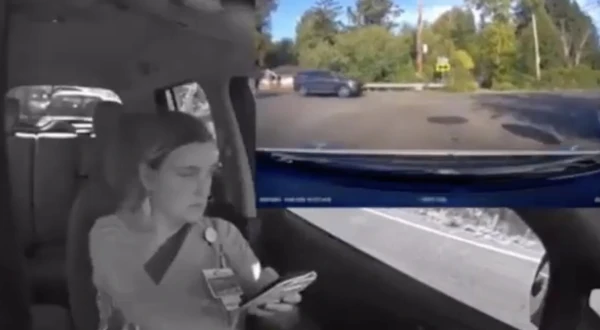
The video clearly demonstrates how dangerous it is to be distracted by a mobile phone or other gadgets while driving.
The comment on the video states that a woman rented a car and got into an accident. She decided to lie about the reasons for the accident, so the owner of the rented car referred to the video footage recorded from inside the vehicle.
In the upper corner of the video, it clearly shows how the driver sees the road when distracted by the phone. At that moment, a black square appears on the screen, writes Focus.
Ruth Purdy, the executive director of the British Road Safety Foundation, stated that according to existing data, talking on a hands-free device is just as dangerous as physically using a mobile phone.
“Cognitive distraction can increase the risk of collision, reduce the ability to recognize hazards, and lead to decreased situational awareness,” she said.
Professor Gemma Briggs of the Open University in the UK shares the same opinion.
“Research convincingly shows that using a phone hands-free is no safer than using a phone in hand,” the researcher emphasized.
Moreover, she added that the increased risk for drivers persists even after the conversation ends – for up to five minutes.
A study published in the New England Journal of Medicine showed that talking on a mobile phone, whether hands-free or in hand, hinders the perception of up to 50% of information about the surrounding environment. This phenomenon is referred to by scientists as “inattentional blindness,” which leads drivers to miss exits, turns, run red lights, and ignore stop signs.
Drivers who spoke on the phone, whether holding it or using hands-free, exhibited equally slow reactions. Their reaction times were slower than those of individuals who were legally intoxicated with a blood alcohol concentration of 0.08 percent.
During a phone conversation, the activity in the area of the brain associated with driving decreased by 37%.