The prototype uses simple and inexpensive parts, and the control is deliberately limited to avoid confusion.
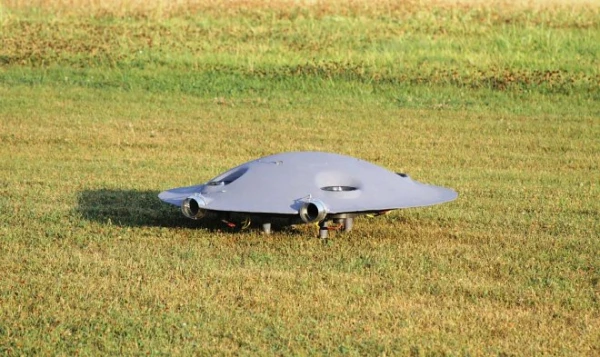
According to Romanian engineer and inventor Razvan Sabi, his universal flying vehicle ADIFO is designed to "change the paradigm of flight." Together with Iosif Taposu, former head of the Department of Theoretical Aerodynamics at the National Institute of Aviation in Romania, he built a working prototype. This machine can fly both as a quadcopter and as a supersonic fighter jet, and it looks like a classic "flying saucer" from comics.
Structurally, ADIFO is a flying wing type aircraft, only it is made in the shape of a perfect disc. Its diameter is 1.2 m, and the central massive part sharply narrows towards the edges to minimize air resistance. Formally, there is a front and a rear part, where two turbojet engines are installed for rapid acceleration. But in reality, ADIFO can move in any direction, rotate, hover in place, and perform a wide range of maneuvers typical of multicopters.
In addition to four standard fans from the drone, ADIFO is equipped with four pairs of side nozzles that release gas jets to create jet thrust. The technology is identical to that used on spacecraft and allows for quick and precise displacement of the vehicle in space without the use of rudders, flaps, and similar mechanisms. When moving at subsonic speeds, all openings are covered by flaps.
The prototype uses simple and inexpensive parts, and the control is deliberately limited to avoid confusion and prevent the loss of the vehicle during complex maneuvers. Therefore, it is not yet possible to speak about the actual flight qualities of ADIFO. Also, although Sabi discusses the potential for creating a piloted version, it is hard to imagine what the interface in the cockpit and the pilot's training should be like to handle a machine capable of almost instantaneously shifting in any direction.
This country in Southeastern Europe has a history of inventing unique flying vehicles. Henri Coandă (June 7, 1886, Bucharest - November 25, 1972, there) was a Romanian scientist in the field of aerodynamics, the discoverer of the Coandă effect. He was one of the pioneers of aviation, the creator of the world's first jet-propelled aircraft design, Coandă-1910.