
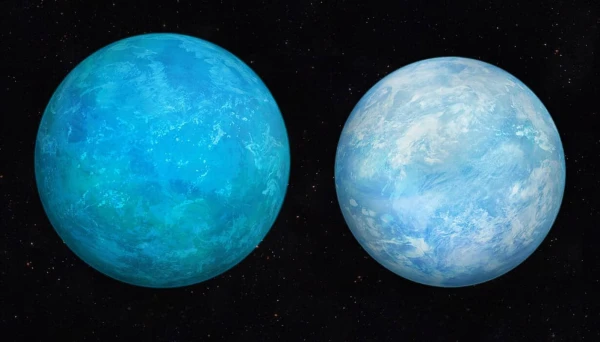
Scientists concluded that initially they can form as purely 'hydrogen'.
Worlds completely covered with water and located very close to their sun are one of the mysteries of modern planetology. Scientists are confident that such planets could not have originally formed as 'wet'. A recent experiment showed that instead, a mini-Neptune can independently produce huge amounts of water.
73 light-years away from us, in the constellation Sculptor, there is a red dwarf TOI-270, around which three exoplanets are observed. All of them are located much closer to it than Mercury is to the Sun. Moreover, two of the three are sub-Neptunes, that is, miniature 'copies' of our icy giant. Such planets are several times larger and more massive than Earth. They are also called mini-Neptunes and gas dwarfs.
Judging by their low density, these planets consist of a solid core surrounded by a shell of hydrogen and other volatile substances. Many sub-Neptunes, including TOI-270 b and TOI-270 d, are considered possible ocean worlds, or more precisely, hycean worlds, planets that have both water and a hydrogen-rich atmosphere. However, gas dwarfs are rarely found in the habitable zone, that is, where liquid water could exist. In the TOI-270 system, the worlds are located too close to their sun for that.
In any case, almost all known sub-Neptunes are found much closer to the 'snow line' in their system. This is an invisible boundary around a star, beyond which distances allow water ice particles to be retained on solid matter grains. According to established scientific views, during the world formation stage in the protoplanetary disk, only in this 'snow' zone can planets rich in water be born.
This raises the question: how do the presumed ocean planets end up where they could not have formed? Until now, the main theory has been the migration of these worlds: they appear in the outer regions of their systems and then move closer. At the same time, in such a case, there is a high risk of a failed 'maneuver' by the migrating planet and its destruction by the star's gravity.
Recently, scientists from the University of Arizona (USA) and the Open University of Israel proposed an interesting alternative theory in their article for the journal Nature: they believe that sub-Neptunes may create their oceans themselves. The researchers decided to test their suspicion experimentally — they placed samples of olivine and other solid rocks in a chamber filled with hydrogen, then subjected the environment to pressures of about 420,000 atmospheres and temperatures of up to 3651 degrees Celsius. In this way, the scientists attempted to reproduce the conditions inside sub-Neptunes, at the boundary between the core and the mantle.
The planetologists' hypothesis was confirmed: oxygen was released from the molten minerals in the chamber, then it reacted with the surrounding hydrogen, and thus water was formed. Moreover, not in insignificant amounts, as previously theorized, but in very large volumes — up to 18 percent of the total mass of all the material used. According to calculations, in fact, a sub-Neptune can turn about 29 percent of its mass into water.
The scientists concluded that initially, sub-Neptunes can indeed form as purely 'hydrogen', that is, 'dry', but over time, near the star, they can become covered with water. According to this concept, ocean planets are a later stage in the evolution of gas dwarfs. It should be noted that the aforementioned star TOI-270 — and thus its planets — is at least a billion years old.














Leave a comment