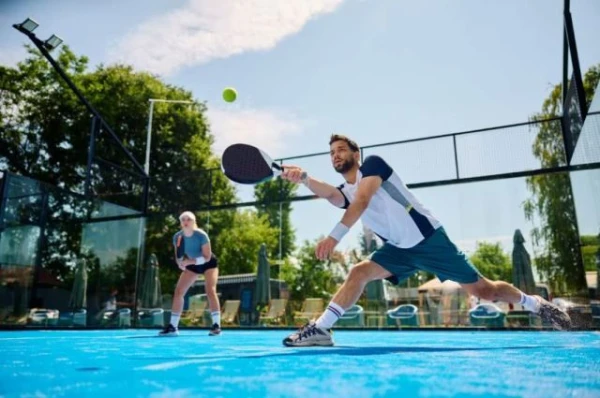
Padel tennis today is one of the fastest-growing sports in the world, played by tens of millions of people. This game is gaining popularity here as well.
It is commonly believed that the game owes its inception to Mexican millionaire Enrique Corcuera.
In 1969, he purchased a house in Acapulco. His wife, Vivian, loved playing tennis, and upon learning that there was no tennis court nearby, she was extremely disappointed. To please his wife, Enrique decided to build a court right on their property. However, due to the complex landscape, the court was made smaller than a standard tennis court.
Additionally, it had to be enclosed with high walls made of sturdy glass. Smaller rackets were chosen for the game, resembling paddles in their construction, which ultimately gave the new sport its name – padel (from the English word paddle).
A turning point in the development of this sport was the acquaintance of Spanish entrepreneur Alfonso de Hohenlohe with padel, who, after visiting Corcuera in 1974, was so impressed by the game that upon returning to Spain, he built two courts there. This marked the beginning of the international spread of padel tennis. Thus, a pastime for one family turned into a global sports phenomenon.
GLOBAL TREND
Padel is a doubles game, meaning there are two players on each side of the court. The main objective of the game is to hit the ball and direct it back to the opponents' half, trying to score points. The game continues until one side reaches a certain number of points or makes a mistake. Walls play an important role in padel: players are allowed to hit the ball after it bounces off the wall. This allows players to create strategies and use the walls in their tactical actions.
Padel began to gain popularity sharply in the 2000s, especially in Europe. In 2023, it was featured at the III European Games, and in 2032, the inclusion of padel in the Olympic program is not ruled out.
EASY TO MASTER
The rapid development of padel is attributed to its relative ease of learning, according to sports instructor Anton Rudkovsky. According to him, basic skills can be acquired after just one or two training sessions. The relatively low physical load compared to tennis is also significant. In padel, victory often goes not to those who hit the ball harder, but to those who can work as a team, analyze the opponents' positions on the court, and think strategically. Therefore, padel is accessible to people of different ages and fitness levels.
At the same time, playing padel burns an average of 400 to 800 kcal per hour of play, depending on the player's weight, match intensity, etc. Padel helps strengthen the cardiovascular system, improve blood circulation, increase endurance, and enhance coordination and concentration levels. Consult a doctor before starting training.