The State Audit Office, in its review "How to ensure a sufficient number of police officers?" indicates that more than 700 employees in the State Police are engaged in positions that, by their nature, do not require police status, and calls for their release from duties not inherent to the service.
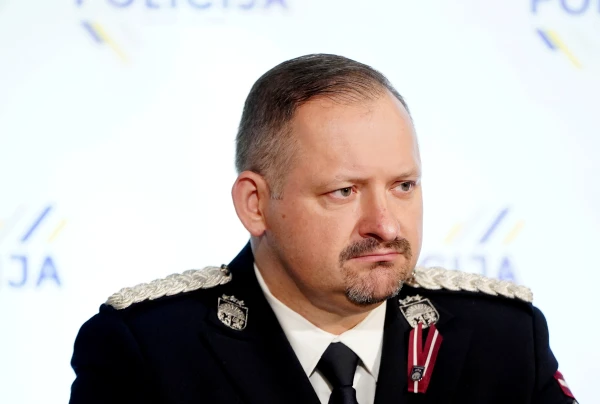
Police Chief Armand Ruks, in a conversation with tv3.lv, agrees that there are areas that can be reviewed, but they are not as extensive as indicated in the State Audit Office report.
The State Audit Office report states: "In the State Police, a significant portion of employees are engaged in positions whose duties do not, by their nature, require police status, increased risk, or special physical training. Their work is mainly related to routine and administrative tasks. For example, investigating administrative offenses, forensic science, licensing, or methodological work, where more than 700 employees are involved. This means that specially trained police officers are not working in areas where their presence is critically necessary, such as in response."
"I can definitely agree that there are areas where this can be addressed," Ruks noted, adding that work in this direction has been ongoing for several years.
For example, since 2015, there are no more financiers, personnel specialists, and communication experts with official ranks in the State Police. In fact, all personnel providing support functions are no longer officials with special service ranks.
However, the State Audit Office urges a broader perspective and, for instance, to change the approach to investigating cybercrimes and financial crimes as well. Ruks does not hide his bewilderment:
"I do not understand where the arguments are for why specifically the investigation of cybercrimes. It seems to me that this is a superficial view of the specific specifics. With the thought that cybercrimes are online, it means that the investigator is simply investigating something on the computer. But that is not the case!"
The police chief emphasizes that cybercrimes involve working with the virtual environment, the illegal internet — the dark web. Moreover, behind them are criminals often connected with organized crime and international activities, and these individuals need to be identified.
Various software solutions help carry out the work, but the investigator must be able to work with them, possess tactics and methods for identifying specific individuals. Then follows operational work, investigative actions with arrests and searches in the physical environment, not just at the computer.
"I don’t know why these areas are highlighted. And now roughly — send them out to the streets for response, and take someone else in their place," Ruks is outraged.
He adds that cybercrimes also include serious offenses such as child pornography, where behind each material is a pedophile and a victim — a child who has suffered sexual violence. Such individuals also need to be identified by working in cyberspace, after which evidence collection, searching for individuals, including accomplices, and other actions follow.
"This is the same operational work, the same investigation as any other. I don’t know, maybe someone thinks that everything happens virtually — the investigator sits in the office, presses buttons, and everything goes to the prosecutor's office. No, that’s not how it happens and it won’t happen — a person will always be needed. And these are trained people," Ruks emphasizes.
He adds that in the Cybercrime Unit, employees are already working under civil law contracts, such as IT specialists. However, attracting such workers has already become a challenge, as they need to provide competitive wages.
"Now I am being told — send them to patrol the streets! Sorry, but who will come in their place? How to ensure sustainability? I agree — there should be a proportional transitional period, then it can be done. But if I have a police officer with skills, trained, who has completed courses, and has a second education, and I have such people… Should I not develop them, not invest in them? That would be madness and wastefulness," Ruks argues.
A similar situation exists with the investigation of administrative offenses. The police chief agrees that investigators of such cases have fewer classic police tasks in their daily work compared to their responding colleagues. However, these employees can be transferred between units where there is a shortage of staff if necessary, as they are officials with police education and training.
"I rely on any service employee. For example, I cannot call a civil law contract worker at two in the morning and summon them to work. Someone will come, but it depends on goodwill. From a legal standpoint, I cannot demand this — it needs to be planned in advance and stipulated in the contract. A service employee is a trained police officer. And Article 5 of the Law on Police states: regardless of the place, time, and position, a police officer, upon seeing an offense or crime, is obliged to act — to prevent, suppress, and call for additional forces. This is the strength of the police, which, in crisis situations, for example, at mass events or protests, goes out to work. These can be officers in uniform, trained, even from offices — I involve them. We include this in the plans, they go out and work on the street, and I rely on this," Ruks explains.
At the same time, he agrees with the State Audit Office that it is necessary to seek different ways to increase the number of the State Police, as the current demographic situation makes this task increasingly challenging.
"The people who make decisions today — in ten years, we will probably no longer be in service. Those who come after will have to live with these decisions. Therefore, we need to be very reasonable and cautious," emphasized the police chief.
The State Police, together with the Ministry of the Interior, has developed a plan for implementing the recommendations outlined in the State Audit Office report. Active work is already underway, but it is impossible to predict the speed of its implementation.