
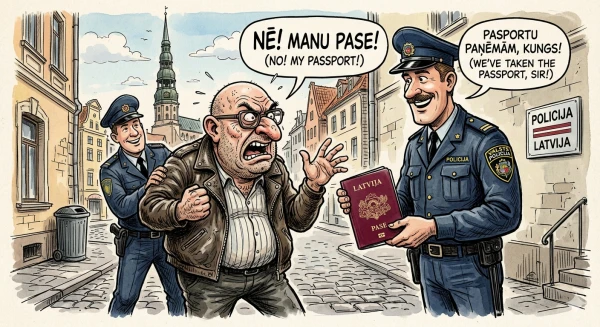
When 30 years ago a budding journalist began working at a newspaper then called "SM," he could hardly have imagined that the Saeima would consider a draft decision "On the deprivation of the citizenship of the Republic of Latvia of Andrei Mamykins." However, this is precisely the issue that the parliamentary Commission on Citizenship, Migration, and Social Cohesion examined in March.
The issue was raised in advance
It was discussed at a very high level. Gunars Kutris, former chairman of the Satversme Court and now head of the aforementioned Saeima Commission, reminded that he and his colleagues "have analyzed the issues of citizenship deprivation many times." In 2024, a study was commissioned on this practice in EU member states, particularly regarding whether citizenship can be revoked if a person does not have a second passport, thus becoming stateless. It turned out that "practically in all countries, this requirement does not exist!"
As early as January 2025, the deputy noted, work began on the procedure in collaboration with the Ministry of the Interior, the Ministry of Foreign Affairs, and the Ministry of Justice.
If we talk about a specific case, written feedback from the mentioned agencies, as well as the Office of Citizenship and Migration Affairs and the Security Police, had already been obtained in advance.
– We need to give a legal assessment of how to address this issue, – emphasized the esteemed lawyer.
"There is a special and stable public-legal connection between the individual and the Latvian state"
This is how the concept of citizenship of the Republic of Latvia was characterized by the sponsors of the draft decision – deputies from the "Latvia First" faction, as well as the non-party members who joined (Elena Klyavinya and Ekaterina Dreilinga were elected to the Saeima from the "Stability!" list, but left). Here, it seems, the colleagues politically sharpened the point. For instance, criminal murderers, corruptors, and simply homeless people and drug addicts are not examples of "mutual accumulation of rights and obligations" – yet for some reason, their citizenship is not planned to be revoked.
"One of the essential elements of this connection is the loyalty of the citizen to the Latvian state, – the initiators further state, – the duty of loyalty includes the constitutional obligation to recognize and respect the constitutional order of the Republic of Latvia, its sovereignty and territorial integrity, as well as to refrain from any action that threatens state security, the democratic order, or the existence of the state."
However, a certain collision arises here. The elections to the European Parliament, in which the candidate from "Harmony" A. Mamykins was elected from Latvia, took place in EU member states between May 22 and 25, 2014. However, the preamble (introduction) to the Constitution of the Republic of Latvia (Satversme) was adopted by the Saeima on June 19, 2014. The President of Latvia proclaimed this document on July 8, 2014. The document defines the foundations of the Latvian state, including the role of the Latvian nation, the Latvian language as the sole state language, and democratic values. That is, the state, so to speak, creatively clarified its essence.
"The duty of loyalty, – the legislators continue, – means not only passive abstention from illegal activities but also a prohibition on engaging in active actions or public calls that are objectively aimed at violent opposition against the Latvian state or its constitutional order."
As for the international obligations of the Republic of Latvia, the deputies urge not to treat them lightly, "recognizing that the regulation of citizenship issues is within the exclusive competence of each state, and in this area, the state has broad freedom of action."
Regarding the latter, who would argue – especially now. After the gifts presented in recent years by the leaders of the largest world powers – and smaller, yet equally bold states – a picture emerges: practically any legal establishment that previously seemed inviolable can, in fact, be disregarded. And, of course, one can complain – to Sportloto, or perhaps to the League of Sexual Reforms.
On behalf of the applicants, Linda Liepina spoke at the commission:
– Our relations with Russia are non-existent, and we cannot find out whether Mamykins has Russian citizenship or not. This discussion is necessary to understand – what we can and cannot do. We need to ask these questions to European institutions.
There is no need to fear international restrictions on stateless persons. L. Liepina pointed out that there is a non-citizen status in Latvia – probably, one can "downgrade" a former full citizen to that status. It is evident that the initiators would like to apply such a practice to a broader group of individuals, starting (for now) with those who slander from abroad:
– There are people who speak openly; I don’t even want to recount the madness they are spreading there; they still hold the status of Latvian citizens.
"We can get him out"
However, such a patriotic desire had an unexpected opponent. Deputy from "New Unity," professional criminologist Andrei Yudin stated that a certain set of measures is initially undertaken, "so that the court begins to work." "If a person has committed a crime against Latvia, they are declared wanted." However, since the specific individual is aware of this, "he will not come to Europe, to Latvia."
– But he can go, for example, to some Asian country. And what happens there? They will also see that he is wanted by Latvia. And if Latvia is looking for a Latvian citizen, we can get him out. If we revoke his citizenship and he is a Russian citizen, then he will never see our Themis.
"If in words – it’s like condemning him, – reflected on the disloyal citizen A. Yudin, a seasoned legal expert, – but in reality, it is in his interests."
G. Kutris further stated that the Security Police expressed itself "quite unequivocally" in a letter to the Saeima Commission – the current Citizenship Law adequately addresses these issues in Article 24. "But at the same time, the Service has no information that he has citizenship of another state," – G. Kutris responded regarding this specific case.
– If we want to judge these people here, – said Oleg Burov (an independent deputy elected from "Latvia First"), – we need to get these individuals to Latvia."
As an additional measure, the chairman of the Commission on State Administration and Local Governments raised the possibility of personal sanctions: "There is real estate in Riga; there is something in the account."
– We always talk about how bad he is. But what about the Land Register? I know where his property is, – O. Burov revealed his detailed knowledge of the property status of his political opponent.
Meanwhile, Oleg Osipovich is not being original here. In Russia, a law was adopted (as of December 28, 2024) prohibiting "foreign agents" from freely disposing of income from real estate and vehicles, as well as receiving passive income. Income from rent, sales, or dividends is credited to mandatory special accounts, which can only be used after the status is removed. Full confiscation has not yet been adopted, but restrictions are tightening.
So we all run together in one direction – that is, away from the law.







Leave a comment