
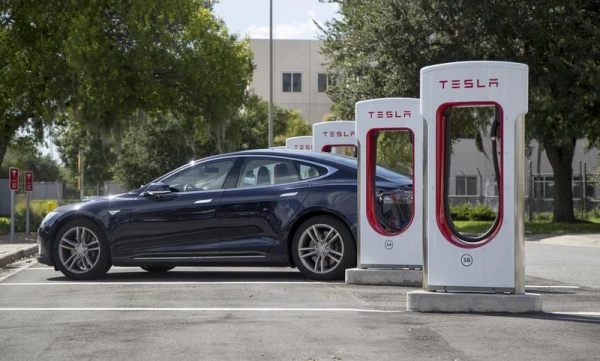
A friend at the gym noted that a "Tesla" type electric car can already be bought for "ten grand". Why has this symbol of prosperity deflated? The fact is that last year the state ended its support program for purchasing electric vehicles. But that's not all...
The State Revenue Service requires payment for electric vehicle charging not through a convenient mobile app, but through a cash register-like device. The Riga City Council is revoking parking benefits for electric vehicles. What has happened — is the state turning its back on green technologies?
"What — can’t breathe? Oh, how I breathed, how I breathed!" - this well-known joke now best describes the sudden crackdown on electric vehicles by the state. Indeed: how much it loved electric cars, how passionately it breathed, granting benefits and urging everyone to switch to them to contribute to saving the planet's climate.
But now everything has suddenly turned in the opposite direction. The State Revenue Service has targeted electric vehicle charging operators for what it considers an incorrect payment method. Until now, drivers paid for charging using a mobile app: very convenient — just a couple of taps on the screen and it was done. This is how it is done in neighboring countries — Lithuania and Estonia. However, the Latvian State Revenue Service decided that our country has its own way, and mobile payment has no place here. It demanded that charging operators purchase special fiscal devices (analogous to cash registers): then drivers will have to pay not through the app, but with a bank card, which will help the State Revenue Service track every receipt and every cent paid.
It is clear that reverting from a 21st-century payment system to a 20th-century payment system will cost charging stations a significant amount. Who do you think will bear the costs of purchasing cash register analogs? Correct — the drivers, making them regret their choice of an electric vehicle.
Moreover, the new requirements from the State Revenue Service will significantly slow down the development of electric charging stations in the regions. After all, operators who planned to enter the market there did not anticipate such additional expenses.
These grievances were indignantly expressed by the Minister of Climate and Energy, Kaspars Melņis: "The accounting rules established by the State Revenue Service, as well as the requirement for the use and certification of local fiscal devices, will create additional costs for electric vehicle charging operators, which will ultimately have to be paid by drivers. Also, in the Baltic region, only in Latvia are operators required to use fiscal devices, without relying on IT solutions for transaction accounting."
He urged the Ministry of Finance to urgently reconsider the State Revenue Service's decision, otherwise the state's policy, which previously encouraged the purchase of electric vehicles, will go to waste: "Every disproportionate complication of the electric vehicle charging process can negatively affect car buyers' choices, delaying the purchase of modern zero-emission vehicles that primarily use electricity produced in Latvia from renewable resources in everyday operation. Replacing each internal combustion engine vehicle with an electric vehicle contributes to economic development and reduces Latvia's dependence on imported fossil resources. The question of the accuracy of accounting seems somewhat comical, considering that the electricity for charging stations is supplied by a state enterprise, so the volume of incoming and used energy is easy to determine. I urge the leadership of the Ministry of Finance and the State Revenue Service to assess the validity of the requirements and to find a mutually acceptable solution together with the industry."
Neither the Ministry of Finance nor the State Revenue Service has responded to this yet.
Meanwhile, the Riga City Council has thrown a wrench in the works for electric vehicles. It has decided to revoke an important privilege for electric car owners — free parking on the streets of the capital. This benefit was a significant plus when people were deciding what to buy: a vehicle with an internal combustion engine or an electric vehicle. The Latvian Electric Vehicle Association (LEAB) specifically conducted a survey and found that free parking was the final argument in choosing an electric vehicle. Therefore, LEAB expressed its protest to the Riga City Council, stating that such decisions affect not only Riga but also trust in green mobility policies throughout Latvia.
However, it is unlikely that the Riga City Council will reconsider its decision. The streets of the capital are congested with cars, the need for parking is enormous, especially in the center, where electric vehicles are parked from morning till night, ruthlessly exploiting their privilege of not having to pay. As a result, the municipality is losing significant money, and the more electric vehicles there are, the higher the losses. So the benefits will no longer exist, and electric vehicle owners will have to come to terms with it.














Leave a comment