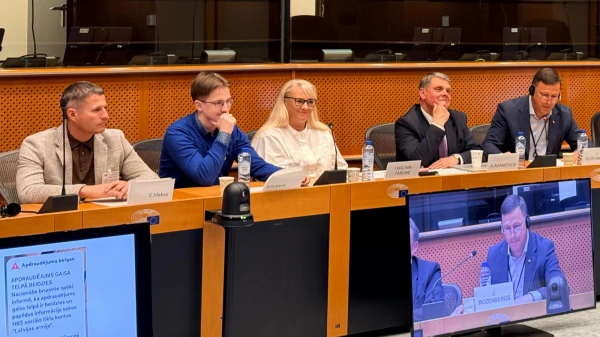
Every time I visit the Riga Zoo, I think about the serpentarium. Where have I seen these slow, cautious movements, bright colors, mimicry, and not very intellectual looks wasting calories? Then I remembered the last round table on "Rail Baltica," and the memory returned, writes Toms Lucis on Pietiek.com.
Then I listened for about 10 minutes and realized that we are hostages. "They" are simply inadequate, they were just the first to put on a white coat and think they are doctors. And we won't last until autumn with "these" — the crisis has already begun.
Why is the Coalition dangerous?
Firstly, these people are not used to making independent decisions.
Secondly, these people are not used to making effective economic decisions, because such decisions also require political freedom of choice, which cannot exist under the wing of Brussels.
Thirdly, the cognitive abilities of "these" people are so limited that they now pose a greater threat to our lives, health, and well-being than to "their" lives.
The possible removal of the Coalition in the autumn elections will be too late and will not prevent the catastrophe of Latvia.
The fuel and gas crisis and its consequences
Aggression against Iran has opened Pandora's box, and the world will never be the same again. In general, it would be normal if Latvians did not care about the world and could predict events and act accordingly. But with this particular government, nothing like that will happen.
The reality is harsh — even if the crisis around Iran ends in two weeks, the economic consequences will be felt by the world for at least six months to a year. Because in many Gulf countries, oil production has stopped and wells are being preserved, and their restoration is a lengthy process. The same applies to gas. Let me remind you that the EU leadership is operating within an IQ range of 60–80, and Latvia should not expect any help from there.
A brief retrospective of the EU energy disaster
From 2009 to 2014, the EU abandoned gas contracts.
In 2022, Nord Stream was blown up. Germany pretended that everything was blown up, although even today there is a completely intact line that could start pumping gas within a week.
The EU leadership reassured European entrepreneurs with theses about gas from Qatar. But in the first approximation, it turned out that Qatar simply does not sell gas on a spot basis.
Against the backdrop of this entire story, German intellectuals closed the last nuclear power plant. Bravo! Thunberg applauds you standing!
But now Iranian rocket men have destroyed one of the largest gas processing plants in the world in Qatar. They threatened to do so if Israel bombed Iranian gas facilities.
Israel, of course, bombed, because the six-fingered does not care, the Messiah will forgive everything.
So, Silin? How many thousand cubic meters of gas do we have in storage? Do you know? Have you refreshed your operations with zeros?
Let's refresh the chemistry as well. Does the lady know what nitrogen fertilizers are made from? Incorrect — not in the Saeima, but from natural gas.
The usual Haber-Bosch process under high pressure in the presence of an iron catalyst. Previously, these "barbaric" actions were performed by Lithuanians in the company "Achema", then they were "Europeanized", the enterprise went bankrupt, etc.
In short — no oil, no gas, no fertilizers — but the Coalition is in power, which has driven a stake and a couple of days ago could not decide what to send to help America in the war.
That's how it is.
Consequences
"While the fat one loses weight — the skinny one will die" — this saying accurately describes the events that will soon unfold in Europe. There will already be a shortage of mineral fertilizers this year, and prices will be sky-high. And our harvest will be bought by those who can pay more — as usual, the Germans.
Oil prices are forecasted at $150–180 per barrel. Hello, who is storing Latvia's strategic reserves? Can you provide more details?
Explosion of food and fuel prices
If solutions are not found, the scenario for this autumn is roughly clear: hyperinflation at best or even a complete collapse of the global financial system if the AI bubble bursts and other stock market problems arise.
Winter is also easy to imagine — given the income structure of Latvian society, most will have to choose: eat or live in a warm apartment.
From experience, it can be said that Latvians will choose to eat, but may live somewhere else, far from the territories controlled by "Unity".
This crisis situation could finally break the already weakened Latvian society and destroy what remains of the state.
And do not hope that the ruling "group of intellectuals" will realize this before the harvest.
What to do?
First — return to reality. The EU is unable to solve this issue due to rigid ideological attitudes. EU representative Kaja was recently waving her hands and calling for a complete embargo on Russian oil and gas. I wonder what she thinks now after the destruction of the Qatari gas giant?
If Latvia wants to survive as an independent state and prevent the remaining residents from fleeing, it needs to follow Orbán's path.
It is no secret that we are still connected to Russia by a gas pipeline, and the Inčukalns storage facility in reverse supplies gas to St. Petersburg. Potash is mined in Belarus and urea is produced — if it is necessary to hand over a couple of hooligans for a profitable contract, that is not too high a price.
In fact, the situation also opens up great business opportunities — Latvia is close to sources of key resources and could earn well on mediation and transit.
The traditional choice of Latvians
Now the question is: what is better — to be young and rich or old and sick. It is obvious that the government of Silin should not be allowed to decide this question, otherwise the choice of "old and sick" is guaranteed.
The war with Iran shows the need for an independent foreign policy — the countries of the Persian Gulf will have to remove US bases if they want to live without bombardments. The US will likely have to come to terms with the impossibility of projecting power in Eurasia and the Middle East and return home to resolve internal conflicts.
And Latvia needs to learn to prioritize the survival of the state and the economic interests of its citizens over directives coming from external centers of power.