It has been a while since anything grand has been built in Riga. Today's children have grown up accustomed to the glass mountain of the Castle of Light rising on the banks of the Daugava – and we remember what an epic it was. But no worries, a new construction of the century will soon commence.
A Symbol of Recent History
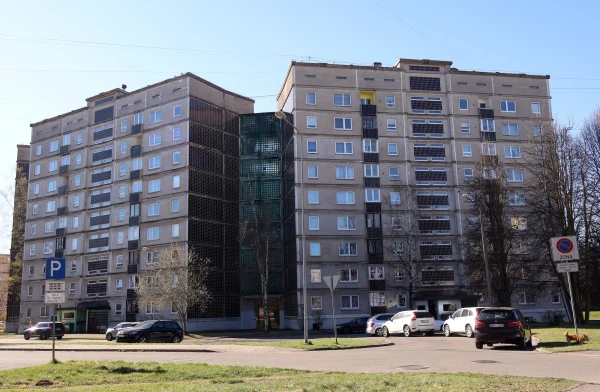
The House of Party-Political Enlightenment, built according to the design of Juris Gertmanis and Valerijs Kadyrovs in 1982, has become a symbol of Atmoda – here, in 1988, the founding congress of the People's Front took place. During its time as the Congress House – and in 1999-2000, a 4-story building was added to it – your author experienced quite aesthetic events here – from a concert by the band "Aquarium" to a performance by Viktor Tsoi, and from the Press Ball to the "Arsenal" film forum. Yes, those were the days!
But for several years now, the Congress House has been virtually empty – only occasionally being used for temporary events, like vaccinations. Now, however, everything will change, as the Riga Philharmonic will be built here. What is it and how much will it cost?
The Matter of 11 Hectares
In February, a draft law on the National Concert Hall "Riga Philharmonic" was submitted to the Saeima. Surprisingly, it was signed by representatives of both coalition factions – Antonina Nenashova ("Progressives"), Liga Klavina (Union of "Greens" and Farmers), Agata Zarina-Sture ("New Unity"), and opposition members – Nauris Puntulis (National Alliance), Cheslavs Batnya ("United List"). Only "Latvia First" was forgotten – although behind it loom the powerful shoulders of the investor and developer. But never mind.
In the first article of the draft law, there is a reference to the fact that the UN requires Latvia to preserve cultural and historical values, in this case, the center of the capital. Therefore, the real estate between Kronvalda and Kalpaka boulevards, consisting of a land plot of 113,612 square meters and two buildings, as well as an underground parking lot, registered to the owner – the municipality of the state city of Riga, must be developed in accordance with the concept created specifically for this purpose by MARK ARHITEKTI and MAILĪTIS ARHITEKTI. Three years ago, this legal entity won an international sketch competition (under the motto Baltic Shine), and therefore the Philharmonic must be built exactly like this!
Truly a unique phenomenon, agree – the parliament orders its capital: "The municipality of the state city of Riga must ensure the development of the construction project for the Concert Hall by December 31, 2026. The construction project is developed according to the idea proposed in the architectural competition. Its goal is to create a new, user-friendly, accessible, high-quality acoustic concert hall, preserving the cultural and historical values of the Riga Congress House, using high-quality modern architectural and design solutions, as well as ensuring longevity, including effective resource use and integrating the new building into the cultural and historical environment of the city."
The Canal Will Be Dredged, Trees Will Be Cut
The construction will decisively change the course of the city canal: "Transformations for the improvement of the surroundings of the Concert Hall can be carried out in the protective zone of the surface water body... the flow area of the city canal (an artificially created water body) can be reduced, ensuring its presence and certain tasks assigned to it through alternative measures."
Similarly, without any euphemisms, they will deal with Kronvalda Park: "The protective territory of the protected trees can be reduced... as well as individual protected trees or plantings of protected trees can be moved or cut down...". However, the authors of the draft law are confident that "the creation of the Concert Hall will contribute to the international competitiveness of the state, cultural tourism, and the long-term development of the urban environment." To ensure that the radical measures concerning the canal and the park are not criticized – the legislators write in advance that their actions fully comply with the 1972 Convention concerning the Protection of the World Cultural and Natural Heritage.
What is Imposed on Rīgas Nami LLC
This municipal enterprise, which is essentially the owner of the current Congress House, will be at the center of the entire mega construction story. By the way, the draft law includes about ten pages from the database of the Register of Enterprises, listing various encumbrances – electrical lines, gas pipelines, and numerous protected "dijkoxs" (old trees under state protection).
According to the announcement from MARK ARHITEKTI and MAILĪTIS ARHITEKTI, the Congress House will not seem small:
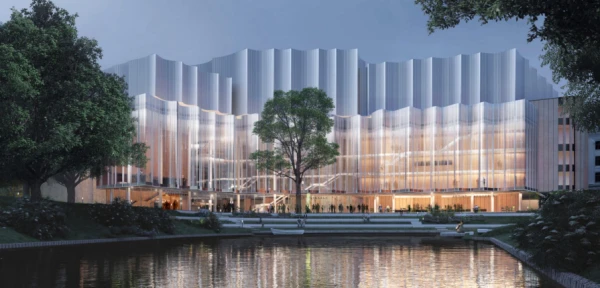
"On the first floor, a continuous public space will be created, and the connection between the internal spaces, the park, and the canal will be strengthened. Through a spacious atrium, visitors will be able to access public terraces on the roof and concert halls located in the central volumes of the building, as well as artist facilities.
The Riga Philharmonic will have three concert halls:
- a main acoustic hall for 1,300 people,
- a small hall for 350 people,
- a rehearsal hall.
It is expected that the Riga Philharmonic will become a vibrant public center, housing several academic music institutions, and will host numerous educational and cultural events daily. The building will also house a music library, restaurants, and cafes."
Dolomite, Concrete, Glass
The architects promise to add shine to the building:
"The new shell of the building will create a sense of openness and integration with the surrounding environment through the use of innovative materials and technologies. The characteristic material of the original volumes, pink dolomite, will be preserved and reused, and elements made of recycled concrete will also be added. Reflective glass and glazed ceramic panels will add shine and variety to the building, changing depending on daylight and the surrounding environment."
The architects also note that one of the themes of the project is "the philharmonic in the park," and the glass bay windows facing the canal will allow concert-goers to "immerse themselves in the beautiful landscape along the canal."
All of this is simply wonderful – but neither in the law under consideration by the Saeima nor in the documentation from MARK ARHITEKTI and MAILĪTIS ARHITEKTI is even an approximate cost of the project mentioned. One can, if digging through news archives, find a preliminary estimate... from 2023 – 61.3 million euros. Beyond that – uncertainty. Considering the appetites of the local construction industry, one can be sure that with the current inflation rates, the budget for the construction "on the ground" will rise to a hundred million. And who will actually build it, where in Latvia can so many qualified engineers and workers be found, who all left during the crisis? Most likely, subcontractors from Poland will be attracted, and they will always have workers from Central Asia. Thus, through national efforts, "The Shine of the Baltic" will be erected...