
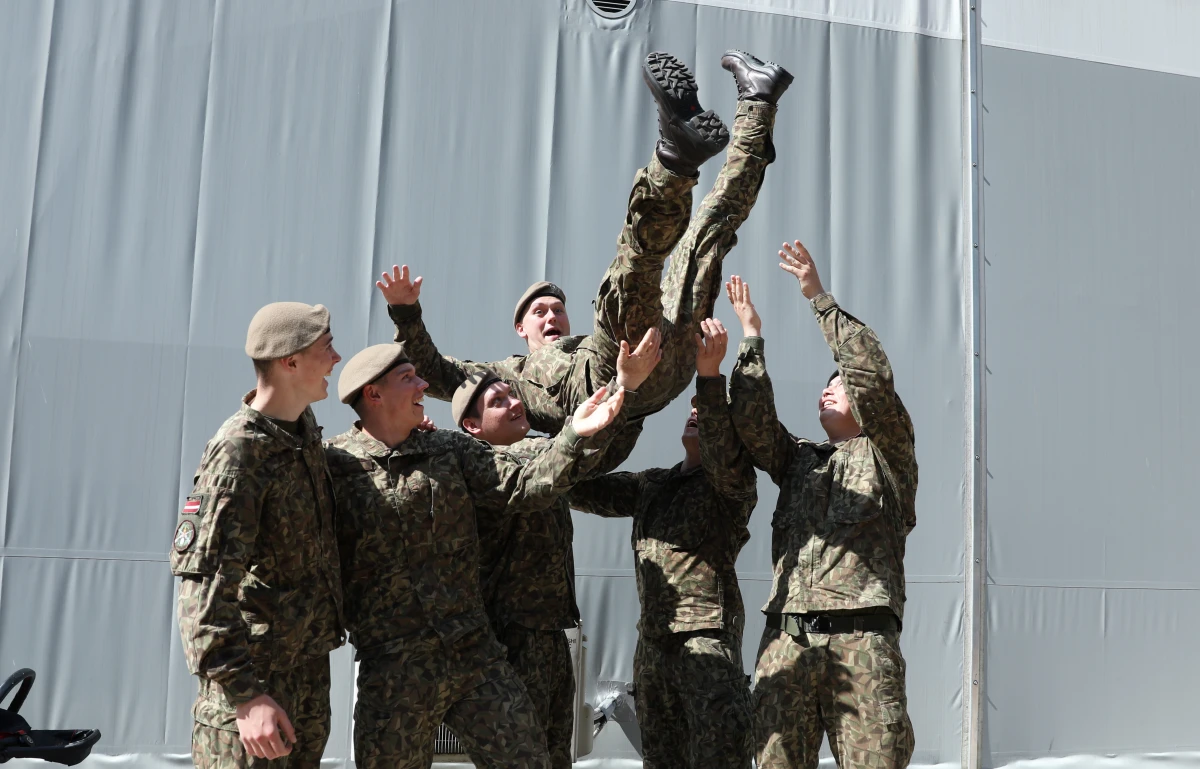
Young people in Latvia are eager to sign up for the National Defense Service (NDS). Attracting volunteers allows for fewer calls through selective drafting. Moreover, as NDS director Kristers Grauze noted, 70-75% of volunteers meet the standards after checks and are accepted for service – while only one in four to five conscripts is fit for service.
Motivated Recruits
At a meeting of the subcommittee on comprehensive defense, chaired by the well-known military expert, retired Colonel and now independent MP Igors Raevs, the geography of the National Defense Service was also discussed. Today, a volunteer has the right to choose their place of service – and therefore the leading military bases are Adazi (Mechanized Brigade) and Lielvarde (Air Force). Mr. Grauze called for the promotion of other units and training grounds – Aluksne (25th Battalion of Zemessardze), Luznava (36th Battalion), and others.
Potential servicemen wishing to join the National Armed Forces are so motivated that they even appeal during health checks. Thus, 10 individuals challenged the verdict of the doctors and won – they wanted to defend their homeland!
"The state cannot cope with such an influx; they are being filtered out," suggested the secretary of the subcommittee Edvins Shnere (National Alliance).
Medical expert of the NAF Sandis Stepinsh pointed out that young people are revealing unnoticed pathologies of the spine. Vision is also a very relevant issue. However, it happens that potential soldiers challenge, for example, skin diseases – and they are still allowed to join the army.
Frayed Nerves and Poor Vision
The medical commission of the Latvian army includes a wide range of specialists – from surgeons to dentists, as well as gynecologists (women also serve); expensive and complex diagnostic equipment such as computed tomography and magnetic resonance imaging, echocardiography, and substance tests are used. "We need to be on two fronts," acknowledged the military medic. Unfortunately, there are those who do not want to join the army – and are even willing to harm their health for this. However, "volunteers do not simulate."
Mr. Raevs mentioned that he had spoken with soldiers of the U.S. Special Operations Forces who lived and trained with heart stimulators.
According to K. Grauze, it is precisely diseases of the nervous system and psychological difficulties that are the leading reasons for initially "discharging" our young men – 20-25% are unfit for service. Then follow the verdicts of the surgeon and ophthalmologist (myopia is common). The Ministry of Defense has negotiated with the Ministry of Health to check relevant indications already among high school students in schools.
Reserve Call: "Twos" and "Threes"
MPs expressed support for narrowing the reasons for medical exemptions. "There are different tasks in the army," stated E. Shnere.
In response, military medic S. Stepinsh pointed out the existing groups:
- the highest includes practically healthy individuals who can be paratroopers and divers;
- followed by those who have suffered injuries but are healthy;
- next are individuals with minor functional disorders who can serve in support units.
There are a total of 6 health groups, the lowest of which, Group 1, are effectively disabled.
– In case of a crisis, we call up both "twos" and "threes," acknowledged S. Stepinsh. – In peacetime, we manage with "sixes" and "fives."
Draft Dodgers Will Be Addressed by Military Police
Medicine filters out, on average, half of the recruits – and another 25% belong to various socio-economic reasons.
If a young man is selected by a random generator for military service and does not appear for the check without a valid reason, a special structure of the National Armed Forces – the Military Police – steps in, which, as Mr. Grauze put it, "tries to motivate."
In addition, there are draftees who have a legal right to deferment – students, scholarship holders, participants in sports teams. Such individuals are transferred to the next draft queue. A work contract abroad can also serve as a basis for deferment.
Edvins Shnere cited Finland as an example, where the attitude toward mandatory service is completely different, and it is practically impossible to "dodge."
– A war is happening nearby, every soldier counts in Ukraine, and here we have depression, I won't go serve. And what if a person has sat at a computer their whole life? Maybe they could become an ideal drone operator? In response, representatives of the military department stated that the term of mandatory service for cyber troops is too short.
Soldiers Are Prepared from Kindergarten
Igors Raevs shared that Estonia has adapted the Finnish model, which is why they have significantly more physical activity starting from kindergarten, where children play outside even in rain and snow.
"Mandatory service is designed to prepare reservists whom we can use in case of war," acknowledged the professional military.
In this sense, it makes no sense to prepare the same "drone operators" through conscription – because they will immediately lose their skills in civilian life: "Only necessary specialties need to be mastered; otherwise, it’s just wasted money." As military medic Stepinsh noted, even during training in the troops, when recruits are subjected to heavy loads, health discharges are identified – 40 individuals who previously received a "five" in health, i.e., the second highest category, were sent to civilian life.
Army in Variety
The Law on the National Defense Service was adopted by the Saeima on April 5, 2023. It establishes the obligation for every citizen of Latvia – male – to serve after reaching the age of 18. Or, if the citizen continues to study for basic or secondary education – within one year after graduating from the educational institution, but no later than the age of 24.
At the same time, it is established that citizens of Latvia, both men and women aged 18 to 27, can voluntarily apply.
Types of service:
- 11-month service in a unit of the regular forces of the National Armed Forces or Zemessardze;
- 5-year service in Zemessardze with an annual training period of at least 28 days (only voluntary choice);
- 5-year service provided for students of higher education institutions and colleges – reserve officer program. The total period of training and performing service tasks is at least 180 days (currently, the program is planned for 214 days) – also only voluntary choice;
- Civil defense service of 11 months – for individuals who, due to their beliefs or religious views, cannot perform military service (only for those drafted into the army).
The National Defense Service will reach full readiness in 2028, when it is planned to annually train 4000 servicemen under the 11-month program. Another 2000 servicemen will have the opportunity to undergo military training under the 5-year Zemessardze program, and up to 500 servicemen will be able to undergo reserve officer training.



Leave a comment