
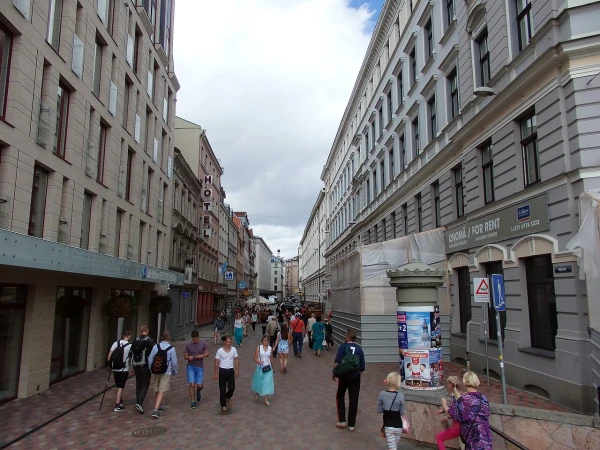
The European Union offers the capital money under the program: "Restoration of unique cultural heritage of European significance." Brussels allocates 5 million euros for the renovation of Valnu Street, and the municipality will add another 3.6 million euros.
The portal bb.lv investigated what the money planned to be spent by the end of 2029 will go towards.
The Pearl of the New Era
In fact, against the backdrop of the medieval streets of Old Riga, Valnu, with its length of 609 meters, almost looks like a modern highway. On old maps from the end of the Russian Empire, this street is named – Fortress Street. This is not its first name; it was first mentioned in 1792 as Barracks Street. At that time, it lay just behind the fortification ramparts – hence its literal translation, Rampart Street.
But there were times when ships docked here. After all, it was at the intersection of the current streets 13th of January, Ridzene, and Valnu that the "Riga Ship" was discovered in 1939 – a 13-meter vessel made of seasoned oak, on which brave Livs sailed the Baltic Sea! The ship's affiliation with the indigenous Finno-Ugric ethnicity was determined by archaeologists, as its shapes significantly differed from those used by shipbuilders in Western Europe, Scandinavia, and Ancient Rus.
The Common Fate of Local Architecture —
-
as a rule, unknown individuals, presumably from merchants, Baltic Germans, developers of the New Era,
-
then Baltic German, Latvian, or Russian architects of the late 19th century,
-
and restorers of the late Latvian SSR.
The oldest houses here can be recognized as:
-
N 45 (17th-18th century, reconstructed in 1880-1881 according to the project of architect Otto Dietze, reconstructed in 1983);
-
N 47 (18th century, reconstructed in 1884 by architect Apollons Edelsons, reconstructed in 1983, characterized by the "Camel Portal" transferred to its facade);
-
N 41 (1737, reconstructed in 1888 by O. Dietze, reconstructed in 1983).
Heritage of German Culture
Those buildings that can be clearly attributed were erected by the most prestigious architects, for example, the first Latvian official architect, Janis Friedrich Baumanis (1835-1891). He built houses N 26, N 28, and N 32 on Valnu (1880s, apartments and shops), N 28 (1868-1870, German Crafts Society, now the private Museum of the Sun).
Another local peasant who became a famous architect, Konstantins Pekshens (1859-1928), built house N 18 on Valnu in the 1910s (apartments and shops), which was later reconstructed in 1985.
The most common creations here are those of the Baltic Germans. Herbert Timer developed the project of a powerful Jugendstil building at N 3. In our time, it was reconstructed by a well-known Riga patron, creating a shopping arcade and placing a replica of the Golden Knight figure in the inner courtyard.
Karl Felks, Edgar Frizendorf, Christoph Haberland – different architectural styles left by the national community of Riga that has passed away. Even the buildings from the 1930s, which now look quite modern – N 11 and N 19, built respectively for a bank and a cinema, belong to the Baltic creators Alfred Karr and Kurt Betge.
By the way, it was during that time, before World War II, that Valnu Street became the first official pedestrian street in the Old Town.
Hotel Quarter
At the corner with Kalku Street (N 28) stands a hotel built by Polish craftsmen in the late 1980s to early 1990s. Almost the entire block between Theater Street and Kalku Street is also occupied by a hotel that had to survive 1956 – a time of moving away from "architectural excesses".
Before its construction, the best Riga hotel "Rim" (1878), which was damaged during World War II, and the parsonage of St. Peter's Church (built in 1910 according to the project of the famous Belgian architect, one of the founders of rational modernism, Henri van de Velde and Bernhard Bilenstein) were demolished.
A competition was announced for the hotel project, in which two groups of architects participated: led by academician Ernest Stalbergs and led by Arvids Miezis. Stalbergs worked together with students Marta Stane, Arturs Reinfelds, Janis Ginter, and Janis Licitis and designed a 9-story building with a large square in front of it, for which it was necessary to demolish the remaining buildings in the block.
The competition commission approved Miezis's project, but only the layout. They considered the facades too austere, and invited Eugen Laube's student – Sergey Antonov – to design them. The Russian architect from pre-war Latvia brought elements of 1930s functionalism into the Soviet project.
What Will Be Done Soon
The goal of the street renewal has been announced: "To promote the development of public external space in Vecriga as a territory included in the UNESCO World Heritage List, to ensure the improvement of pedestrian infrastructure quality and accessibility of the environment for diverse user groups, and accessibility of cultural and tourism services."
The following is planned to be implemented:
-
Construction of pedestrian infrastructure on Valnu Street and its connections (changes in traffic organization adapted for pedestrian infrastructure needs);
-
Restoration of the pavement to ensure environmental accessibility (a combination of historical cobblestones with modern solutions);
-
Reconstruction of related engineering communications;
-
Elements of modern landscaping (lighting, plantings);
-
Unified design solutions (information signs);
-
Information stands;
-
Publicity and community involvement.
Scope of Work
Presentations made by the designers show that there will be no fundamental changes in the appearance of Valnu – but some improvements will certainly be made. There will be more elements of small greenery, and the cobblestones will be laid more evenly. A specification for this pavement, as well as for conceptual lanterns, is attached.
Of course, there will also be stylish black bollards!
The central area of the project is Valnu Street along its entire length from Smilshu Street to 13th of January Street. The reconstruction work will also affect the Theater Square and the 1991 Barricades Square, Meisteru Street, Kalku Street from Meisteru Street to Aspazijas Boulevard, Audeju Street (from Kaleju Street to Aspazijas Boulevard), a small section of Amatu Street, and it is also planned to reconstruct the connections of Valnu Street with Aspazijas Boulevard and 13th of January Street.
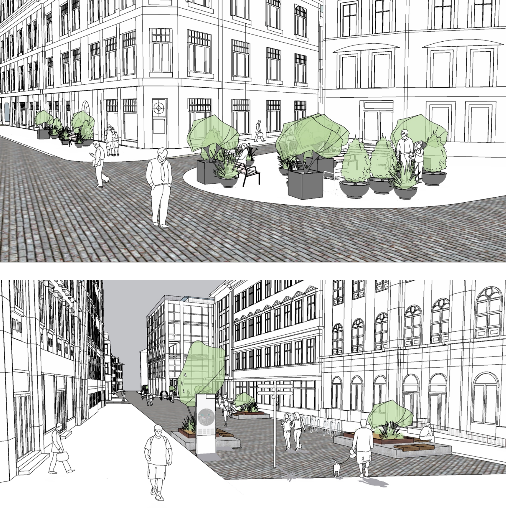
Infographics: riga.lv
Potemkin Village
All this is, of course, wonderful – and the continuity with the previous composition of the Council, which started this project, is all the more evident. However, in reality, Valnu already looks quite decent, unlike, for example, those streets that still display neglect.
Of course, no old ruin can be restored for the current price of 5 million euros – moreover, we immediately run into property rights, etc. Therefore, Vecriga will have to embody the theory of small deeds – well-maintained public spaces with neglected "owner" buildings...







Leave a comment