
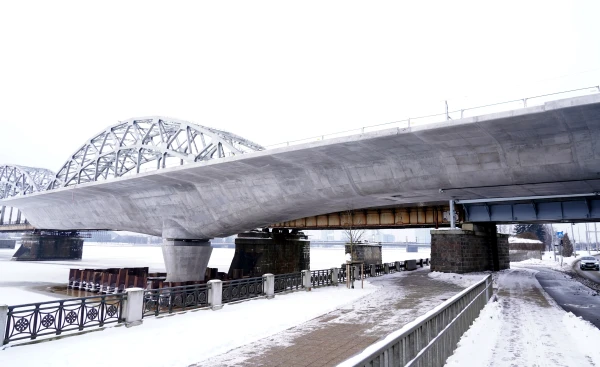
Estonia has an agreement with Latvia that the European gauge railway line 'Rail Baltica' will be completed by 2030, despite concerns about delays in the project's implementation, said Estonia's Minister of Infrastructure Kuldar Leis, according to LETA citing ERR.
This week, a special commission of the Estonian Parliament for state budget control met with Latvian politicians and representatives of the European Court of Auditors to discuss whether it is possible to complete the project within four years, with the greatest concerns arising from delays in Latvia.
"The management of this project is weak. More effective management should be ensured by an agreement between the states. Secondly, I am convinced that we should strive for at least a bilateral agreement with Latvia so that we — and the taxpayers of Estonia — can be assured that Estonia's investments in the project over the years symmetrically guarantee that Latvia will also develop it," said the head of the special commission of the Riigikogu, Urmas Reinsalu.
Minister Leis noted that the greatest risk for the implementation of 'Rail Baltica' is that the government of any country decides to abandon further construction of the railway line. Latvia and Lithuania confirmed that they will continue work according to the established schedule and are ready for joint procurement of trains, he said.
"We have an agreement among the three states, under which all prime ministers reaffirmed to the European Commission that 2030 is the target, so there is no need to conclude a separate agreement between one, two, or three countries," Leis explained.
The technical director of the project implementation company in Estonia, 'Rail Baltic Estonia', Lauri Ulms, noted that there are certain concerns and risks regarding how quickly it is technically possible to complete the project. "If funding is sufficient, this is still the last moment to make these decisions and complete the construction of the railway in our direction," he said.
So far, procurement in Latvia has been almost a third more expensive than in Estonia.
"Latvia's knowledge and experience regarding the project were significantly less than Estonia's when we started the procurement process. When the procurement process was initiated, the bidders accounted for a higher price because the risks were significantly higher. On the other hand, the geotechnical conditions in Latvia, where construction work needs to be carried out, may be significantly or slightly worse than in Estonia," Ulms noted.
The missing funding is planned to be sought in the next budget of the European Union. In the new budget, a larger share of funds than before will be allocated to defense, which, according to Leis, could be beneficial for 'Rail Baltica'. He added that projects that have already received support from the European Commission will continue to receive funding.
"Together we applied for funding for 'Rail Baltica', and we need to show that construction is progressing at the promised pace. Besides the next period, there is also news that funding can be obtained earlier — already in 2026–2027 from the leftovers of this phase, which means that the funding situation is constantly changing, and there is no tragedy here," said the minister.
As reported, according to information from the joint venture 'RB Rail' established for the project, the cost of the first phase of 'Rail Baltica' in the Baltic countries could reach 14.3 billion euros, of which 5.5 billion euros is in Latvia, although potential savings of up to 500 million euros are possible through the optimization of technical solutions, as well as other possible savings.
The total cost of the first phase in Estonia is estimated at 3.1 billion euros.
The total expenses of the project according to the cost-benefit analysis in the Baltic countries could reach 23.8 billion euros. In the previous cost-benefit analysis in 2017, it was assumed that the project would overall cost 5.8 billion euros.
The 'Rail Baltica' project involves the creation of a European gauge railway line from Tallinn to the border of Lithuania and Poland, in order to further connect the Baltic countries by rail with other European states. In the Baltic countries, a new European gauge railway line (1435 mm) is planned to be built, stretching 870 kilometers with a maximum train speed of 240 kilometers per hour.









Leave a comment