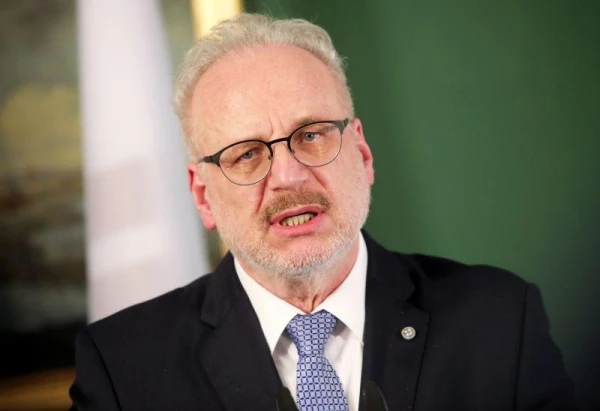
The future fate of Ukraine is existentially important for Eastern Europe, while at the same time there is a feeling that we are one step closer to a change of power in Russia, said the current director of the analytical center Artis Pabriks, who served as Latvia's defense minister at the beginning of the Russian invasion.
Four years ago, in the early hours of the war, Pabriks urged the West to do two things — impose the toughest sanctions against Russia and provide maximum support to Ukraine. Now, commenting on his previous statements, Pabriks noted that Ukraine has received more from the West than Russia expected, but still less than necessary.
Accordingly, this is the main reason why the war continues to this day.
"The war has been going on for four years, and the West still does not realize what it is facing and is unable to make adequate decisions. We see that Western society has become more divided, which gives hope to Putin, as his level of pain is incomparably higher than in the West," Pabriks explained.
He emphasized that Russian narratives about societal fatigue from the war are spreading in the West. The participation of U.S. President Donald Trump's special envoy Steve Whitkoff in the negotiations plays into Russia's hands.
Moreover, the West is still unable to completely abandon Russian oil and gas, Pabriks added, noting that there is regression in the Olympic issue, and the influence of Russian information agents persists. "All of this gives Russia hope to endure," Pabriks emphasized.
Pabriks believes that for Putin, this war is a matter of survival, as he needs an external enemy.
At the same time, the former Latvian minister has a feeling that "we are one step closer" to a change of power in Russia. This means that the West must be prepared for such changes. "Even if the level of pain in Russia is high and societal tolerance for the war remains, a counterstrike must follow," Pabriks is convinced.
Although there have been many discussions and decisions regarding military support for Ukraine from the West over these four years, no single "wonder weapon" will work. At the same time, the West should be more actively involved in defending Ukraine's airspace with its weapon systems. "NATO countries need to get more involved themselves and not be afraid of (Russia)," Pabriks noted.
The expert also believes that various operations planned by Russia against the West will only escalate. "Explosions, diversions — they will continue this, and various operations will only intensify. This also makes me think that the regime is becoming increasingly unstable. We must be ready for anything," emphasized the former defense minister.
Russia's large-scale invasion of Ukraine began in the morning of February 24, 2022.