
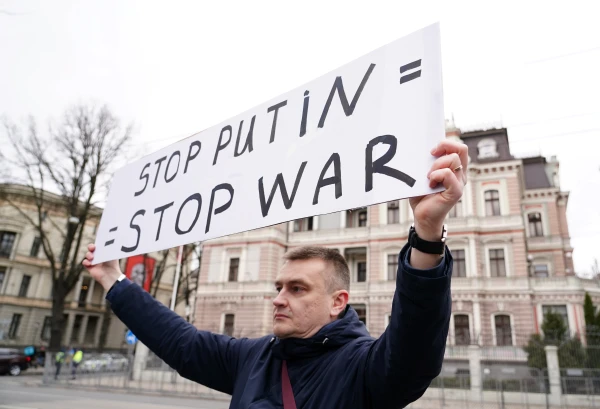
If Russia succeeds in international politics and diplomacy, the scale of activity and manifestations of aggression from its supporters will increase in Latvia, predicts the State Security Service (SSS) in its review of activities for 2025, reports LETA.
The full-scale war unleashed by Russia against Ukraine and the related events last year remained the main topic capturing the attention of Latvian society and influencing public sentiment. According to the State Security Service (SSS), Russia's aggression against Ukraine in 2025 affected Latvian society even more strongly than in 2023 and 2024.
This trend is explained by events on the international stage, including calls for the effective capitulation of Ukraine, which raised concerns in society about the possible formation of geopolitical conditions favorable to Russia. International events intensified the feeling of uncertainty and vulnerability, raising questions about the implications of changes for the security of the Baltic States, the SSS notes.
The majority of Latvian society continued to support Ukraine in its struggle against the aggressor, remained vigilant, and opposed pro-Kremlin manifestations in Latvia, according to the SSS report. There was also a public demand for measures to strengthen internal security, enhance the position of the state language, and reduce Russia's influence.
However, according to the SSS, there remains a segment of the Latvian population that secretly or openly continues to support Russia and its aggression against Ukraine. The main part of the supporters of aggression consisted of residents who use the Russian language in everyday communication. Their sentiments and forms of expression, according to the SSS, remained unchanged. These individuals continue to oppose current initiatives aimed at ensuring the security of Latvia and strengthening the position of the Latvian language. Any efforts by Latvia to reduce the influence of the aggressor state are mistakenly interpreted by this segment of society as "Russophobia" and "discrimination against Russian speakers." The consumption of Russian propaganda resources by this audience contributes to the entrenchment of such views, the report notes.
The SSS emphasizes that last year in Latvia there was a confrontation between the pro-Ukraine majority of society and a segment of residents sympathetic to Russia. This confrontation continued to sustain hidden ethnic tensions, as the majority of society condemned manifestations of support for Russian aggression.
Supporters of Russian aggression in 2025 primarily expressed their views on social media. Monitoring of the information space conducted by the SSS shows that the volume of such activities on social media increased.
The rise of such manifestations was most often observed during periods when the international situation seemed more favorable for Russia. However, on the streets of the country, such manifestations became less frequent.
Together with the State Police, the SSS continued to monitor pro-Kremlin actions in the public space. Most often, the services focused on cases where individuals displayed symbols glorifying Russia on clothing or vehicles. Images and stickers featuring the letter "Z" and other symbols supporting Russian aggression were also recorded in urban environments. More frequently than in previous years, the SSS received information about loud music celebrating Russia or shouts of aggressive slogans in support of the aggressor country.
The SSS predicts that in 2026, the sentiments of supporters of Russian aggression in Latvia will continue to be influenced by geopolitical events in the region. If Russia succeeds in international politics and diplomacy, the scale of activity among supporters and manifestations of aggression will increase.


Leave a comment