
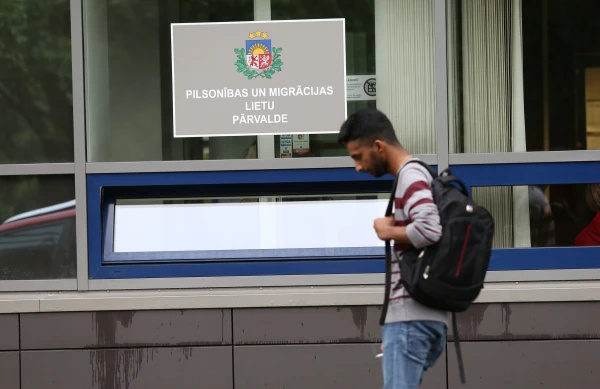
If this continues, then "migration issues" in the Saeima will overshadow "language issues."
Of course, politicians will not forget about the fight against the Russian language in the public space, but the nationalists have realized that in an election year, especially under conditions of fierce competition on the right flank, the struggle against "aliens" (that is, citizens of third countries) may be very appealing to voters. Especially after the disgraceful defeat of the National Alliance in the "game" surrounding the Istanbul Convention.
Currently, "migration" issues have simply "flooded" the parliamentary agenda. Judge for yourself.
New law and new amendments
At the upcoming plenary session of the parliament, deputies will discuss in the second reading a new Immigration Law (to which a staggering 130 amendments have been submitted!). They will also consider amendments to the existing Immigration Law that will allow the annulment of temporary residence permits for those foreigners who have been administratively prosecuted three times within one calendar year.
It should be noted that the new Immigration Law tightens the procedure for obtaining a residence permit and increases the responsibility of employers for inviting guest workers to the country.
A parliamentary investigative commission on migration issues has also begun its work in the Saeima. The goal is to find the "weak points" in Latvian legislation that, as stated by the head of the commission, Janis Dombrava (National Alliance), lead to a massive influx of citizens from third countries into Latvia.
The situation in the migration sphere was discussed in detail at a recent meeting of the Saeima's Defense and Internal Affairs Committee. During it, deputies were informed that the government has also "taken on" migration issues — in particular, it concerns tightening the control over foreign students.
The Ministry of the Interior plans to submit proposals for amendments to the law on improving the regulation of the stay of citizens from third countries to the relevant Saeima committee by mid-February.
Deposit for foreign students
Thus, the Ministry of the Interior proposes to stipulate in the law that first-year students from third countries must immediately make a deposit in case they are expelled from the university for any reason and their residence permit is annulled. This deferred money should cover the costs of returning the foreign student to their homeland.
It cannot be ruled out that expelled students will be prohibited from immediately enrolling in another university — first, the student must return home and then go through the procedures for obtaining a visa and subsequently a study residence permit again.
The aim of such measures is to avoid a situation where citizens of third countries use education solely to enter an EU country — specifically, Latvia — and then find work there.
According to the Ministry of the Interior, this condition could serve as an important tool for reducing the risks of abuse of entry and stay conditions.
Instead of Latvian, English will be tested
Proposals are also being prepared for preliminary testing of students' proficiency in English. After all, often, the level of English proficiency among students is so low that they would not even be able to study in school in that language, let alone in a higher education institution.
Most likely, foreign students will no longer be able to bring their families with them. As it turns out, the right to family reunification is not provided for in the European Union (EU) Directive "on the conditions of entry and residence of third-country nationals for the purpose of research, studies, training, voluntary service, pupil exchange programs, or educational projects and for the purpose of work as a guest worker." The right to invite family members is expected to be retained for doctoral students to promote the attraction of highly qualified citizens from third countries to the Latvian labor market.
It is also planned to introduce a requirement that foreign students must have financial means for living for at least the next six months.
Control over guest workers
Proposals are also being prepared to tighten the procedure for bringing guest workers into the country. It cannot be ruled out that employers will be prohibited from inviting foreigners for low-skilled jobs.
We dare to assume that this fixed idea will provoke the most active objections from employers, as foreigners are invited for such jobs not out of choice, but because local residents do not want to perform such heavy work, and the pay for such work is, to put it mildly, inadequately low.
Reading all these proposals and ideas, one might get the impression that… Latvia has indeed been flooded with "foreigners" - like, for example, Belgium or now Sweden. In reality, fortunately, our country has not even come close to the top of EU countries with a high percentage of migrants from third countries. However, the figures and their interpretation vary.
"The Office of Citizenship and Migration Affairs claims that there are 107,060 citizens of third countries in Latvia. In the European Union, there are a total of 26.5 million (!) citizens of third countries who have the right to enter Latvia," notes the head of the parliamentary investigative commission, Janis Dombrava.
Black scenario from nationalists
However, even now, when the issue of migration from third countries is not yet relevant in Latvia, vigilance should not be lost. After all, as the example of other European countries shows, the situation in the migration sphere can change dramatically (and not for the better!) in just a couple of years. Especially considering that Latvia has not managed to obtain "concessions" from Brussels regarding the distribution of migrants by quotas. Estonia and Poland have achieved such "exceptions." As for us, we will either have to accept refugees according to quotas or buy ourselves out — paying 20,000 euros for each refugee we refused to accept.
Nationalists are warning of the worst-case scenario: "A new wave of immigration against the backdrop of negative birth rates - we have a record low birth rate in the last 100 years! - will lead to the replacement of Latvians by foreigners."
Theoretically, such a scenario cannot be ruled out, as the demographic situation in Latvia is indeed close to critical.








Leave a comment