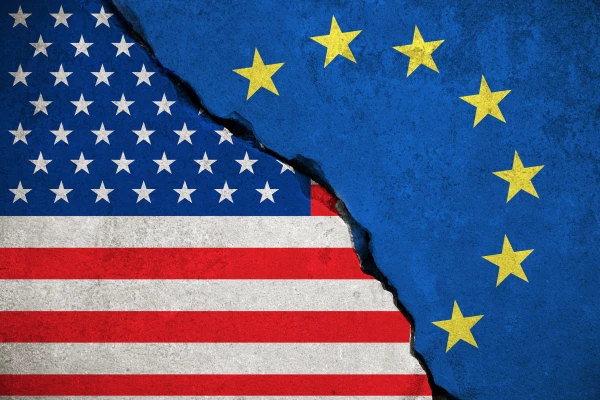
In the event of a serious security threat, the European Union (EU) may be forced to use its economic tools against the US, stated Sandis Schrader, a board member of the Latvian Transatlantic Organization (LATO) and a researcher at the Latvian Institute of International Affairs (LIIA), in a conversation with the LETA agency.
In his opinion, during Donald Trump's first presidential term, Europe may have underestimated the seriousness of his statements and approach to achieving foreign policy goals. Now, according to the researcher from the Latvian Institute of International Affairs (LIIA), a situation has arisen in which representatives of the transatlantic community, which has so far been viewed as a single family with shared values and interests in security, are forced to think and act according to the principles of the theory of international anarchy.
"This means that smaller NATO member countries need to organize themselves and even consider the possibility of using military force to limit the foreign policy goals of the alliance leader — the US, which effectively threatens to push the world back to a colonial mindset," the expert explained.
Schrader noted that the threats from the US president to EU countries, including the imposition of tariffs, are effectively pushing Europe to finally start acting synchronously, united, and strategically towards its most important NATO ally and leader of the West — the US. In his opinion, the goal of such actions is to deter US engagement against liberal democracy and the global system that has allowed America to be a leading power for decades — in military, economic, political spheres, and especially in the context of so-called "soft power."
"Trump's current foreign and defense policy has destroyed what made the US a unique country since 1945 and during the Cold War — the ability to build alliances and attract allies based on specific laws and norms that even great powers like the US adhered to for the sake of common interests," added the board member of LATO.
He agreed that the transfer of Greenland under US control is impossible unless Denmark voluntarily sells or relinquishes the territory. The expert noted that an alternative could be a military seizure of Greenland, which would effectively mean the end of NATO. Schrader pointed out that EU countries, European NATO members, and Canada are already redeploying their forces to Greenland — primarily to alleviate concerns raised by Trump's statements about the security of Greenland and the US. In his assessment, this is a thoughtful combination of public diplomacy and military strategy aimed at deterring the US from using force and violently seizing Greenland.
"The US is capable of seizing Greenland militarily, and no EU country or European NATO member will be able to stop them, as the US accounts for about 70–80% of NATO's total military potential. European countries are not capable of countering the US militarily," stated the LIIA researcher.
He emphasized that such a situation is a dream for Russia. In the short term, EU and NATO countries are forced to direct their military, political, and diplomatic resources to deter aggression from the US — from rhetoric to threats of sanctions and even potential military intervention in Greenland, as such discussions are already taking place in Washington. This means that attention and resources are not being directed towards supplying necessary weapons to Ukraine to deter Russian aggression, and in the short term, Moscow benefits from this.
In the long term, according to Schrader, if the escalation between European NATO countries, the US, and Canada continues, the strategic beneficiaries will not only be Russia but also China, as neither Europe nor the US will be able to effectively deter authoritarian regimes whose logic is based on a return to a colonial order: "big countries do what they want, and small ones suffer," and international laws no longer apply.
The expert noted that the growing influence of China and Russia in the Arctic has long been recognized by the security services of Denmark, the US, Canada, and northern European countries. In his opinion, it is the coordinated and timely actions of the EU and the US that have so far been the main tool preventing geopolitical control by Russia and China over the Arctic.
Schrader believes that Trump's rhetoric suggesting that US security and economic interests may be limited in the event of cooperation with Europe on security and economic development in Greenland does not withstand rational criticism. Neither Denmark nor any other country prohibits American companies from operating in Greenland, and there are no obstacles to economic cooperation between European countries, Denmark, and the US. Therefore, the LIIA researcher concludes that this rhetoric is aimed at annexing Greenland to the US — either with Denmark's consent or through the use of force.
According to the expert, EU countries need to seriously consider that the US can, under certain circumstances, turn from a strategic ally into a security threat. He reminded that the US has been calling on Europe to increase its military capabilities for over 20–30 years, as America alone cannot ensure security and stability in Europe, given the growing challenges from authoritarian regimes — including Russia, China, and countries in the Middle East. However, Europe has long relied on the US to ensure security not only in Europe but also in the world.
Schrader emphasized that the idea of strategic autonomy for Europe has always existed — including in the rhetoric of France — but has mainly remained declarative, as real autonomy is only possible with common and coordinated military capabilities, not the policies of individual states. So far, the EU has not been able to act cohesively enough, but the current situation creates an unprecedented necessity to strive for this, as the threats Europe faces simultaneously — from the rhetoric of the American administration to Russian aggression and Chinese ambitions — have not been encountered in European history before.
"In the Baltic states, they say that Russia cannot be understood with the mind, and now it is becoming difficult to understand Trump's actions in foreign policy and security, because he is doing everything to weaken the US — militarily, economically, and politically," said the board member of LATO.
He emphasized that the US still retains its status as a leading world power largely because Europe has restrained its actions towards America, even in situations where the US acted against European interests. If European security interests are seriously harmed, the EU may be forced to use its economic leverage against the US to limit Trump's "colonial fantasies," Schrader concluded.
Earlier, it was reported that thousands of people took to the streets of Copenhagen, the capital of Denmark, on Saturday to protest against the US president's intentions to annex Greenland, an autonomous territory of Denmark.
The day before, Trump stated that he might "impose tariffs" on countries that oppose his plans for Greenland.