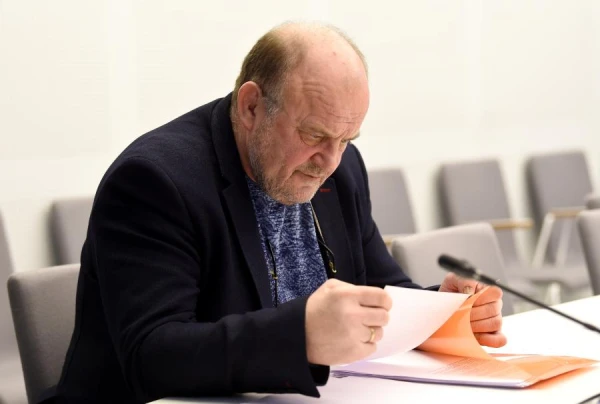
On Friday, the Riga District Court found former Saeima deputy Janis Adamson guilty of espionage in favor of Russia and sentenced him to eight years and two months in prison and two years of probation.
The sentence can still be appealed to the Supreme Court.
In November 2023, the first-instance court also found Adamson guilty of espionage and sentenced him to eight years and six months in prison with a two-year probation period.
Today, the district court ruled to overturn the Riga City Court's verdict regarding Adamson's guilt and punishment under the Criminal Code article on minor fraud, resulting in a six-month reduction of the prison term. The court ruled that criminal cases related to two offenses involving minor fraud should be terminated.
The court upheld the security measures imposed on Adamson – the obligation to report changes in residence, a travel ban, and bail – until the day the sentence takes effect. If this sentence remains in force, the bail of 30,000 will be returned to its donor Ginta Usule-Adamson.
Adamson is charged under three articles of the Criminal Code – espionage, minor fraud, and the acquisition and possession of ammunition for firearms without the appropriate permit. The former MP was also charged with minor fraud related to reimbursement for fuel expenses, amounting to about 100 euros. Additionally, several dozen cartridges were found in his possession.
Regarding possible espionage, information available to the LETA agency indicates that law enforcement suspects Adamson in more than 40 episodes.
Adamson is suspected of transmitting information to Russia for four years prior to his arrest. It is unofficially known that Adamson provided both publicly available documents – various amendments to laws, information on military procurement and budget – and supplied information after visiting the eastern border of the country, informing about the position of the Baltic Assembly regarding "Nord Stream 2." Also, according to unofficial information, he used his parliamentary computer to transmit information.
The Latvian television program "De facto" reported that during the initial court hearings, Adamson was questioned about money transfers to his daughter, which the prosecution considers payments from Russia to the politician. According to the prosecutor, Adamson received remuneration for espionage, and the money was transferred to Adamson's daughter in Russia. Adamson called this absurd, claiming that he himself transferred money to Silonov – usually 100-200 euros every couple of months – so that he could send it to Russia to Adamson's daughter's account.
Adamson was also questioned about his visits to Moscow, during which he met with individuals whose identities cannot be verified, as the politician refused to provide their full names to the court. The prosecution believes that Adamson transmitted information specifically to the Federal Security Service of Russia.
The case materials indicate that various information transmitted to the FSB was provided by former investigator of the Ministry of the Interior Andris Strauhtmanis and former employee of the State Security Service Arturs Shmaukstelis. Their connection to the espionage has not been proven.