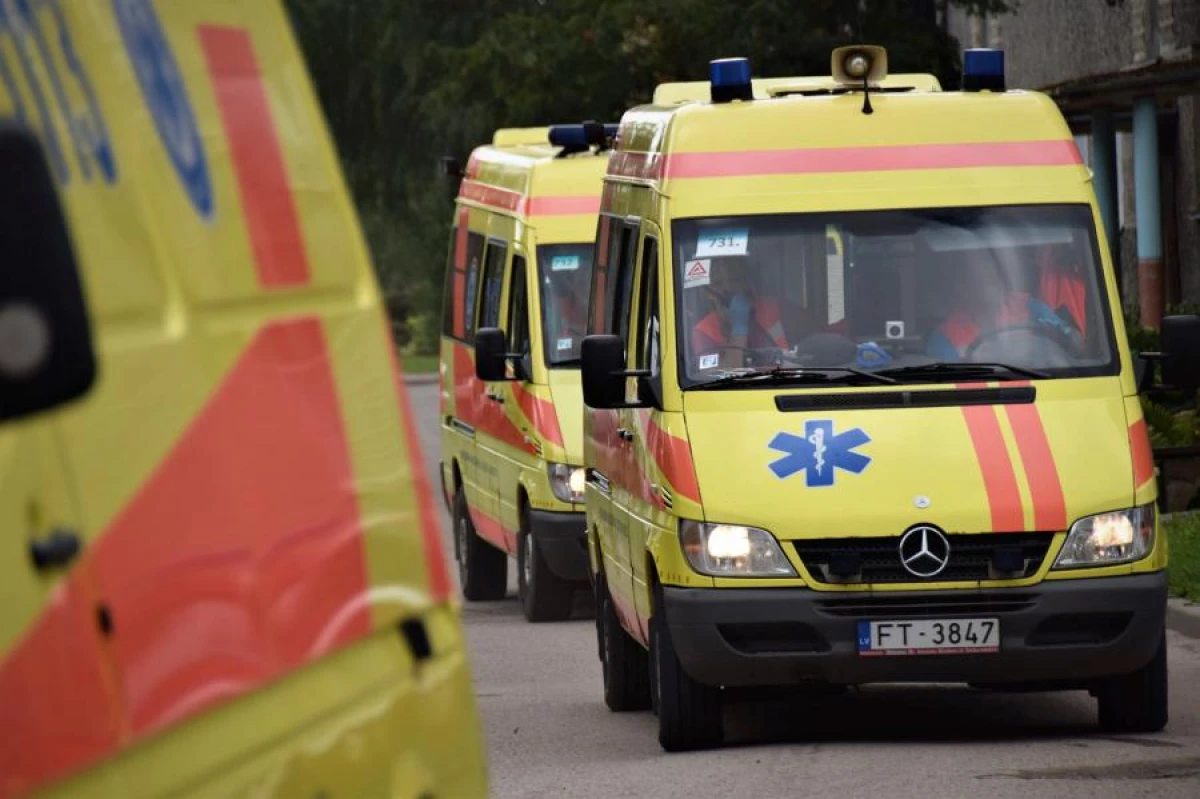
A hospitalized man had to urinate in a diaper right in the ambulance because the team could not transfer him to one of the largest hospitals in Latvia for three hours. Medics are sounding the alarm: if the system is overwhelmed in peacetime, what will happen in the event of a major disaster or military crisis?
Bb.lv has already reported on the critical situation at Stradins Hospital (PSKUS), where long queues of Emergency Medical Service (NMPD) teams form at the emergency department. Concern was also expressed by NMPD physician assistant Rafael Ciekurs, who points out that the prolonged problem has remained unresolved for years, and its consequences could be costly for society.
In his Facebook post, Ciekurs noted that just recently one of the teams had to wait with a patient in line at the hospital for a full three hours. During that time, the patient, who could not be brought inside, was forced to relieve himself in a diaper. According to the medic, the current excuses from officials irritate him.
"Yesterday, while watching 'Panorama', I would have needed earplugs myself. And not because of the noise from the patients. But because I had to listen again to arguments that no longer withstand any professional criticism.
About two months ago, my new employee sent me another photo from the PSKUS ramp and expressed his outrage. The team with the patient stood for about three hours. The patient was a 45-year-old man. The situation reached the point where we had to suggest the patient urinate in a diaper because the team with the patient could not enter the hospital.
This is not an 'inconvenience'. This is not a 'feature of patient flow'. This is not 'one unfortunate shift'. This is a humiliation of the patient's dignity. This is a patient safety issue. This is a paralysis of the NMPD teams' work. And this is a management problem that has not been resolved for years," he noted.
The situation is paradoxical because, in recent years, the clinic has gained more space while the number of patients has decreased. So what is the issue?
"Let's be honest: compared to 2010, the number of patients has decreased by more than 11,000 by 2025, the facilities have been expanded, processes have supposedly been improved, but the queue at the ramp still exists.
Do I want to say that the PSKUS Emergency Medicine Center does not need new facilities? No. Of course, it does, and urgently. But a new building will not solve the problem of management miscalculations if the flow of patients from the Emergency Medicine Center to specialized departments continues to be a bottleneck.
If departments often prioritize planned patients while acute patients remain in the emergency department or at the ramp, then the problem is not with the NMPD hospitalization bureau. The problem is not with the team. The problem is not with the patient. The problem lies in the internal patient flow within the hospital itself."
While highly valuing the work of doctors, physician assistants, and nurses at the PSKUS Emergency Medicine Center, he emphasizes that they have become hostages of the situation. "These doctors, physician assistants, and nurses have to endure a tremendous load every day, the emotions of patients and their relatives, the hospital's inability to ensure normal patient flow, and public pressure.
But the emergency department is not an isolated island. The Emergency Medicine Center is the bottleneck of the entire hospital. If departments do not accept patients, the center's work stops. If the center stops, the ramp turns into a ward. If the ramp becomes a ward, NMPD teams become an extension of the hospital. And this is unacceptable."