
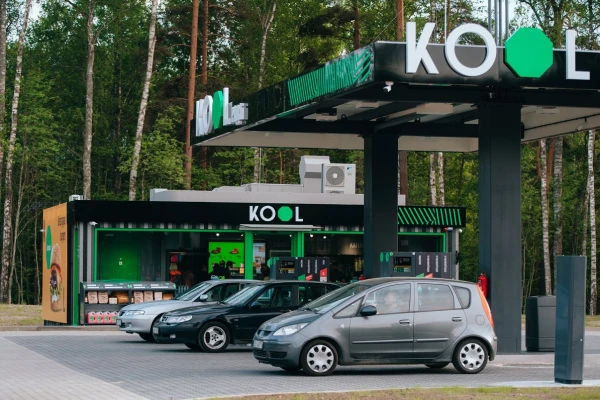
Events in the world continue to amaze. If I were to describe them all, it would probably turn into not just an article but an entire book, so I will focus only on the most recent and probably the most astonishing – when a controversial political initiative suddenly shifted to the status of a draft law, writes fuel expert Alexey Shvedov.
Surprise 1. As is known, the initiative "solidarity payment" comes from the Ministry of Economics, headed by Viktor Valainis. It is surprising that, with the Ministry of Finance in place, the fiscal collection is somehow initiated by the Ministry of Economics, whose competence is primarily the development of the economy and ensuring its growth, rather than tax collection.
Surprise 2. The Ministry of Economics of the Republic of Latvia is supposed to ensure the necessary investment climate and conditions for increasing the competitiveness of enterprises; however, the "solidarity payment" completely contradicts the strategy for the development and growth of the local economy, not to mention attracting foreign investments to the country.
Surprise 3. While the Ministry of Economics spends efforts and resources on developing and promoting the "solidarity payment" project, which in fact cannot stop the rise in fuel prices in the local market if prices are rising globally, the economy of the Republic of Latvia is threatened by a problem far more serious than rising prices at gas station pylons. This is stagflation. That is, zero or negative economic growth, with simultaneous rising prices.
This is precisely the problem that all available human and material resources of the Ministry of Economics should be focused on right now. Stagflation is one of the most severe situations in the economy because it disrupts not only the "usual logic" of managing state finances but also the fates of even those citizens who have not yet lost their jobs.
Surprise 4. The authors of the law, namely the Ministry of Economics, propose that the members of the Saeima urgently adopt a law that lacks the most important element – the mechanism for calculating the "objective price." As someone distant from politics, I cannot even imagine how, in such a case, a member of the Saeima will act, what criteria they will follow when they essentially have to vote for something unknown.
Surprise 5. The Competition Council is a state body that should be responsible for ensuring equal conditions. Therefore, one of its main goals is to create conditions so that the market itself forms prices through fair competition. The "solidarity payment," however, will only lead to a decrease in competition in the market. Thus, the Competition Council should have been leading the resistance to the "solidarity payment" initiative at the administrative level.
Surprise 6. The Competition Council should have a complete picture of how pricing occurs in the fuel industry of Latvia. The formulas for contract prices, what Platts quotes and premiums are used, delivery conditions, payment terms, and so on. In early April, they collected an enormous amount of extremely sensitive information (commercial secret) through a special request in one go, which no participant in the Latvian fuel market has in such a complete form. And yet they remain silent or at least do not publicly correct the authors of the "solidarity payment" law.
Surprise 7. Anyone can see right now that there are no "super profits" in the fuel retail sector. The margin in this sector fluctuates around 1-2%. That is, for every 100 euros in turnover, the fuel retailer earns about 1-2 euros. Fuel retail is one of the most capital-intensive, high-risk, and at the same time low-margin types of business both in Latvia and in Estonia.
It is possible, of course, that I am surprised by many aspects due to the fact that I have not been in Latvia for long. However, many colleagues who were born and lived here will also experience similar feelings. Moreover, even those who, like me, witnessed previous significant spikes in diesel prices in the global market over the past 25 years are surprised.





Leave a comment