
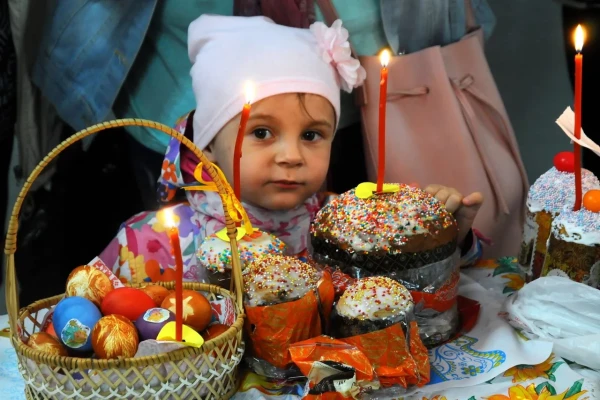
This year, Orthodox Easter falls on April 12. Preparation for the holiday takes seven weeks of Great Lent and concludes with Holy Week – a time of prayer, reflection, and soul cleansing.
The History of Easter
The holiday of Easter traces its roots to the ancient Hebrew tradition of Passover, which was celebrated in memory of the liberation from Egyptian slavery. According to tradition, it was during Passover that Jesus Christ was crucified, and on the third day, He rose again.
Christian Easter has become a symbol of new hope, redemption, and the beginning of eternal life. In the early centuries of Christianity, the Resurrection of Christ became the central event of the church year. It is celebrated not as a day of mourning, but as a celebration – joyful and bright.
Unlike Christmas, which has a fixed date, Easter always falls on the Sunday after the first full moon following the vernal equinox. This calculation has been established since the 4th century according to the Alexandrian Paschalion. Therefore, the date can vary from April 4 to May 8.
How Easter is Celebrated by Orthodox Christians
The festive service begins late on Saturday evening and continues throughout the night. The central moment is the procession around the church singing "Christ is risen!" and the response "Indeed, He is risen!" After this, the solemn liturgy begins, and believers bless kulich, eggs, and paskha – traditional symbols of the holiday.
Easter eggs symbolize new life, kulich represents the body of Christ, and the cottage cheese paskha is a sweet treat that reminds us of spiritual joy. The fast comes to an end, and dishes that were abstained from for seven weeks appear on the tables. But the main thing about Easter is not the food, but the inner state of joy, gratitude, and spiritual renewal.
Throughout the week following Easter, known as Bright Week, believers greet each other with the Easter greeting, attend services, and share the joy of the Resurrection of Christ. During this time, the doors of churches are open – a symbol of the open Kingdom of Heaven.
Traditions and Signs
Easter is always celebrated in the family circle. On the morning after the service, it is customary to break the fast – to start the meal with blessed eggs and kulich.
Children are told about the meaning of the holiday, taught kindness and respect for tradition. People visit relatives, especially the elderly, share treats, and help those in need.
Many folk signs are associated with Easter. For example, it was believed that on this day the water in rivers and wells becomes healing, and all prayers are especially heard.
Easter is not just a day on the calendar. It is the center of the Christian faith, a holiday in which history, faith, hope, and love merge. It reminds everyone of the main victory – the victory of life over death, meaning over chaos, good over evil. It is no coincidence that Orthodox Christians call Easter the "Feast of Feasts."
Q&A
What is Allowed and What is Not Allowed on Easter
On the eve of the main Christian holiday, many newly faithful people ask questions about what is allowed and what is not allowed on Easter.
The magazine "Foma" asked Archpriest Igor Fomin to answer some of them.
Is it permissible to baptize a child on Easter?
Baptism can be performed on any day of the year, so theoretically it is possible to baptize a child on Easter 2026.
But in practice, this is rare, usually in special circumstances. Parents who come to churches with this intention often receive a refusal. And it is quite justified. The holiday of the Resurrection of Christ is preceded by a week filled with liturgical events. The service on Great Saturday is also long, after which the kulich and eggs are blessed throughout the day. The night prayer is joyful but also lengthy, and in the morning, many churches have a second liturgy. During all this time, the churches are full of people. It is clear that, on one hand, this is not the most suitable environment for baptism. On the other hand, it is difficult for the priest to find time to perform the sacrament and communicate with the family of the baptized.
The day of baptism is the birthday of a new Christian. It is better for each of these interconnected joys to have its own day, so that each can be fully felt.
Is it permissible to do housework on Easter? To clean, knit, sew?
When we read somewhere that there is a prohibition on housework during the holiday, we should understand that this is not a prohibition, but a blessing for us to spend this time focusing on the Lord, the holiday, and our neighbors. So that we do not get caught up in worldly fuss. The prohibition on work on Easter is not canonical; it is more of a pious tradition.
Household chores are an integral part of our lives. You can engage in them during the holiday, but only approach it wisely. So as not to spend Easter doing a thorough cleaning until nightfall.
Sometimes it is better, for example, to leave unwashed dishes in the sink than to get irritated at family members who did not wash their plates.
Is it permissible to drink alcohol on Easter?
Easter is preceded by a long and strict fast, and on the holiday, believers finally allow themselves to eat rich food and drink.
After the long services of Holy Week and the festive service, while resting at a laid table, one can drink on Easter, but, of course, one should not get drunk. A little wine or some other alcoholic beverage will not harm those who have no problems with alcohol. But for a person who does not know moderation, especially if they are dependent, it is necessary to abstain.
Most believers strive to take communion during Holy Week, on Easter, and during Bright Week. And everyone knows the recommendation to behave in such a way after receiving the Holy Mysteries that one "keeps Christ within oneself." It is obvious that this is not supported by the abuse of alcohol. If – and this happens under the influence of alcohol – a person suddenly lets go of their "brakes," then all their Lenten efforts and endeavors will be in vain. And the Easter joy, which one wants to carry in their heart for as long as possible, will evaporate in an instant.
It is as if a person climbs a mountain, and when they reach the summit available to them, they are so happy and proud that, having stumbled, they roll down. Bitter and disappointing, isn’t it? Such a cruel joke can be played on a person by excessive drinking.
That is, a little drinking on Easter is permissible – in limited quantities, wine adds cheerfulness and helps to relax after tension. Christ Himself could drink wine with His disciples, and even His first miracle is related to this drink. But it is also perfectly fine not to drink on Easter, because this holiday is so great that even without wine, it is joyful and bright in the soul.
Is it permissible to give gifts on Easter?
Of course, it is permissible to give gifts on Easter. After all, with them we share our warmth, care, and joy with others.
According to legend, Mary Magdalene presented Emperor Tiberius with a regular egg, which turned red when she informed the Roman ruler about the Resurrection of Christ. Therefore, even today, a traditionally pleasant Easter gift is an egg.
Today, there are many options for gifts – one can give edible painted or chocolate eggs, a nice souvenir, or even a piece of jewelry. But one can also give other pleasant things – cards, souvenir birds, beautifully packaged kulich and cottage cheese paskha, festive kitchen sets (egg holders, dishes, towels).
Books and icons are also given. Gifts may not necessarily be related to Easter in meaning, and the choice is based on the interests of the specific person.
Yuri POZHIDAEV.












Leave a comment