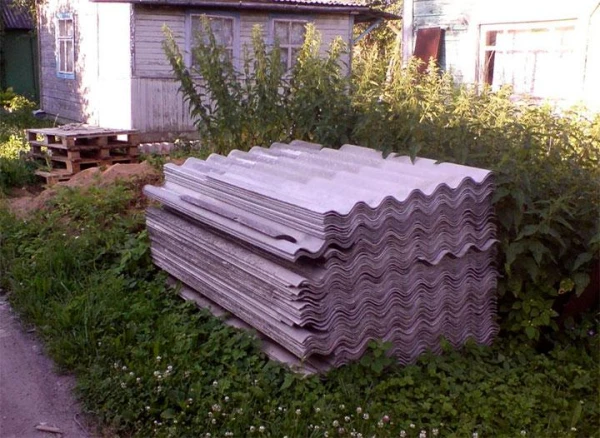
In Latvia, there are still about one million tons of asbestos-containing cement, despite the fact that the production and sale of asbestos products are already banned in Europe. This is reported by the Latvian television program "Vides fakti."
Residents are not in a hurry to get rid of the hazardous material mainly due to the high cost of its disposal. This year, the program to support the disposal of asbestos-containing cement is planned to continue, but the Ministry of Climate and Energy (KEM) is still assessing which groups of residents will be eligible for assistance, as reported by public media.
Asbestos-containing products are recognized as hazardous: their particles can cause skin irritation and allergic reactions, and when dust enters the respiratory tract, it can lead to lung cancer and other oncological diseases, including tumors of the esophagus, larynx, and stomach. Moreover, diseases caused by asbestos exposure typically manifest only 15–20 years after contact with the material.
Although the already installed cement is permitted for use, it deteriorates over time due to environmental exposure. As warned by the State Environmental Service, worn material begins to crumble and release harmful substances. Asbestos-containing waste cannot be mixed with household waste, nor can it be sold, given away, or transferred to other people.
One of the main reasons residents do not dispose of old cement remains the high cost of disposal. According to waste operators, the disposal price can range from 400 to 600 euros per ton.
Andris Karlsons, a board member of the company "Eco Baltia vide," explained that the cost depends on several factors: the distance to the landfill for asbestos disposal, the volume of waste, its packaging, and the need for transportation. According to him, the service is available throughout Latvia, but the final price heavily depends on logistics.
Residents can pack the cement in construction bags themselves and take it to the landfill. If the volume of waste is too large for transportation in a personal vehicle, they can order its removal.
The high cost of disposal leads to the situation where hazardous waste sometimes ends up in nature. They are thrown away in forests, buried in the ground, or even used in road surfaces. According to the "Vides SOS" app, in 2025, there were 2825 reports of illegally dumped waste, of which 114 concerned hazardous waste. Information about contaminated sites is passed on to local governments, which either organize the cleanup themselves or delegate it to landowners.
The ministry reminds that the Latvian Environmental Protection Fund's program for collecting asbestos is in effect. It is designed for three years, with an annual allocation of 300,000 euros. Last year, more than 300 applications were submitted, and 260 households disposed of asbestos-containing cement for free. A total of 684.41 tons of such waste were collected.
Rudite Vesere, Deputy State Secretary of KEM for Environmental Policy, reported that this year, certain groups of residents will also be able to dispose of asbestos-containing cement for free. Documents are currently being prepared to launch the program, and the list of support recipients is still being finalized. The ministry does not rule out that, with sufficient funding, other categories of residents may also receive assistance. The program is expected to be launched before the beginning of summer.
Information about the locations for accepting asbestos-containing waste can be found on the website skiroviegli.lv, and tariff data can be found on the websites of waste operators. Authorities also warn that one should not trust private offers on the internet for the collection and disposal of hazardous waste without checking permits in the State Environmental Service registry.
If there is no possibility to dispose of the cement, specialists recommend storing it safely — for example, in a shed or under cover. At the same time, owners are obliged to ensure proper handling of such waste. Administrative liability is provided for violations of the rules.