
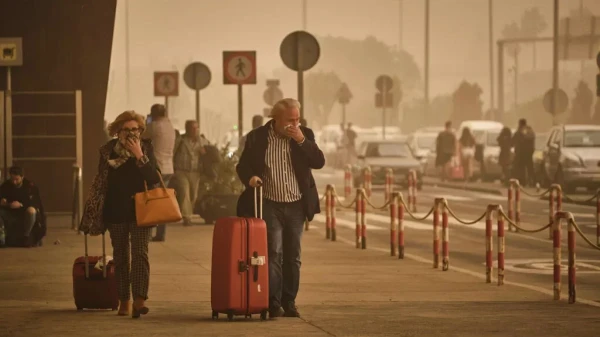
Europe has once again faced an unusual natural phenomenon: huge masses of dust and sand, lifted by storms in the Sahara Desert, have crossed the Mediterranean Sea and begun to spread across the continent. For us in Latvia, this is no longer news - in recent years, such "greetings" from Africa have been reaching Riga and Kurzeme more frequently. However, each time this raises a logical concern: is it dangerous for health, and should we rush to get masks?
What is happening in the sky above us
Currently, the main dust flows are being recorded over Southern and Central Europe. In such cases, the sky takes on a characteristic milky or yellowish hue, and sunsets become unnaturally bright. If precipitation is added to this, we will see what is known as "dirty rain," leaving streaks on cars and windows of houses.
The main question concerning Latvians is: is there a real threat? At the moment, the concentration of particles at ground level in our region remains within acceptable norms. The bulk of the dust is moving in the upper layers of the atmosphere. However, for people with asthma, chronic lung diseases, or severe allergies, even a slight increase in the level of PM10 particulate matter can cause discomfort.
Specialists are closely monitoring the trajectory of the air masses. It is important to understand that the intensity of the dust depends on the strength of the wind and atmospheric pressure over the Baltic.
"It is expected that the dust will mostly remain at high altitudes, but some of it may settle to the ground, especially if it rains," meteorologists note, emphasizing that rain is the main factor for "clearing" the sky, but at the same time, it is also the reason for the appearance of dirty deposits on surfaces.
Should precautions be taken?
For the average resident of Latvia, the threat is minimal. This is more of an aesthetic issue and an extra reason to visit a car wash. However, if you notice that the horizon is shrouded in haze and breathing has become more difficult, it is recommended to reduce the time spent on outdoor physical activities and close windows in indoor spaces.
We will continue to monitor the data from air quality monitoring stations. So far, the forecast is favorable: the majority of the African guest will transit above our heads, not creating critical problems for the region's ecology.







Leave a comment