
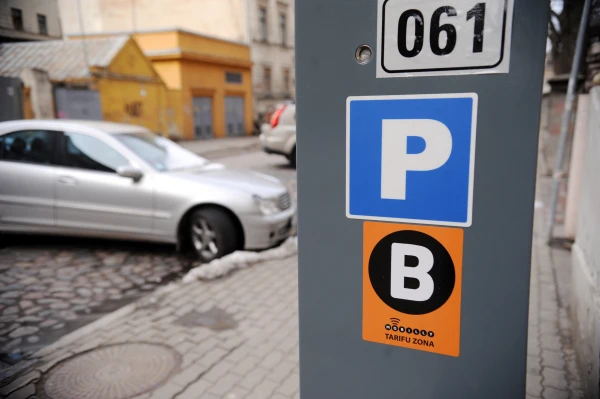
Forgetting to pay a bill can happen to anyone, but Kristaps’ published story about his wife’s forgotten parking bill takes an entirely unexpected turn — all the way to the topic of political party funding.
A man writes:
“Maybe someone has experience and advice. The situation is that my wife’s relatives parked in the ‘Rimi’ parking lot in the Alojas quarter, which is serviced by Park Expert. Apparently, in January they forgot to register the car number, because now a letter has arrived from Julianus Inkasso Latvija. We won’t even dispute this fact — let’s assume they forgot.
But at no point was a letter received from Park Expert itself (this is not the first time — previously we received a letter and paid the fine to them, and everything seemed to be in order). Park Expert claims that they sent a letter at the beginning of March, and if it wasn’t received — that’s not their responsibility, and they are not obliged to send registered letters. The Consumer Rights Protection Centre (PTAC) says to file a complaint with Julianus Inkasso Latvija.
Julianus Inkasso Latvija asserts that if a collection letter from them was received, but none from Park Expert, then one should file a complaint with Latvijas Pasts, as they have proof of sending the letter.
The obligation to send registered letters lies only with state institutions, while private companies do not send them (is this really so...? A rhetorical question). When asked about PTAC’s recommendation — they reiterated that they have proof of sending. The post office says that they cannot guarantee anything if the letter is not registered (which seems logical).
The amount is small — a €35 fine and €15 for collection. In principle, one could pay and forget if it were just about the desire to profit from the €15 fee. But a record of collection for a person with an impeccable credit history could create problems someday. How should one act more wisely in this situation?” asks Kristaps.
In the comments, it quickly becomes clear that this is not an isolated case. Many users share similar experiences, noting that the notification of the fine from the parking operator often does not arrive at all, and letters from collectors follow immediately. One commenter even referred to it as “legal racketeering,” emphasizing that they also received such a letter without prior warning.
Others point to systemic problems — disorganized legislation and too much freedom for private companies. The question arises as to how a private firm can have such a close connection with collection mechanisms, as well as why modern means of communication, such as SMS or email, are not used if companies have customer contacts.
The discussion also includes practical advice. Some recommend paying only the initial fine to Park Expert and ignoring the collectors, while others suggest settling everything to avoid possible problems in the future. Someone else notes that such cases usually do not affect credit history, but there is no complete certainty about this.
Some commenters share specific cases where the fine was paid, but collectors continued to demand additional payments. Others claim they ignored such letters and faced no consequences, while a third group admits they ended up paying everything “for peace of mind.”
Certain users urge to avoid these parking lots altogether, characterizing Park Expert as a problematic company with inflexible customer service and unclear rules. It is also mentioned that the registration of the vehicle is sometimes given a very short time, increasing the risk of receiving a fine.
Overall, the discussion reveals a broader issue — a lack of communication between service providers and customers, as well as unclear responsibility in cases where official notifications do not reach the recipient. Although legally companies can refer to the fact of sending, in practice this leads to situations where people find out about a fine only when it has already been handed over for collection. Such cases raise the question — is the current system sufficient to protect consumer interests, and are clearer rules needed to ensure that a person is notified of a violation in a timely manner before the case is sent to collectors.















Leave a comment