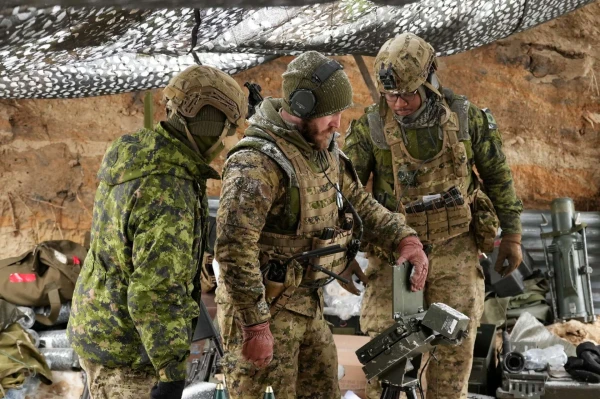
Loud and regular gunfire can be heard these days in the Adazi area, where the artillerymen of the allied forces are training. In these exercises, the soldiers of the Multinational Brigade hone their interaction to quickly detect and neutralize enemy positions if necessary.
On the snowy military range in Adazi, artillerymen from Canada, the USA, Sweden, and other allied countries have been stationed at various positions for the fourth day, reports TV3 News. During these exercises, their task is to enhance their capabilities in providing accurate and sustained fire support: to detect a target and destroy it.
After firing, the crew swiftly reloads the howitzer, and within seconds it is ready to strike again.
"Yes, on average, one shell takes 10 seconds. On a good day, we can fire six rounds a minute. It can be done faster — reloading in about seven to eight seconds. This artillery is magnificent. If the team is good, shells can be released very quickly — they are deadly and shoot at long distances," says an artilleryman from Canada.
Strikes are delivered from camouflaged trenches, where it is so cold that soldiers can see their breath. However, the Canadians are not deterred. They experience such weather conditions every year, although they had to get used to the Latvian winter.
"We have really understood the Latvian winter and its impact. It is different from the Canadian one — it is wetter, ice can form or get stuck in the mechanisms, but we have been doing this for nine years, so we understand the equipment and the influence of the Latvian winter on it," notes Andrew Kerr, commander of the multinational NATO artillery battalion.
The M777 howitzers demonstrated by the Canadians are also used in Ukraine. The commander acknowledges that much of the training takes into account the Ukrainian experience. Therefore, strikes are delivered from trench positions equipped like bunkers to protect personnel and equipment from air attacks.
"One thing is camouflage, but also survival. We place sandbags on the roof. We ensure that it is a bunker. As you can see, we are experimenting with various types of anti-drone nets so that drones cannot get down here. There is also experimentation based on what we have seen in Ukraine. And what you do not see here are our anti-drone capabilities. Such an area would also be protected by various means of countering drones — electronic or kinetic," explains Kerr.
To make the exercises as close to real combat as possible, soldiers sleep in the trenches and provide their own supplies. The work is not easy — one shell weighs over 40 kilograms, and up to 60 rounds can be fired from one position in a day. The Canadians admit that only constant training allows them to understand how to best accomplish the assigned task.
"One of the things we are constantly studying is the terrain we have come to defend. We go to different places in Latvia and study this land. We look at settlements and think — what do we need to do to defend Latvia? And from where could the enemy potentially come? We try to gain an understanding of each specific location," explains the commander of the multinational NATO artillery battalion.
Another detail being practiced in these exercises is the use of shells from different manufacturers in artillery systems. This is also done with consideration of the Ukrainian experience — it is necessary to be able to shoot accurately with any available ammunition.