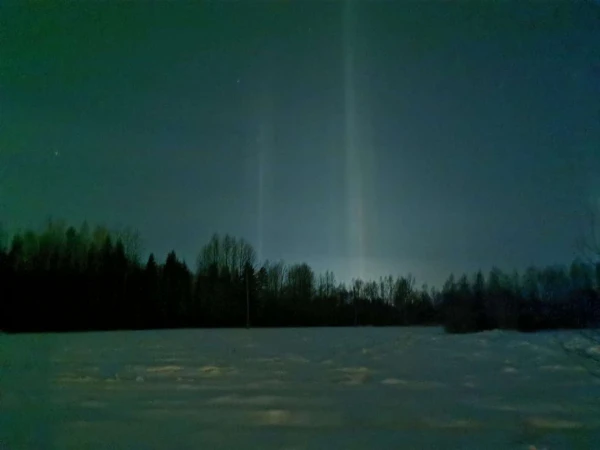
At the end of the week, light pillars were spotted in the Krustpils region — this was reported by Andis, who captured the rare and beautiful atmospheric phenomenon in several photographs. TV3 weather presenter Mārtiņš Bergšteins confirmed that Andis indeed managed to record light pillars — this is a relatively rare optical phenomenon in Latvia, writes tv3.lv.
Light pillars are an optical effect that occurs in the atmosphere. Visually, it appears as a vertical column of light above or below a bright source, such as streetlights, traffic lights, or spotlights. As Bergšteins explains, this is not a physical beam of light, but rather an optical illusion.
The effect occurs when light reflects off tiny, flat-shaped ice crystals that are suspended in the air. These crystals act like millions of small mirrors, reflecting light in the direction of the observer, creating the illusion of a vertical light column.
<script async src="https://platform.twitter.com/widgets.js" charset="utf-8"></script>A breathtaking scene of glowing light pillars created as streetlights bounce off floating ice crystals in –30°C cold pic.twitter.com/YBrNugwS5b
— Astropics (@astropics) December 16, 2025
Certain weather conditions are necessary for the formation of light pillars: frost of at least -10 °C, a dense snow cover on the ground, a moderate wind that lifts the crystals into the air, and, of course, a bright light source.
Sometimes pillars can form at higher temperatures — the main condition is that there are indeed flat ice crystals in the air.
"In very rare cases, light pillars can be observed in summer, but then they form in cirrus clouds at several kilometers high and appear much dimmer and shorter in duration than in winter," explained Bergšteins.
In Latvia, light pillars can be observed almost every winter; however, this is a relatively rare phenomenon — especially compared to, for example, solar or lunar halos, which can be observed dozens of times a year. At the same time, light pillars are most often recorded only a few times during the winter season.