
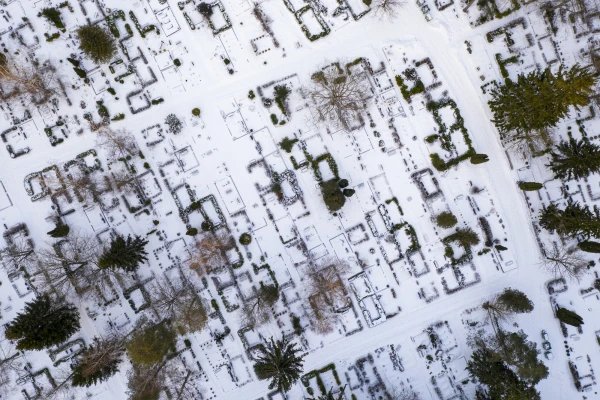
The scattering of the ashes of deceased relatives may be allowed in cemeteries — this provision is included in the proposed law on cemeteries, which was reviewed today in the second reading by the Saeima's Commission on State Administration and Local Government, reports LETA.
If it was initially planned to establish that the ashes of the deceased must be buried, it is now proposed that both burial of the deceased or urn and scattering of ashes in specially designated areas will be possible in the cemetery.
Scattering ashes in any other place is not covered by this law.
This law will apply only to cemetery territories.
As previously reported, the Saeima is considering a draft law on cemeteries, which provides for a unified regulation of the establishment, maintenance, expansion of cemeteries, and allocation of burial places.
The draft law states that the decision to create, expand, or close a cemetery is made by the local government council. The decision to create a cemetery specifies its name, boundaries, and possible types of burials.
The local government may establish the time when the cemetery is closed to visitors, indicating the justification for such restrictions in the decision.
At the same time, at the request of the local government, access to the cemetery must be ensured for the implementation of cultural and historical traditions even during the established restrictions on visits.
The creation and expansion of cemeteries must be planned by local governments in advance, in accordance with territorial planning documents.
A cemetery is closed for burials if there are no free places, and a columbarium is closed if there are no free places for urn placement.
The draft law includes basic requirements for the maintenance of cemeteries, stipulating that the local government must ensure at least the presence of such amenities in the cemetery as a sign with the name of the cemetery, information about visiting restrictions (if any), as well as the name and contact information of the cemetery manager.
The draft also provides for the requirement to designate the boundaries of the cemetery on the ground if they are not marked by environmental or infrastructure objects.
The purpose of the regulation is to visually delineate the territory of the cemetery, which is necessary for compliance and control of its usage rules and public order (if such rules are established).
However, this requirement does not mean that the local government is obliged to fence the cemetery. After assessing the location of each cemetery and available resources, the local government has the right to choose the most appropriate way to designate its territory.
Regarding amenities, the draft law stipulates that at least one point for collecting household waste must be established at the cemetery or at its boundary, and depending on attendance, a place for water collection and a toilet should also be provided.
However, if the attendance at the cemetery is very low, it is permissible that the establishment of a water collection point and toilet may not be required.
A transitional period of one year from the date of the law's entry into force is provided for the creation of such amenities, to give local governments more time for their establishment if they have not yet been created.
Cemeteries must have signs directing to cult buildings and other public facilities. Such buildings include churches, chapels, mosques, synagogues, and other religious or cult buildings, as well as buildings associated with cemeteries, tombs, farewell halls, crematoria, columbaria, and similar structures.
The draft law also provides for the obligation of local governments to create and maintain an electronic register of burials in municipal cemeteries. The document specifies the minimum amount of information that must be included in such a register.
The creation of this register must be completed within one year after the law comes into force. Prior to the establishment of unified regulation, most local governments already collected such information, but they did so differently and to varying extents.
In this regard, the draft law stipulates that previously collected information must be included in the register within three years from the date of the law's entry into force.
The draft law also proposes a unified procedure for the allocation of burial places in municipal cemeteries.
Burial places are provided by the local government as a special right to use public property.
In the first place, when considering the issue of allocating a burial place, the last declared address of the deceased or an additional address specified by them will be assessed. At the same time, the possibility of providing a place at the applicant's address is not excluded.
In addition, in accordance with existing procedures, the right to obtain a burial place of the applicant's free choice is maintained if they already have a free place in this cemetery or if there are free places in the chosen cemetery.
A specific procedure for allocating burial places is established, providing that priority is given to the deceased or applicants residing in the territory of the respective local government.
After receiving the application, the local government will provide the applicant with information about available places in the cemetery specified in the application, and the applicant will be able to choose a place. If there are no free places in the chosen cemetery, the local government will offer other cemeteries where burial is possible.
The applicant will also be able to request the reservation of an adjacent place, thereby forming so-called "family" burials.
The decision made by the local government regarding the allocation or refusal to allocate a place can be appealed within the local government itself and contested in the Administrative District Court.
The draft law also defines the basic requirements for the maintenance of burial places and the responsibilities of their holders — for example, how to prepare the place for burial, to tidy it up within three months after the burial, to remove wilted flowers, wreaths, branches, and to regularly care for the place, including vegetation and elements of improvement.
A unified regulation for recognizing a burial place as neglected and revoking the right to its use is provided. The cemetery manager must inspect the places at least once a year, between April 1 and November 1, and inform about neglected areas.
Neglected areas are considered those where wilted flowers, wreaths, fallen leaves, branches, remnants of candles, broken or damaged elements of improvement, and other items that significantly deteriorate the overall appearance of the cemetery are not removed.
Based on the inspection, the local government makes a decision to recognize the place as neglected and informs its holder about this. The holder is given three years to tidy up the area, which cancels the decision made.
If the holder is unknown, the manager, by the decision of the local government, places an informational notice on the site with contact details.
The notice may also be placed in other locations, for example, in the official publication "Latvijas Vēstnesis", if the holder is unknown.
Information about recognizing the burial place as neglected will also be included in the public part of the municipal burial register.
If the area is not tidied up within the specified time, the local government will make a decision to revoke the right to its use.
The draft law also provides for unified regulation of burials and placement of urns in columbaria, updating data in the Register of Natural Persons, and other issues.
With the entry into force of the new law, mandatory rules of local governments regarding the use of municipal cemeteries will be repealed.











Leave a comment