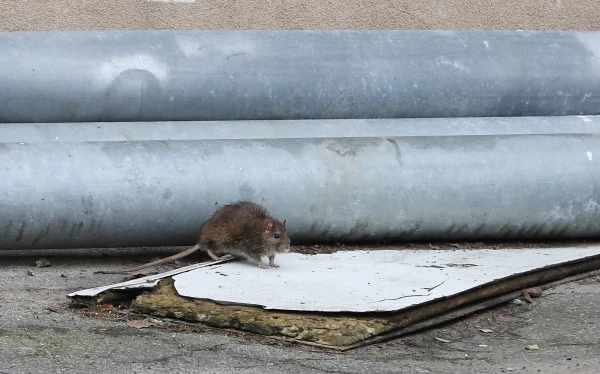
Recently, while running past one of the supermarkets, I noticed a crow sitting on the edge of a stone planter, engrossed and eagerly pecking at something. Upon closer inspection, I was stunned: the crow's "lunch" was... a huge dead rat.
Today, rats can be found everywhere in Riga: in yards and parks, in the basements of buildings, and sometimes even in apartments, especially on the first floor, on the streets in any neighborhood. They seem surprisingly calm, comfortable, and at ease. This cannot be said about people!
Local Measures Won't Help: The System Needs to Change
At the end of November last year, a call was posted on the portal manabalss.lv urging Riga residents to support an initiative that the fight against the rat invasion should be conducted centrally, and that it should be the responsibility of city services rather than individual managers.
"Residents of Riga, especially those living in the city center, have been suffering for at least two years from the excessively increased population of rats and mice," explained the initiative's author, Tatiana Bondare-Yudina. "According to public information, a dangerous infectious disease, leptospirosis, transmitted by uncontrolled breeding rodents, is actively spreading in Riga."
The epidemiological situation is particularly exacerbated in the cold season when rats and mice infiltrate premises, contaminating food products.
In the opinion of the initiative's author, the current fight against rodents – as it is conducted now – is completely ineffective. The logic is simple: today, the responsibility for this area lies entirely with the managers of individual buildings and adjacent territories. If the managers, while conducting deratization activities, do not coordinate their actions with each other, nothing prevents rodents from migrating during such activities in one building (block, neighborhood) to where these activities are not currently taking place. And then, when people start poisoning them there, the rats will move back to a safer place. And they will continue to migrate from place to place. In other words, targeted measures to evict them are, to put it mildly, ineffective.
Why They Multiply
The author of the initiative sees the reason for the rat population explosion in the capital in a relatively recent innovation – the placement of containers for biological waste throughout the city, the contents of which attract rodents: "Plastic containers are not protected from rodents – rats easily gnaw holes in them to get to the food. The city urgently needs to find a solution to this problem." The article concludes with a call to the city authorities:
-
organize coordinated centralized deratization measures throughout the city, combined with cleaning the territory and measures to prevent new rat invasions;
-
prioritize the fight against leptospirosis and other diseases transmitted by rodents – urgently develop and implement preventive measures against the mentioned diseases, as measures were once taken to combat Legionella bacteria (in particular, disinfection of water pipes);
-
require companies responsible for waste disposal to install containers that are literally not accessible to rodents;
-
regularly inform the public about the preventive measures being taken.
Response from the Riga City Council: Rats Are Very Smart, and People Are to Blame
So what do the city authorities think about this? After sending a request to the Riga City Council, we received the following response:
– The municipality does not have information that the number of rats has significantly increased (only seasonal fluctuations are observed). Sometimes more complaints come in, but this only means that the rats have simply become more noticeable, either due to a lack of food or because someone has disturbed them.
Rats become more noticeable in the autumn-winter period when their natural food decreases, so they search for food near containers, close to food establishments and buildings. Rats also tend to appear in urban environments if they are disturbed, for example, during construction work.
Rats migrate in search of food. The city is usually warmer, there are many hiding places and burrowing opportunities, and a lot of food can be found in basements and trash containers. Additionally, many people feed various animals and birds, not considering that this food or its remnants also attract rodents. Thus, human habits also influence the increase in the rodent population.
Rats are very smart and adept at adapting to conditions. They are cautious and timid animals – they only venture into open spaces when they are short on food or when they are chased or frightened. They are very careful with found food and new types of treats, namely baits. For example, rats never eat all the bait at once; first, they approach the treat slowly, sniff it, and only taste a little. If they sense that something is wrong, they won't even touch the "treat." Researchers of rodents have even concluded that female rats teach their young to evaluate food by many criteria to avoid poisoning and falling for cleverly placed bait. This is why they are quite difficult to eradicate.
According to the Riga City Council Regulations from May 15, 2024, No. RD-24-270-sn "Regulations on the Maintenance of the Territory and Buildings of the Riga City Municipality" ("Mandatory Rules for the Care of the Territory and Maintenance of Buildings of the Riga City Administration"), the owner or manager of the property is responsible for maintaining the property and the adjacent territory in order and for maintaining sanitary cleanliness. Therefore, if you notice rats in an apartment building or its vicinity, you should contact the building manager, whose duty is to conduct deratization activities at least once a quarter (and more often if necessary). It is also important that trash containers are located outside the building, that all of them – especially the containers for biological waste – are tightly closed, and that waste is disposed of in the container (not next to it), in short, that everything around is kept clean. The building manager must also ensure that waste containers are not overloaded, that their lids are always closed, and that waste is not lying on the ground.
In turn, food establishments and grocery stores are required to comply with special requirements regarding the storage of food and waste, as well as regular deratization activities. The Food and Veterinary Service oversees this area of their activities.
Thus, the best means of combating rats are reducing the food supply (closed trash containers, refraining from throwing away food, etc.), limiting their movement opportunities, and deratizing premises.
The long response from the municipality concluded with this advice:
"If there is no response to complaints from the manager, you should contact the Health Inspectorate. Inspectors will conduct an inspection and, if they confirm that the invasion of unwanted 'guests' is indeed taking place, will instruct the manager or owner to take appropriate measures within two weeks."
Moreover, this applies not only to rodents; accordingly, depending on the problem, the manager will be required to carry out either disinfection, pest control, or deratization. Or all of these. And notify the sanitary inspection of the implementation of these measures.
There Is No One Responsible
Gints Georg Murashov, Head of the Communications Department of the Health Inspectorate:
– Currently, no significant increase in the spread of rats and mice is observed in Riga, at least based on the dynamics of complaints received by the Inspectorate. However, the Inspectorate agrees that coordination of deratization actions is necessary. Given that deratization services have been transferred to the free market (i.e., there is currently no single service provider), the Riga municipality should assess how possible it is to organize coordinated deratization actions carried out by businesses.
The Inspectorate representative also emphasized that to organize effective deratization activities, the recommendations of specialists (zoologists) should be taken into account, who could suggest the most effective means and methods of deratization.
"No Reason to Panic"?!
Based on the responses provided above, neither the city authorities nor the Health Inspectorate currently see any reason to take urgent measures!
At the same time, people on social media are posting outraged posts about how rats are literally taking over the capital! What this could lead to (and has already led to) is clear to anyone who has ever glanced at a history textbook. Moreover, the material damage is the least of the evils that could occur if the trend of increasing rodents in the city continues and the measures to exterminate them are ineffective.
I believe that in our time, it is possible to hold such an opinion: since we are talking about living beings, perhaps deratization does not necessarily have to be aimed solely at extermination? Perhaps it is worth considering that rats have no place among humans, and that somewhere far outside the cities, some "landfills" could be built where attractive food waste for rats could be transported, and where they would "want" to migrate. They would then become part of the local wildlife, and their population would be regulated by natural selection...
However, this is indeed a question for zoologists and other specialists. For now, one thing is clear: the current measures to limit rodents are not yielding the desired effect, but no changes to the system are planned.
At the time of writing this article, only 413 signatures had been collected for the initiative Novērst žurku izplatīšanos Rīgā ("Prevent the Spread of Rats in Riga"), which is planned to be submitted for consideration to the Riga City Council, out of the required 2000. And we urge our readers in Riga or property owners in Riga to pay attention to this exceptionally important initiative manabalss.lv/i/3848. If, of course, we want to (quote) "live in a safe and clean environment free from infections."