
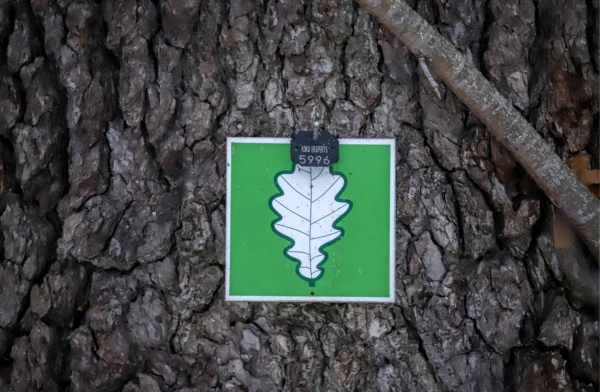
The Department of Nature Protection reminds that large ancient trees (dijkoki), protected dendrological plantings, and protected alleys are protected natural values. Therefore, the cutting down and/or removal of such trees, even if they have been damaged by a hurricane, is only permitted with the department's permission and under special conditions. After the aftermath of the hurricane, landowners' applications for the removal of fallen or uprooted trees are prioritized, reports tv3.lv.
Actions to address the aftermath of a hurricane depend on the nature of the damage and the degree of threat. For example, if a tree poses a danger, is completely uprooted, irreparably damaged, has lost its ability to grow, and its removal is necessary to eliminate the threat, the landowner must photograph the ancient tree with documented damage and promptly notify the department by phone about subsequent actions to eliminate the threat as soon as possible.
After addressing the aftermath, it is necessary to submit an application with photographs of the tree and the damage obtained to receive written permission.
Similarly, this should be done if the tree poses an increased danger—for example, if there is a risk that the trunk may split or fall, if it has already split, leaned, or if the root system is partially torn from the ground, creating a threat to human life, infrastructure, movable or immovable property.
If the tree is completely uprooted, irreparably damaged, and has lost its ability to grow but does not pose an immediate threat, the landowner must also submit an application to the department for written permission to cut down (remove) the ancient tree. Such actions are permissible only after obtaining permission, which may specify special conditions. In some cases, the removal of the trunk of an ancient tree is prohibited if it is a habitat for protected species.
We remind you that the cutting down of a protected tree is allowed only if it has become dangerous and there are no other ways to eliminate the threat—for example, by pruning branches or installing supports—or if the tree has completely lost its ability to grow. Written permission from the department is required for the removal or cutting down of a tree in any case. The application form can be found on the department's website in the "Permits and Approvals" section.
Information about changes in the condition of the tree, photographs, and signed electronic applications should be sent to the email address of the relevant regional department. These applications are prioritized. In case of urgent threat elimination, you are asked to contact the relevant regional department by phone. Contact information for regional departments is available on the department's website.
If it is necessary to verify whether the tree has protected status, it is recommended to use the "Ozols" natural data management system, which registers all ancient trees declared in Latvia.
An ancient tree is perceived as an independent ecosystem and is a habitat for many rare and endangered mammals, birds, insects, fungi, and other organisms, so their protection and care are regulated by the "General Rules for the Protection and Use of Specially Protected Areas" or individual protection and use rules for a specific protected area.
The responsibility for the care of the tree lies with the landowner on whose land such an ancient tree is located. The landowner is also obliged to comply with the rules for the protection and use of the protected area and to report any existing or potential changes, such as broken branches or fallen trees.









Leave a comment