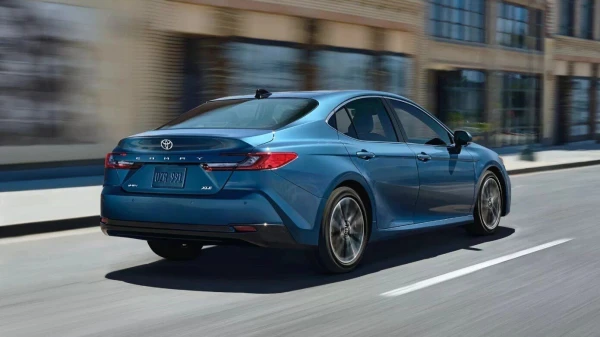
Toyota significantly reduced the list of "unique" parts, and the sedans became unmatched in price.
The 2015 Toyota Camry, classified as a business sedan, is regarded by experts from the American publication TopSpeed as the benchmark of reliability among all cars ever made.
According to estimates by J.D. Power experts, the reliability of the seventh-generation Camry, produced from 2011 to 2017 under the VX50 index, reaches 90 points out of a possible 100.
The authors of the study claim that this car is capable of covering over 400,000 kilometers (250,000 miles) with virtually no breakdowns. The 2015 model is also noted for its cost-effectiveness in maintenance, surpassing many competitors. According to RepairPal, the average annual service costs in the U.S. are approximately $378.
It is noteworthy that only Japanese cars made it to the TOP-10 most reliable vehicles, with six Toyota models, one Honda, two Mazdas, and one Subaru. However, the Camry rightfully holds the first place, as this sedan has also led in sales in America for the past 25 years.
In the 1980s, the large German trio and American companies dictated the trend for E-class sedans, while Toyota promoted its cars in lower classes and smaller sizes (not counting SUVs, of course). The first front-wheel-drive Camry with the V10 index appeared in the U.S. in 1983, but neither it nor its subsequent modifications gained much popularity until the end of the century. Among similar cars, the leaders were the Honda Accord and Ford Taurus.
Before the arrival of the Toyota Camry XV20 in 1996, the situation remained unchanged. This model was introduced as one of the first significant results of applying the kaizen concept. Toyota's marketers and PR specialists actively worked to make kaizen a discussed phenomenon in America, a kind of new industrial ideology. To this day, it is believed that the success of the Camry is due to its quality, reliability, and comfort, although the key factor was the price. More precisely, the fact that kaizen also implies a philosophy of cost reduction.
Toyota significantly reduced the list of "unique" parts, eliminated the station wagon body style, and the XV20 sedans became unmatched in price. During this period, Toyota decided to release a simplified version L (without an audio system, power windows, and air conditioning), which cost only $16,880!
By 1997, the Toyota Camry took first place in passenger car sales in America for the first time, and over the next 20 years, it only lost this position once (in 2001, the Honda Accord became the sales leader for the last time). By 2006, Camry sales had increased tenfold, and since then, its leadership in the segment commonly referred to as the business class in the Russian market has remained undisputed. Popular wisdom says: "If you don't know what to choose, take the Camry!"
It is hard to say how relevant this principle remains today. The new generation of Japanese cars is being released under the name Toyota Camry IX (XV80).
<iframe width="560" height="315" src="https://www.youtube.com/embed/rPdpLaL5YKc?si=Fq3bAXMYM8-R_DSC" title="YouTube video player" frameborder="0" allow="accelerometer; autoplay; clipboard-write; encrypted-media; gyroscope; picture-in-picture; web-share" referrerpolicy="strict-origin-when-cross-origin" allowfullscreen></iframe>