
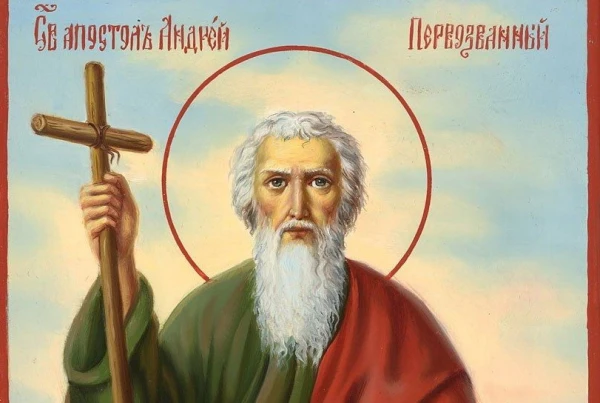
On Saturday, December 13, Orthodox Christians honor the memory of the apostle Andrew the First-Called, the first disciple of Jesus Christ.
According to the Gospel of John (John 1:35-42), the apostle Andrew was a fisherman; he was the first to follow the Savior and then brought his brother, the apostle Peter, to Him.
As the magazine "Foma" writes, after the Ascension of Christ and the descent of the Holy Spirit upon His disciples, the apostle Andrew traveled to many lands preaching the Gospel — to Asia Minor, Thrace, Macedonia, reaching the Danube, passing along the Black Sea coast, Crimea, and the Black Sea region.
According to tradition, along the Dnieper River, the holy apostle reached the place where Kyiv is located today. There he climbed one of the hills, where he erected a cross, saying to his disciples: "Do you see these mountains? On these mountains, the grace of God will shine, there will be a great city, and God will raise many churches."
There is also a tradition that Saint Andrew went even further and reached the settlements of the Slavs, where Novgorod was founded. From there, he traveled through the lands of the Varangians, reached Rome, and then returned to Thrace, where in a small village of Byzantium (the future Constantinople) he founded a Christian community. The last city where the apostle arrived and where he met his martyr's end was the city of Patras. It was in Patras that he was crucified by order of the governor Aegeas.
During the reign of Emperor Constantine the Great, the relics of the holy apostle Andrew were transferred to Constantinople, where they were placed in the church of the Holy Apostles next to the relics of the holy evangelist Luke and the disciple of the apostle Paul — the apostle Timothy.
Traditionally, on this day, it is customary for sailors, fishermen, and their relatives to go to church.
Also, on Andrew's day, a hearty table is set, naturally, a fasting one, as the Christmas fast is ongoing.












Leave a comment