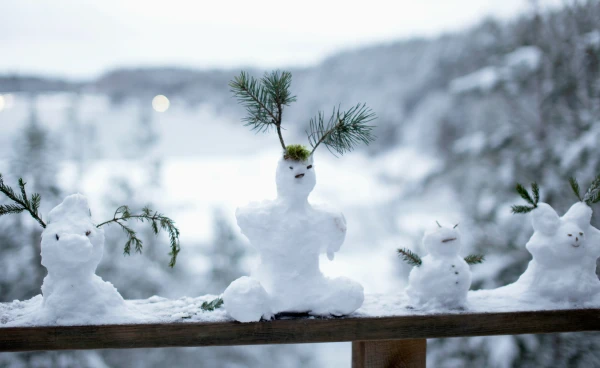
December is the first month of the calendar winter. A time of waiting for the Sun to return to nature. "If the Advent time is dry and clear, a dry summer and good weather for haymaking are expected. If Advent is without snow — there will be a lot of snow at Christmas. If in December green leaves can still be found on trees and bushes — sowing should be done early in spring. December is the winter hat, January is the winter coat, and February is the winter boots," writes nature and weather observer Vilis Bukshs in his blog "Mans laiks."
November passed without severe frosts and deep snow. According to Bukshs, according to the belief: "If the first snow falls, there are 50 days left until the sledding path. Since in some parts of Latvia the first snow fell only on November 17, it is not worth expecting a sledding path until the Feast of the Three Kings, or Epiphany (January 6). But it seems that everything will be different — around Christmas, at least in some regions of Latvia, the Christmas old man will be able to deliver gifts to children on sleds. After the winter solstice on December 21, light and moderate frosts, as well as light snow, are expected in many places.
In the first half of December, the weather will be predominantly uniform. During the day, the air temperature will fluctuate from 0 to +7 degrees. At night, with clear skies, temperatures may drop below -3 degrees in some places. It will be cloudy, with frequent fogs and brief precipitation: drizzling rain, wet snow, and icy conditions. Roads will freeze at night and be slippery.
In the middle of the month, more precipitation and windy days are expected. Daytime temperatures will be around zero and slightly above. It will be cloudy. During the waning moon, around December 17, it will get colder. Snow will fall more frequently. A thin snow cover will form in eastern Latvia. Roads will be slippery.
In the second half of December, closer to Christmas, there will be more snow, and frosts will intensify. Daytime temperatures will range from -1 to -7 degrees. In some places, clear, windless nights are expected to bring frosts of up to -10…-15 degrees, and Christmas in parts of Latvia will likely be white. At the end of the month, it will warm up. Light frosts and brief precipitation are expected. Roads will freeze and be slippery.
Overall, the first month of winter promises to be warmer than usual. Precipitation of various kinds will be mostly within the norm. In the second half of the month, freezing of rivers and lakes in Eastern Latvia will begin.
Beliefs about December state: if the north wind blows during the new moon in December, snow and frosts are expected. "This year, the new moon falls between December 20 and 26. As June is in summer, so is December in winter. The relatively cool and rainy June indicates that December will be mostly warm and humid," explains Bukshs.
According to Bukshs's observations, December will start slowly, but in the second half of the month, winter will strengthen and remain. No severe frosts are expected before the Day of the Three Kings (January 6). Later, a winter rich in precipitation and wind will come, with harsher frosts in the middle of the season. Although spring is forecasted to start early, it will be cold and prolonged.
Latvian folk signs for December:
-
December 4 — Barbara, sheep day, the only day before Christmas when one can go in disguise. Barbara opens the doors to winter. The weather on Barbara will be the same as on Christmas and New Year. If there is ice on this day — Barbara breaks it (there will be a thaw). If not — Barbara makes it (there will be frost). If there is frost on December 4 — then there will be frost for all the holidays in winter. If there is a thaw — then the holidays will also be with a thaw.
-
December 6 — Nicholas or Horse day. The birthday of the Christmas old man. A holiday for domestic animals, especially horses. Those who do not honor this day will have trouble with horses, poultry, and sheep. If on this day horses are rubbed with snow — they will not get sick, and evil spirits will not touch them. If it is warm and foggy on December 6 — June 6 will be cold and rainy. If there is a north wind and snow on December 6 — summer will be cold and wet.
-
December 9 — Wolf Day. If wolves howl and roam close to homes — there will be frost.
-
December 10 — the day when fish go to the bottom and sleep. The bear also goes into hibernation, and the moose sheds its old antlers.
-
December 11 — Day of the magpie and jay. If one of them calls — you should follow it, as a happy surprise awaits you.
-
December 13 — Day of Saint Lucia. From this day, the day becomes longer by a "chicken's claw." In some regions — for the time of the rooster's crow. On this day, according to beliefs, witches go to a meeting in hell. If the morning is clear — the rest of December will be dry. If it snows and blizzards — there will be more snowstorms before Christmas.
-
December 17 — Day of the black crow. The black crow before Christmas shows what the rest of the winter will be like. If birds fly in pairs — there will be no severe frosts, and thaws will be frequent. If the bird is alone and flies north before sunset — winter will be harsh. If three days before the solstice the crow flies north — winter will be fierce. If a traveler has lost their way — they should follow the cawing crow.
Winter solstice — Christmas. The richest in traditions, beliefs, and rituals holidays of winter, which last from December 21 to 27 and even longer. On Christmas, the Sun descends from the heights of the heavens, kisses the Earth, and drives away witches, beginning to rise toward the North Star. On Ligo night, in the depths of the Universe, the Sun turns around and rushes back to Earth to nurture new Life together. If it is sunny and clear on December 22 — it will be frosty and clear on December 31. If it is cloudy and frosty — there will be a thaw on New Year. The wind blowing on December 25 will prevail until Maria Spring, March 25. If it is damp after Christmas — winter crops are in danger; if before — they are not.
From December 26 to January 6, one should observe the weather: these 12 days symbolize the weather for the 12 months of the following year. For example, December 26 corresponds to January, December 27 to February, December 28 to March, and so on.
Old Year's Eve — December 31. It is associated with New Year's traditions, symbolizing the beginning of a new annual cycle. If it snows that evening — bees will swarm well, and there will be a rich harvest of apples. If the "stars sing" — there will be a good summer.