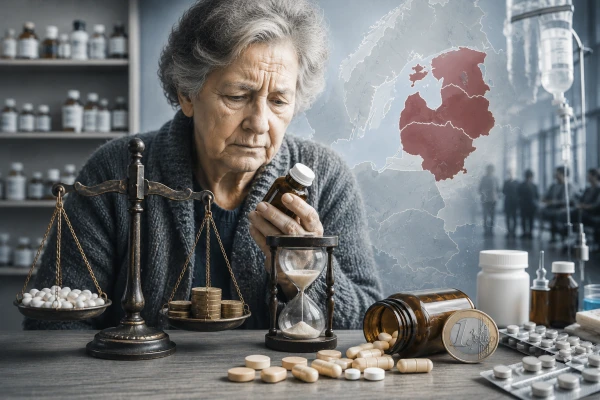
In recent years, the average life expectancy of people worldwide has increased, but simultaneously, birth rates have declined. This changes the balance between the working-age population and pensioners. Already in Latvia, the share of residents aged over 65 is about 22%. And pensioners are already struggling to obtain the medications they need.
In many countries of the European Union, elderly people are forced to live on the brink of poverty, unable to afford all the necessary everyday goods, including medications. This problem is also relevant in Latvia. Especially in conditions where there is no quick increase in pensions, and the healthcare budget is experiencing a prolonged deficit.
The number of chronic diseases increases with age
Chronic diseases, including diabetes, kidney diseases, and cardiovascular diseases, are already one of the biggest health problems in society. And their number is expected to continue to grow. A study published in 2024 in the European Journal of Preventive Cardiology predicts that the overall prevalence of cardiovascular diseases worldwide could increase by 90% by 2050, and the overall mortality from them could rise by 73.4%.
Latvian pensioners are already struggling to obtain the medications they need, while the healthcare system is looking for ways to increase the budget for reimbursable medications. In the future, as the number of chronic diseases grows, larger sums will be required not only from patients' pockets but also from the state budget. But this is not just about medications for chronic diseases. A similar situation will also affect, for example, cancer patients, as the incidence rates of these diseases are also rapidly increasing.
Considering these trends, it can be concluded that looking to the future, it is necessary to think about both the accessibility of medications for patients and budget sustainability issues. Planning not only for attracting funds but also for their effective distribution. This includes continuing to form the budget for reimbursable medications based on the most economically advantageous drugs available to the general public. This will allow funds to be directed to other important services - prevention, diagnosis, and rehabilitation of patients.
There is already a shortage of medications today. What will happen in the future?
Another threat to the health of residents is the shortage of medications, which is already being observed throughout Europe. Data from a 2024 survey show that all European countries have faced disruptions in the supply of medications. There is a shortage not only of specific or rare drugs but also of widely used medications - 96% of countries reported difficulties in ensuring medications intended for the treatment of cardiovascular diseases. In the future, with the increasing number of patients, this situation may only worsen.
The reasons for the shortage of medications are quite diverse. They include a raw material crisis triggered by Covid-19, rising prices for gas, electricity, and transportation, especially exacerbated in our region due to Russia's invasion of Ukraine. For comparison, in recent years, the cost of air transportation for medications has increased by 30%, while the cost of sea transportation has increased by 600%. This may make medications less accessible, disrupting supply chains.
The situation also widely affects generic medications, which in recent years account for about 76% of all medications used in Latvia. Their production can begin after the expiration of the patent on original medications, and they provide an equivalent therapeutic effect, using only 46% of the total budget allocated for medications.
Another problem is the small number of medication manufacturers. According to Medicines for Europe, in 66% of cases, the reason for the unavailability of medications was precisely this. In 2024, 47% of generic medications in Europe were produced by just one company, 22% by two companies, and 12% by three companies. It is frightening to think that these few manufacturers have to meet the needs of all countries. Accordingly, if even one link in the production chain breaks, the supply of medications will be at risk. Recent data show that due to the reduction in the number of manufacturers, generics that were available on the market 10 years ago are increasingly disappearing. This decline particularly affects areas such as cancer treatment and the availability of antibiotics, increasing the risk of medication shortages and jeopardizing patients' access to life-saving treatments.
One of the main reasons for the reduction in manufacturers is the pricing policy for medications in Europe. The cost of producing medications is rising, while the allocated state budget is not. As a result, the production of some specific medications leads to financial losses, and companies abandon them. For example, the availability of one medication for the treatment of ovarian cancer and small cell lung cancer decreased by 49% from 2015 to 2023. If the problem is not addressed, the number of such medications may continue to grow in the future.
The European approach or what can we do in Latvia?
In many European countries, governments are already looking for ways to ensure residents have constant access to necessary medications. For instance, Sweden and Norway have already begun revising their compensation mechanisms in an effort to prevent them from leaving the market. Meanwhile, France has focused on supporting local businesses so that some necessary medications can be produced locally. Similar solutions are also being sought in Portugal, the Czech Republic, and other European countries.
All these countries share the determination of decision-makers to find a solution to the problem. Without increasing the budget for reimbursable medications and forward-looking planning, including support for manufacturers, we may find ourselves in a situation where the shortage of medications in the long term threatens not only seniors but society as a whole.