
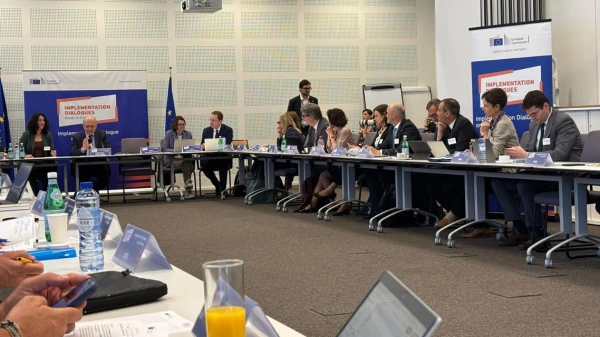
Last week, lawmakers of the Republic of Latvia, members of the European Affairs Commission, gathered for a meeting to discuss the "Omnibus Defense Readiness Package" developed in Brussels.
Apparently, local voters and taxpayers are not supposed to know about the plans of the European Commission — therefore, the event with the participation of Defense Minister Andris Sprūds ("Progressives"), parliamentary secretary of the Ministry of Foreign Affairs Artem Urshulsky, and 9 other officials present, along with 15 participating remotely, was recorded in the registry of "limited access information."
The Situation Is Not Peaceful
However, for its own, the European Union is quite open. In particular, the official website Europa.eu reports on the adoption in Strasbourg on June 17, 2025, of the "Omnibus Defense Readiness" (translated from English):
"Europe is facing an acute and growing threat. The only way to ensure peace in Europe is to be ready to deter those who wish to harm us. High-intensity armed conflicts have returned to Europe, and the international order established after World War II and the Cold War is in question..."
This, as they say, is in general terms, but regarding a specific adversary:
"Although the Union is not at war, the intense conflict at its borders and Russia's aggressive posture mean that Europe is facing a situation that is not peaceful, and our security and desire to build a future free from coercion and aggression cannot be taken for granted. We have seen how Russia has turned gas exports into a weapon, leading to uncertainty in supplies and sharp price spikes, and how it has deliberately struck at Ukraine's energy infrastructure. Our security depends on the readiness of both civilian and military forces. According to threat assessments conducted by several EU intelligence agencies, Russia's capabilities to produce military equipment have significantly increased, and it has military potential to test the unity of Western states..."
The Carriage of the Past
That is how it is, but the so-called unity of the West does not seem to be very well coordinated. For the existential threat from the Russian Federation, which the "Omnibus" breathes, is perceived somewhere along the latitude from Finland to Bulgaria, but on Cyprus and Malta, in Ireland and Portugal — it is not perceived at all. The document was likely clearly drafted by officials from somewhere in the former socialist camp, hence its pathos. After all, the same foreign policy service of the EU has been taken over by the active ex-Prime Minister of Estonia, Kaja Kallas.
"To build a truly independent Europe, a new form of Pax Europaea for the 21st century must be developed — one that will be shaped and managed by Europe itself," the document from Strasbourg postulates. The "Omnibus" will support the efforts of member states to strengthen the defense-industrial base and the overall defense readiness and flexibility of the EU by 2030 by creating the necessary conditions for priority investments in defense capabilities, ensuring the necessary predictability for industry, and reducing bureaucratic red tape. The scale of the necessary efforts must take into account the significant and chronic underinvestment in defense over the past decades and the accumulated deficit of defense investments in the member states."
But, as they say — as you name the ship, so it will sail. The name of the wooden, horse-drawn carriage clearly correlates with the stagnating defense industry of the "Old World"!







Leave a comment