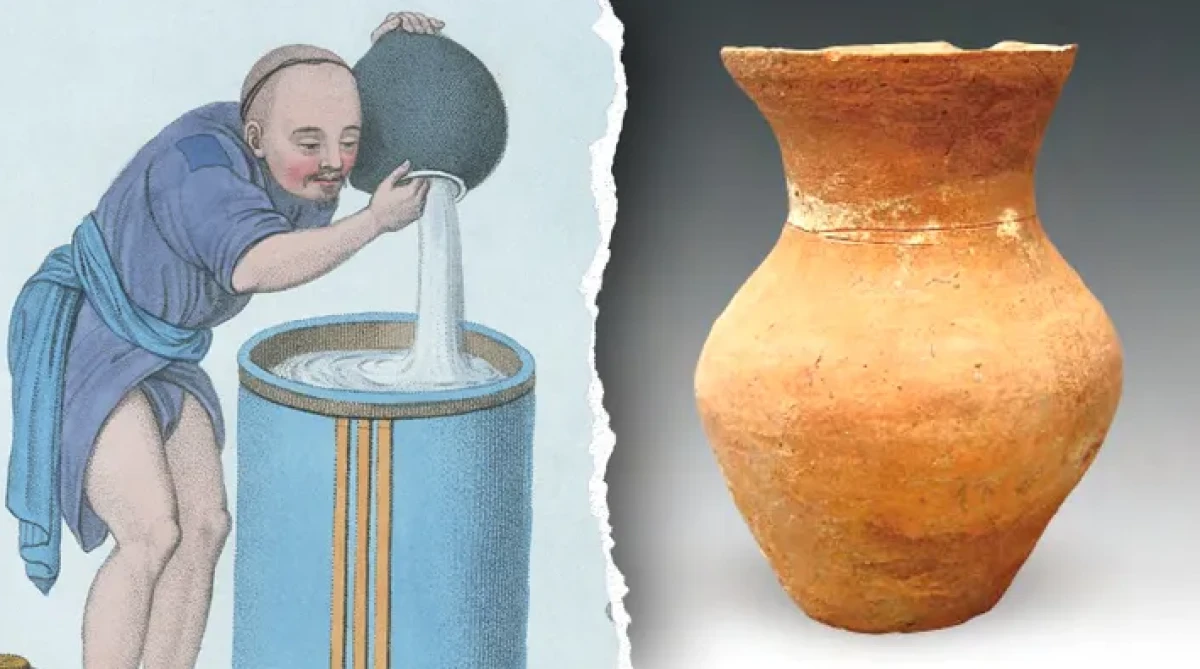
The beverage was brewed primarily from millet with a small amount of wheat and barley added.
Alcoholic beverages have a long history, with their production and consumption in Ancient China traceable to the early Neolithic period. The oldest archaeological evidence of alcohol presence was found at the Shangshan site (10,000–9,000 years BC) in Zhejiang Province.
Archaeological data showed that there were two main brewing technologies in Ancient China: the "nie" method, which used sprouted grains (malt) as a starter, and the "qu" method, where the starter was made from fermented grains or herbs. While millet was the preferred crop in the north, rice was predominantly used in the south, corresponding to the regions of grain domestication.
Until now, the study of ancient Chinese alcohol had to rely on barely visible residues preserved on ceramics rather than on the beverages themselves. This left many details of early brewing methods and traditions unclear.
Therefore, the discovery made during excavations at the Shanjiaobao cemetery in northwestern modern China was unique. Archaeologists uncovered 183 tombs dating back to the so-called Warring States period (475–221 BC). At that time, this territory belonged to one of the seven states that fought against each other, the Qin state.
Deep within a tomb located on the outskirts of the cemetery, a tightly sealed bronze bottle with an unusual garlic-shaped neck was found. The neck was sealed with cloth from the inside and with a sticky organic ointment from the outside.
Inside the bottle, scientists, whose article was published in the Journal of Archaeological Science: Reports, discovered approximately 3740 milliliters of a clear, light bluish-green liquid with no odor, and a small amount of sediment at the bottom. Researchers suggested that the liquid was so well preserved for over two thousand years due to the double-layer sealing.
Chemical analysis showed that the liquid contained high levels of lactic and oxalic acids — characteristic of grains — but almost no tartaric acid. Therefore, researchers concluded that they were not dealing with fruit wine, but rather an alcoholic beverage brewed from grains. The chemical analysis also revealed over 2400 organic compounds in the liquid, including amino acids and sugars.
Upon closer examination of the liquid using high-resolution microscopes, more than 100,000 tiny starch grain particles were found, the size and shape of which allowed for the identification of the crops used in the beverage's production. The results showed that it was primarily brewed from millet grains (92%) with a small addition of wheat and barley grains (8%).
The liquid also contained over 8500 yeast cells. This confirmed that the liquid was once beer that had fermented during production.
Additionally, characteristic damage on the wheat and barley grains indicated that they were crushed and heated. This means that the brewers of the Qin state used the "qu" method — one of the two traditional ways of preparing a starter for fermentation, the researchers concluded.