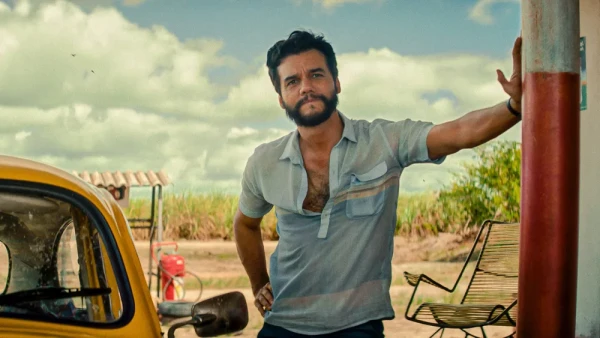
The action of "Secret Agent" unfolds in 1977 in Brazil.
The main reason why "Secret Agent" by Kleber Mendonça Filho became a true event of 2026 lies in the director's ability to deconstruct the political thriller — a genre that, as the news and the latest Oscars suggest, is once again in vogue. The director eschews a straightforward depiction of dictatorship, making a radical move: he removes torture and open terror from the frame. In Brazil in 1977, unfreedom is not special forces on every corner, but the hum of fans, alarming newspaper headlines, and suddenly empty apartments.
The action of "Secret Agent" unfolds in 1977 in Brazil, where a military junta has been in power for thirteen years. The main character, the restrained and intellectual Armando (Oscar nominee Wagner Moura), arrives in the coastal city of Recife. Under a false name, he finds refuge in an unusual communal house organized by an elderly dissident. At the same time, he takes a job at the local archive to find documents about his mother, who gave birth to him while still a minor. Gradually, we understand that Armando is not as simple as he seems, and moreover — he is being watched. In contemporary Brazil, student archivists listen to recordings of Armando's phone conversations and unravel the detective plot alongside the viewer.
Drawing inspiration from Alan Pakula's "paranoid trilogy" and Michelangelo Antonioni, Filho strips his hero of a heroic aura. Marcelo, played by Wagner Moura, is not a fiery revolutionary, but a former academic and intellectual whose only goal is to reunite with his son and regain his right to a private life. His tragedy, resonant with the fate of the characters in Francis Ford Coppola's "The Conversation," lies in the fact that in an authoritarian system, the very attempt to "simply live" becomes a subversive political act.
The film is placed in a unique structure of "dual optics." The narrative of the 70s is constantly interrupted by footage from the present, where modern history students are deciphering the archives of intelligence services and dissidents. This technique of "digital archaeology" exposes the mechanics of power: the viewer sees how a living human life before their eyes turns into a dry "protocol No...". To emphasize the irrationality of what is happening in the 1970s, Filho weaves urban legends into the plot, such as the myth of the "hairy leg-killer" terrorizing city dwellers at night. This surreal touch in the spirit of Gogol or Kafka serves as a metaphor for the public consciousness, which, under censorship, begins to give birth to monsters in an attempt to explain the unexplainable state terror.
But ultimately, "Secret Agent" is also a statement about cinema itself. The film, one of whose characters works as a mechanic in a movie theater, enters into a dialogue with its contemporaries — Spielberg's "Jaws" and Donner's "The Omen." These pop culture markers do not just create a backdrop; they mirror the hidden threat lurking in the frame. This is what transforms Filho's work into something more than a historical film: formally set in the 1970s, "Secret Agent" actually lives in 2026, exploring the universal mechanisms of how politics and history erase human lives, while people and art resist this.