
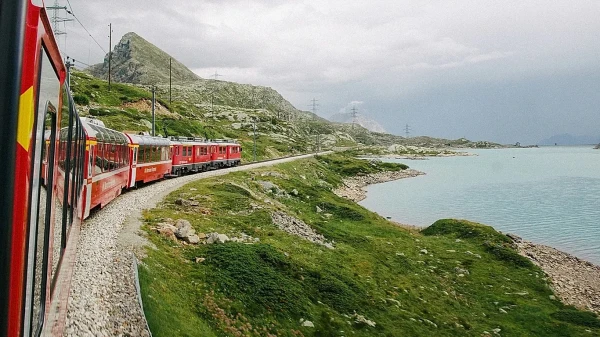
This shift in focus opens up new opportunities for railway companies and tourist destinations.
There has always been something magical about traveling by train. From the golden age of luxurious carriages to steam-powered journeys through mountains and highlands, railways have long captured the imagination of travelers.
Today, train travel is experiencing a renaissance, especially in Europe, where new routes and destinations are emerging, offering a wide variety of travel options across the continent.
For many passengers, a train is no longer just a convenient way to get from one major city to another; it is becoming an important part of the journey itself through Europe.
This revival has been ongoing for several years, says Bjorn Bender, CEO and Executive Chairman of Rail Europe, but it is now gaining momentum as governments and carriers actively invest in the sector.
"I think several factors have come into play over the last five to ten years," he says in an interview with Euronews Travel at the ITB Berlin travel fair. "It all started with a discussion about sustainability, which continues to drive interest in train travel, especially among young people.
But the real acceleration is now being fueled by investments from railway operators across different countries at the European Union level. Take, for example, the European Green Deal, under which more than €100 billion is being directed towards railway infrastructure, rolling stock, and so on."
As a result, the network of services is expanding across the continent: new connections are being opened, modern trains are being introduced, and night trains are making a comeback.
"We are certainly seeing an expansion of offerings — primarily on international and cross-border routes: new trains are being introduced, night trains are returning, and so on," he explains.
"Twenty years ago, it was the dull part of the transport system. Now, on the contrary, it is the most interesting part, and there is every chance that railways will become the backbone of mobility in Europe."
A significant portion of this growth is driven not by daily commuters, but by travelers exploring Europe by train.
At Rail Europe, which specializes in selling train tickets and passes across Europe, they note that most of their clients travel outside their home country.
According to Bender, the group serves more than 80% of so-called "non-home travelers." These are people who choose cross-border routes like London – Paris or use trains within a country after flying into Europe.
"We have many clients from outside Europe," he continues. "Primarily from the USA and India, for example, but also within Europe, it is mainly people who are traveling outside their usual environment."
For such travelers, the train journey itself is an important part of the experience of vacationing in Europe.
"The key here is the experience, and experiences begin with inspiration," says Bender. "It all starts with the right information, with searching, booking, and payment."
The goal of Rail Europe, he adds, is to simplify this process. "Our mission is to make everything as simple as possible, to remove complexity and unnecessary obstacles for the customer."
Traveling Beyond the Capitals
As the popularity of train travel grows, passengers are increasingly venturing beyond the most popular European destinations.
Many tourists have already visited the major capitals, notes Bender, and now want to discover lesser-known cities and regions. "They have already seen London, Paris, and Rome," he says. "Now they are interested in Budapest, Copenhagen, or Warsaw."
This shift in focus opens up new opportunities for railway companies and tourist destinations.
While connections between major cities are already well established, improving links to destinations beyond the capitals is becoming a priority.
"When it comes to vacations, when people go on holiday, they want to visit second- and third-tier cities and regions in Europe," he explains.
Investments across Europe are gradually expanding such networks and improving access to a wider range of places.
Digital Platforms Simplifying Travel
One long-standing issue with international train travel has been the fragmentation of European railways.
Different national operators, ticketing systems, and tariff structures have traditionally made booking cross-border trips more complicated than purchasing an airline ticket. Now, digital platforms are working to eliminate these obstacles.
For instance, Rail Europe brings together hundreds of operators into a single booking system. "We consolidate all 250 European railway carriers connected to our system into one search, one booking, and one payment," says Bender.
This means that a traveler can plan a complex route through several countries in one operation.














Leave a comment