
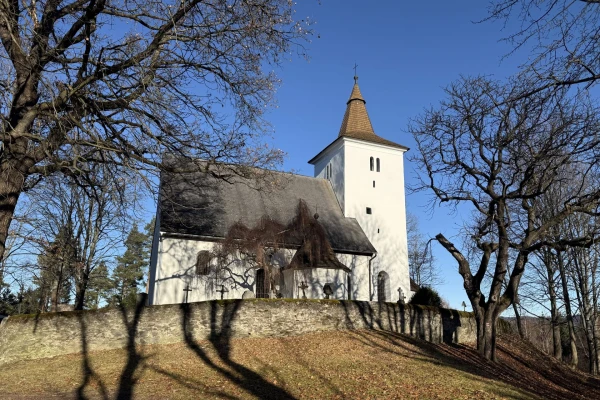
The answer lies not in the realm of dogmas but in the space of culture and human experience.
In a country that has long and almost proudly worn the label of "one of the most irreligious in Europe," churches continue to live their quiet but stable lives. Moreover, they are not necessarily centers of faith. More often, they serve as places of memory, beauty, and opportunities to pause amidst the hustle and bustle of life. A study by the agency STEM/MARK shows that the attitude towards sacred buildings in the Czech Republic is much more complex than simply "believe – do not believe."
The Czech Republic indeed remains a country with a low level of religiosity. In a survey conducted by STEM/MARK in January 2026, 37% of respondents identified as believers, but only 12% simultaneously declared affiliation with a specific denomination. This means that formal religious identity is a minority affair. Nevertheless, 70% of the country's residents visit church buildings at least occasionally. Almost three-quarters of respondents step over the thresholds of churches, cathedrals, basilicas, chapels, monasteries, and associated complexes – bell towers, cloisters, and pilgrimage sites.
At first glance, there seems to be a paradox. If the country is not very religious, why do churches remain so in demand? The answer lies not in the realm of dogmas but in the space of culture and human experience.
The most common reason for visiting is tourism and interest in monuments. 95% of those who visit churches do so primarily to see a historical site. A church in the Czech Republic is primarily an architectural dominant, a part of the urban landscape and cultural code. Even young people, who generally visit church buildings less frequently than other age groups, if they do enter, most often do so "as a tourist attraction."
But there is also a second, more subtle motivation. 66% of visitors cite the important feeling of silence, tranquility, and a special atmosphere. The church space is perceived as a place to pause. It offers a refuge from urban noise, a chance to be alone with oneself, to simply sit and feel the volume of the space. Women note this motive more often than men (72% versus 60%), and among people over 60, it reaches 74%. Interestingly, even among believers, 80% say they seek silence in the church above all, rather than participation in the service.
The actual liturgical function turns out to be much less significant. Only 23% of respondents cite the service as a direct motive for visiting. Even among believers, this is less than half – 42%. This creates an intriguing picture: the church as an architectural and emotional object attracts more than the church as an institution.
Cultural events play a separate role – concerts, guided tours, public actions. For some people, this is a convenient and neutral way to "enter" the church space without a religious subtext. Music under Gothic arches or an exhibition in a monastery courtyard becomes a kind of bridge between secular and sacred culture.
Age differences are also noticeable. Among young people aged 18-29, 58% visit church buildings in the Czech Republic. In the group over 60, this figure rises to 82%. Gender differences are also consistent: women enter churches more often than men (76% versus 63%). The level of education plays a significant role: 86% of people with higher education visit church buildings, while among those without a high school diploma, this figure is 58%.











Leave a comment