Different regions of Germany have created their own unique recipes.
German cuisine is known far beyond the country's borders, and German sausages occupy one of the top spots on this list. Yes, it is a common product that is easy to find in supermarkets. But it is also an important part of regional culture, history, and even legislation. Some recipes are protected as strictly as French champagne.
Residents of different regions of Germany attach special importance to their sausages and bratwursts. In Bavaria, they take pride in weisswurst, in Thuringia — in rostbratwurst, and in Frankfurt, they can tell the story of rindswurst better than any tour guide. Sausages and hot dogs here are not just gastronomy, but also a way of self-identification.
The Origins of German Sausage Culture
The history of German sausages dates back to the deep Middle Ages. The first documents mentioning such products are found in regions located within modern Germany. For example, in Thuringia, records of sausage production date back to the 14th century. These documents show that sausages of that time were made from the most accessible ingredients: pork, beef, garlic, pepper, caraway, and marjoram.
Interestingly, even in the Middle Ages, production was controlled by city authorities. Thus, in the 13th century, a rule in Landshut stipulated that sausages could only be made from high-quality pork. This shows how important a product they were for the residents of the region.
Moreover, Germany became one of the first European exporters of sausages. For instance, in 1769, the famous mettwurst sausage from the city of Göttingen was sent to England, Denmark, Sweden, Turkey, and even India. Such geography emphasized its high reputation.
Germany as the Home of 1500 Types of Sausages and Hot Dogs
Today, Germany produces about 1500 varieties of sausage products. Different regions have created their own unique recipes.
For example:
Nuremberg — small aromatic bratwurst;
Erfurt — spicy rostbratwurst;
Munich — tender weisswurst;
Frankfurt am Main — legendary frankfurter and rindswurst;
Berlin — iconic currywurst.
Each dish has its own story and regional character.
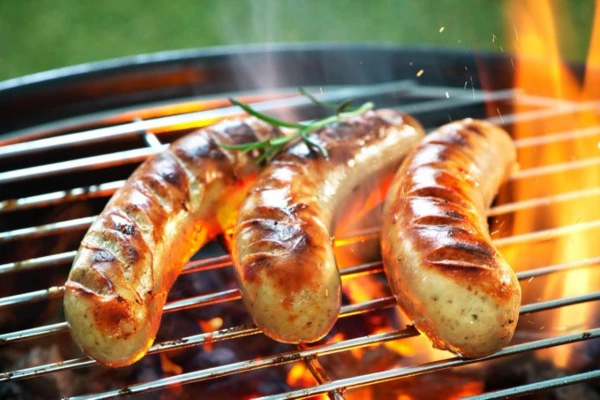
Thuringian rostbratwurst is considered a symbol of the region. They are made from lean pork with the addition of salt, marjoram, pepper, and garlic. The local tradition involves grilling them on a grill that is pre-rubbed with a strip of bacon — this deepens the flavor. According to local customs, the sausages are poured with light beer during cooking. This gives a slight caramel note.
Nuremberg bratwurst is one of the most recognizable German sausages. They are small, aromatic, and served in quantities ranging from 6 to 12 pieces. They are most often placed in a bun called Drei im Weggla — three sausages inside a crispy bun. A distinctive feature is the addition of marjoram, which forms a recognizable taste.
Weisswurst are tender white sausages traditionally eaten in the morning. Locals believe that after noon, the dish loses its freshness. For weisswurst, veal, back fat, lemon zest, and parsley are used. They are served with pretzels and sweet mustard. This is a classic Bavarian morning.
Rindswurst in Frankfurt appeared in the 19th century when local butchers decided to create a beef sausage suitable for the Jewish community. Today, rindswurst is one of the most popular dishes on the streets of the city.
The history of currywurst is closely linked to post-war Germany. The inventor of the dish is considered to be Herta Heuwer — a woman who ran a small snack bar in the western part of the city. She mixed ketchup, curry, and several secret ingredients, after which she poured this sauce over a fried sausage.
<iframe width="560" height="315" src="https://www.youtube.com/embed/nZZHhaY_vFg?si=yHinSPDyBenmk_xz" title="YouTube video player" frameborder="0" allow="accelerometer; autoplay; clipboard-write; encrypted-media; gyroscope; picture-in-picture; web-share" referrerpolicy="strict-origin-when-cross-origin" allowfullscreen></iframe>