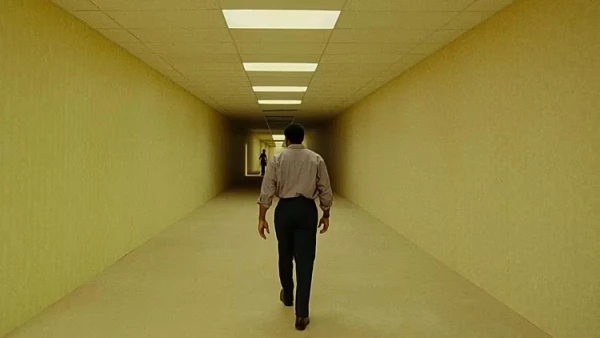
The new documentary reflects on fulfilled prophecies.
Unless you have been in a blissful comatose state all this time, you have surely noticed that the ubiquitous slogan at the center of George Orwell's dystopian novel "1984," along with his invented concepts of "Newspeak" and "doublethink," have long transcended popular culture. They are becoming increasingly relevant in our reality.
In his new documentary Orwell: 2+2=5, renowned director Raoul Peck weaves Orwell's life and words with archival materials and footage that seem ripped from the latest news broadcasts, to help viewers understand: although Orwellian terms have long become familiar expressions, we still seem not to fully realize how much the nightmare of "1984" has already become a reality.
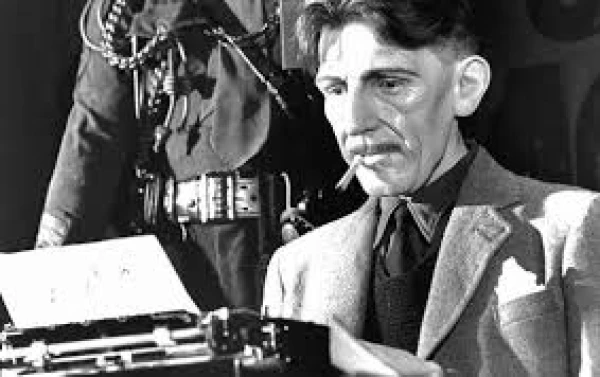
Just as he did ten years ago when he turned to the texts of the late James Baldwin to create a multilayered chronicle of the history of racism in the U.S. (I Am Not Your Negro), here Peck plays with chronology, emphasizing the timelessness and prophetic power of Orwell's prose. A voice from the past that resonates in the present. The director connects personal diaries, articles, and letters of Orwell, voiced by Homeland star Damian Lewis, with archival photographs, newsreels, and contemporary news stories, showing how the past helps us understand the present. And what is even more frightening, Peck shows: we have long been given a detailed "textbook" of totalitarianism, which has been used for a century – and continues to be implemented – as a blueprint for governments around the world, while we still allow ourselves to be deceived.
Haiti. Myanmar. Russia. Israel. The United States of America. Orwell: 2+2=5 demonstrates not only how history repeats itself but also how modern leaders like Donald Trump, Vladimir Putin, Viktor Orban, and Benjamin Netanyahu employ similar tactics, fueling the machinery of oppression.
Peck's film covers a vast array of themes, intertwining the past and present, fiction and reality – so much so that the documentary at times literally leaves one dizzy.
World War II and the dismantling of institutions; bombed streets of Ukrainian cities; the history of book bans; indoctrination under the banner of MAGA; the role of media and social networks allowing lies to spread faster than facts; unregulated artificial intelligence threatening the very idea of objective truth; surveillance capitalism... Everything merges into a deliberately blurred, disorienting image of the world, and the message is both clear and chilling: Orwell speaks to our troubled times no less than to his own era.
Some of the most powerful episodes of the film are brilliantly edited sequences in which Peck spares neither the viewer nor his characters.
We hear Trump rewriting the history of January 6: Peck overlays his false words ("there was so much love in the air") on footage of real violence, giving additional weight to Orwell's phrase: "From the point of view of a totalitarian regime, history is something to be created, not studied."
We see Orwell's warnings about political language come to life in examples of "Newspeak" – ubiquitous euphemisms that hide distortions of reality and hollow meanings. "Collateral damage" – over footage of destroyed Berlin in 1945; "cleansing" – in Myanmar in 2017; "peacekeeping operations" – over footage from Mariupol in 2022; "wonderful profits" – over fragments from Animal Farm; "antisemitism 2024" – with the explanation: "a term weaponized to silence critics of Israel's military actions."
Cinema also serves as a warning. Just as in I Am Not Your Negro, Peck turned Hollywood against itself, showing through film fragments how the image transmitted by Hollywood cultural production diverged from social reality, here the director carefully weaves fragments of adaptations of 1984, as well as episodes from films by Terry Gilliam, Steven Spielberg, Lauren Greenfield, and Ken Loach, to emphasize: art reflects the era, but it can also warn.