
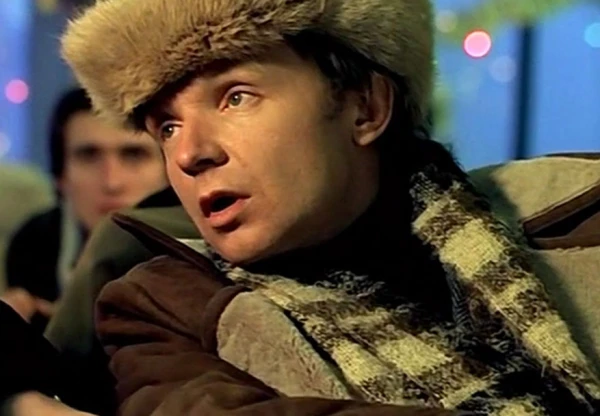
In addition to the gift of transformation, he was also an artist.
His last name could be associated with softness, shyness, some kind of tenderness, and his most famous characters seem to confirm this: from the kind Zhenya Lukashin to the indecisive Novoseltsev; from the spineless Karandyshev to the shy Alyosha Karamazov. However, Myagkov's list of roles also includes the manly Alexey Turbin, Arkady Gaidar, and even Lenin. On the other hand, Lukashin and Novoseltsev are not so soft inside at all.
Andrei Vasilyevich himself was certainly an intellectual, a cultured person — but by no means a weak-willed man. Perhaps that is why — looking from the outside, in perspective — he was able to vividly and volumetrically portray his characters, so that they are invariably remembered and appreciated by the audience.
Andrei Myagkov was born on July 8, 1938, in Leningrad, in a family completely unrelated to acting: his father was an associate professor at the Technological Institute, and his mother was a mechanical engineer. And Andrei himself, at his father's insistence, graduated from the Technological Institute and even managed to get a job at the Institute of Plastic Masses. But he was not destined to work in his technical specialty.
During an amateur course performance, Myagkov caught the eye of one of the teachers from the Moscow Art Theatre School, who invited the young man to try his luck in Moscow. Myagkov easily passed the entrance exam, graduated in 1965, and joined the Sovremennik Theatre, taking his place among great actors. Myagkov's theatrical roles, among which there are many tragic ones — the Baron from "At the Bottom," Alexander Aduyev in "An Ordinary Story," Bessmenov in "The Philistines" — are a huge part of his work that is too rarely remembered.
In the same year, 1965, Andrei made his film debut — in Elem Klimov's film "The Adventures of a Dentist," and he was cast in the lead role! However, the film was quickly shelved. True fame came to the actor three years later with the role of Alyosha Karamazov in Ivan Pyriev's last film. The director approved Myagkov for the role without an audition.
He was principled in choosing roles.
It started small: while still at the Moscow Art Theatre School, student Myagkov had a conflict with the teachers. He flatly refused to learn French. The reason was that Andrei was struck by the atrocities of the French during the 1812 war, which he had recently read about... The situation escalated to the point that the student was to be expelled. Only after that did Myagkov reconsider, promised the rector to pass the exam — and kept his word, learning French almost to perfection in just a few months.
Andrei Myagkov was very selective later in his work as well. After the role of Karamazov, offers poured in, including to play the most important role in the Soviet Union: Lenin himself. The actor flatly refused. Director Mark Donskoy managed to convince him only by promising that there would be minimal propaganda in the film. And in 1973, Myagkov played Ilyich — but as a young and in love man, in the film "Nadezhda," dedicated to the leader's wife, Nadezhda Krupskaya.
He was not wanted for the role of Lukashin.
It is hard to imagine "The Irony of Fate" without Myagkov as Zhenya Lukashin. And yet, things could have turned out that way. Andrei Mironov or Oleg Dal were wanted for the role of Lukashin. The chairman of the USSR State Committee for Cinematography, Philip Ermash, forbade Eldar Ryazanov from casting Myagkov. During the auditions, he portrayed a drunk so convincingly that Ermash thought the actor had indeed shown up under the influence. Yet he had just played Lenin! The director had a hard time defending his choice.
Hard as it is to believe — Myagkov's relationships with his colleagues on the film were not very good. Olga Naumenko, who played Galya, felt much more comfortable on set with the cheerful and open Oleg Dal. Serious Myagkov seemed to her a closed grump who wouldn’t say a word after filming. And Barbara Brylska was also not thrilled with such a Lukashin — she even tearfully asked Ryazanov to remove the kissing scenes. The director, however, was adamant. And he was right: the film was released and became a classic of New Year's cinema.
He could not stand alcohol.
The film brought the actor the long-awaited fame. But not without side effects: Myagkov developed a reputation as the country's main drinking buddy (even though, according to the plot, Lukashin is a teetotaler!) He was gifted brooms and bottles of vodka, constantly urged to drink together and, of course, to go to the bathhouse together. It was hard: "I practically don’t drink, and I can’t stand the bathhouse at all," the actor later explained. "But people want to see Lukashin in me, so sometimes I nod along and say that I love to bathe — so as not to upset them."
Myagkov generally disliked this role: Lukashin seemed to him not a romantic hero, but a frivolous mama's boy who ruined several lives. The nationwide love for "The Irony of Fate" seemed excessive to him. He even suggested pausing the annual screening of the film — for about forty years, to at least restore some freshness to the perception of the film. Moreover, he was upset that because of "The Irony," he became a hostage to one role.
He nearly died while filming "Cruel Romance."
In 1984, during the filming of the movie "Cruel Romance" with the same Ryazanov, Myagkov miraculously escaped death. According to the plot, his character Karandyshev chases a steamboat in a boat. Myagkov swam too close to the huge 350-kilogram paddles of the steamboat "Lastochka." The boat was instantly shattered into splinters, and the actor went under the water. Only the wig surfaced.
The film crew was horrified; cameraman Vadim Alisov even told an assistant: "Shoot, these are the last frames from the life of a great actor." But soon Myagkov's head appeared above the water: somehow he emerged without a scratch. The next day he calmly finished the scene, and nine days later even jokingly held his own wake.
In "Office Romance," Novoseltsev is the opposite of Lukashin.
For the role of Novoseltsev, Ryazanov without a shadow of a doubt invited Myagkov again. But the task was not easy: it was necessary to transform the romantic Lukashin into something completely different: a sluggish, "unambitious," "office rat" Novoseltsev. For the character, they came up with fake disheveled mustaches and glasses with thick lenses — in them, Myagkov's gaze became bewildered. Another successful touch was the white socks, carelessly slipped down to his worn-out shoes.
One of the most challenging moments was the slap that Novoseltsev delivers to the scoundrel Samokhvalov at the climax. Myagkov could not gather himself to deliver a proper blow. Oleg Basilashvili, who played Samokhvalov, recalled that he told him: "Andryush, I beg you, give me a good hit to the face, I won’t be offended." Several takes yielded nothing. Finally, frustrated with the failure, Myagkov got angry and "hit properly."
However, Ryazanov entrusted the actor to perform several songs on behalf of his character in "Romance" — in "The Irony of Fate," Myagkov also hoped to showcase his vocal abilities and was upset with the director for not giving him such a chance.
In "Garage," Ryazanov deprived him of his voice as punishment.
For "Office Romance," Ryazanov wrote the song "Nature Has No Bad Weather" and showed it to the actors, pretending it was poetry by William Blake. Everyone praised the lines, but Myagkov muttered something like "It could have been better." For this, the director gave him the role of lab assistant Khvostov in the film "Garage," who was hoarse from a cold — completely without lines... However, Ryazanov himself said that it was a joke. "For an actor, playing a role without lines is a very difficult task. Myagkov handled it brilliantly."
He was a true one-woman man.
No, he had romances in his youth. For example, while still in the drama club at the Technological Institute, he fell in love with Tamara Abrosimova. The young people dated for three years, but never decided to marry. But after entering the Moscow Art Theatre School, Andrei Myagkov met his classmate Anastasia Voznesenskaya, and this was forever.
Voznesenskaya literally fought for Myagkov when he was expelled for failing French, helping him with retaking exams and reinstatement. The actress became famous, while Myagkov lived for some time literally in the shadow of her fame — a trial for an actor-husband. Later, on the contrary, Myagkov became famous for his roles with Ryazanov, while directors forgot about the actress...
Myagkov, in turn, always supported his wife, often refusing to act if she was not given a role in the same film, helping her overcome her alcohol dependence. Their marriage was not affected by the inability to have children.
They lived together for almost 60 years — a rare case of an inseparable couple in the creative environment. As Zhenya Lukashin said: "Love is not a cold, it doesn’t go away!"
Not only an actor but also a writer and an artist.
For his wife, according to Myagkov himself, he took up the pen. When Anastasia Voznesenskaya "read all the detective novels" — Andrei wrote an entire detective trilogy to please her. "The Gray Gelding," "The Stradivari Violin, or The Return of the Gray Gelding," and "Caution, Glass! The Gray Gelding. The Beginning" were published and successful. In 2010, the first book was even adapted into a series.
And that’s not all: in his spare time, Myagkov was fond of painting, especially portraits. He enjoyed painting his colleagues: Oleg Yefremov, Galina Volchek. And in 1991, he portrayed General Secretary Mikhail Gorbachev. His portraits were more psychological than realistic, in the style of Picasso. Myagkov himself, with irony, recalled the reaction of his models: "Especially sensitive ones, it was rumored, prepared appeals to the courts demanding to hold me accountable for insulting their personality. My delicate mother-in-law once said, standing in front of the freshly painted portrait of her daughter: 'You know, Asenka, I think he doesn’t love you very much.'"
He hardly acted in the last decades.
And again, perhaps the reason was Myagkov's lack of softness, principledness, and maximalism. He was disappointed with the course that Russian cinema took, disliked the soulless imitation of Hollywood, the spectacles, fights, and action. He called it "an injection of tastelessness." Moreover, the actor did not want to engage in "self-repeats" and exploit his previous successes. He only acted in the film "The Irony of Fate. Continuation," which he later regretted.
He refused roles in big cinema, gave few interviews, and kept to himself. "For me, it’s better than to be diluted," he said. And he remained that way — smart, sensitive, honest, a true tuning fork of conscience and talent.







Leave a comment