Her relationships with her fellow writers were quite complicated.
It is not very clear how old Agnia Barto is today. Probably 125. But it could also be 124. Or 120. Or 127. Different sources (old encyclopedias, new ones, interviews with her daughter) mention different dates: 1904, 1906, 1907... But it is probably more accurate to believe the preserved birth record in the office of the city rabbi of Kovno (Kaunas) from February 1901.
Her mother was a housewife, her father was a veterinarian, and her uncle was a physician. Agnia did not live long in Kovno; her parents moved her to Moscow. Her uncle worked in Yalta at the Slavati sanatorium, and during her visit there, Agnia wrote her first poems: "In the Slavati sanatorium, white beds stand."
She saw herself as a ballerina, but, shaken by Mayakovsky's collection, she preferred poetry. According to one version, the People's Commissar for Education Anatoly Lunacharsky persuaded her to write for children. At a concert of graduates from the choreographic school, he heard Agnia reading the poem "Funeral March" with animal seriousness, smiled, invited her to his reception, and suggested she compose something for little ones. According to another version, her idol Mayakovsky told her after a performance for children in Sokolniki: "This is who you should write for!"
On that very trip to Sokolniki, they traveled in the same car, and Mayakovsky "...seemed focused on something of his own. While I was thinking about how to start the conversation more intelligently, the usually silent writer Nina Sakonskaya spoke to Mayakovsky, to my envy. I, not being shy, became timid and did not open my mouth the whole way... It was important for me to talk to Mayakovsky because doubts were overtaking me: was it time for me to start writing for adults?"
She did write for adults, for example, during the war years. But we primarily remember her children's poems. However, constrained by shyness, she heard from Mayakovsky only: "This is who you should write for!.." - and took it as a sign of fate.
Among her very first works is "The Little Chinese Boy Van Li." This is a story about the hard life of a simple boy in the Celestial Empire - he toils while "the mandarins in beautiful jackets sit on the terraces of the smoking rooms." He was unlucky. But he heard about Lenin and, from his father's stories, "loved him very much."
Regarding her early poems and rhymes, Barto used the epithet "monstrous": "In one of my first children's books 'Pioneers,' I managed to rhyme:
A boy stands by the linden, Crying and sobbing.
They told me: what kind of rhyme is this - 'stands' and 'sobbing'? But I argued that it should be read this way.
One of her teachers was Korney Chukovsky. He criticized her early works but friendly suggested how to work. Once, in 1934, Agnia Lvovna encountered Chukovsky on a suburban train, asked him to listen to her poems, he agreed, and suddenly announced: "Poetess Barto wants to read us her poems!" Barto "...was taken aback, as Chukovsky could leave no stone unturned from my poems, especially in front of everyone..." And she lied that this was the composition of "a five-and-a-half-year-old boy." Chukovsky was delighted; the poems were about the rescue of the Chelyuskin crew: "How I feared spring! I feared spring for nothing! You are saved anyway..."
Interestingly, a few years before this, Barto was among the writers who signed an open letter to Gorky as part of a discussion about children's literature. Chukovsky was seriously criticized there. Among other things, for the lines "And for the unclean chimney sweeps - shame and disgrace!": as if this contradicted what we teach children that "the work of a chimney sweep is as important and honorable as any other." This was mentioned in passing, as part of the discussion about children's literature. But it was still a blow, and Chukovsky could not forget it: too much was falling on him in those years, and even the great literary critic Nadezhda Krupskaya referred to "The Crocodile" as "nonsense" and "incredible gibberish" (actually, after this, chimney sweeps began to be criticized).
In Chukovsky's diary, there are several mentions of Barto. "She always says sensible things, behaves correctly and intelligently - but for some reason, she is very unpleasant to me." "I gave [Samuil Marshak] my book 'From 2 to 5' to read, and his main remark was: how could I put the names: Marshak, Mikhalkov, Barto next to each other. And stories flowed about the tricks that Barto played on him in the 1920s." "[Tvardovsky] treats Barto with disdain." Well, that's how it is.
And at the same time, he valued her poems. He wrote to her: "I read 'Grandfather's Granddaughter' aloud and not once. It is a true 'Shchedrin for children'... 'Younger Brother' is a smiling, poetic, lovely book... Your satires are written from the perspective of children, and you converse with your Yegors, Katyas, Lyubochkas not as a teacher and moralist, but as a comrade hurt by their bad behavior..."
Two tragedies: the death of her son and husband
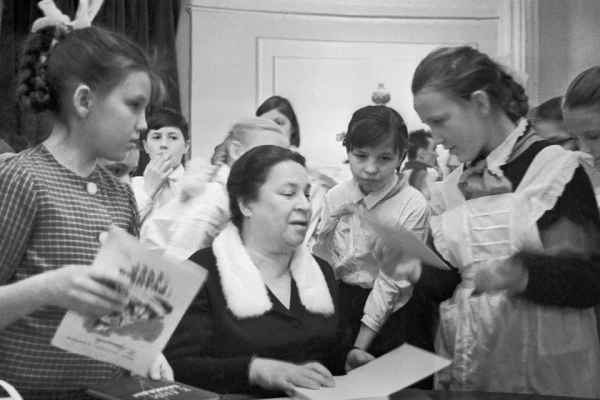
She composed many wonderful poems for children. She wrote scripts for good feature films - "The Foundling" (together with Rina Zelena), "The Elephant and the Rope," "Alyosha Ptitsyn Develops Character." For many years, she hosted the program "Find a Person" (the prototype of the television show "Wait for Me"), with which she helped reunite 900 families separated by war.
As for her personal life... She divorced her first husband Pavel, an ornithologist and also a children's poet, quite quickly. From him, she retained a beautiful surname (his grandfather was an Englishman named Richard Barto; Agnia Lvovna's maiden name was Volova) and a son Edgar (Garik). He died at 18: he was riding a bicycle in Lavrushinsky Lane when he was hit by a car. Barto closed herself off, considering adopting a child from an orphanage - she traveled a lot to them and wrote a poem about one of them called "Zvenigorod."
Another tragedy was the death of her second husband, energy scientist Andrei Shcheglyayev. She outlived him by 11 years.