
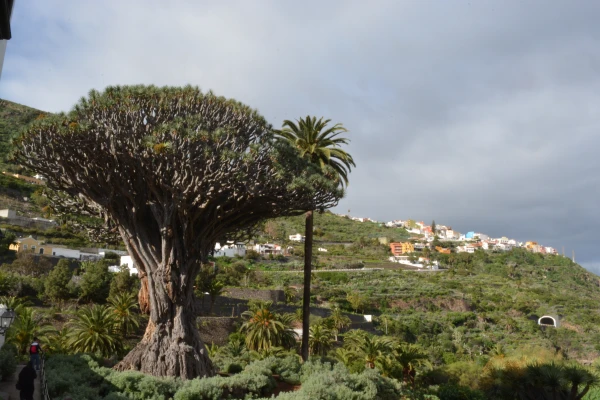
Having first arrived at the blessed Canary archipelago over a quarter of a century ago, I, like a wound-up toy, constantly flew south – with companies, with family. Playa de las Américas – a guaranteed result, both in winter and summer. And now I decided to break away from reality and headed north.
The surprises began even in Riga. It is no coincidence that the islands belong to the European Union, and according to geographical division, they are located in Africa. Opposite Fuerteventura is the border of Morocco and Western Sahara. 100 km in a straight line!
German Automotive Industry Takes You to Paradise
The northern coast of Tenerife in winter is as budget-friendly as, say, Turkey. Considering that it has been 10 years since my last trip, I was looking forward to a trouble-free week in the town of Icod de los Vinos. But then I received a "svarigs pazinьojuмs" from the national tour operator – unfortunately, a transfer to my destination was not included. I had to make my own way there.
Said and done. Through mutual correspondence, I chose a Spanish hatchback that was supposed to be waiting for me at Tenerife South Airport. A journey across the entire island awaited.
My native airBaltic pleased me with Starlink air connectivity – I had no idea back then that in these 6 hours of flight, the internet would be several times better than in the following week. And to be honest – since I arrived, there was no point in sitting online at home; I needed to help the Spanish economy!
Upon arriving at the airport named after Queen Sofia, filled with retirees, rarely interspersed with young families with children, predominantly from Northern and Western Europe, I struggled to get to the area where a shuttle was picking up other rental car seekers. The shuttle bus took travelers for free to a vast area with colorful air-conditioned booths, where, over free coffee, the charming señora Lola made me a weekly renter of a snow-white product of the German industry from 2025, with 11,000 km on the speedometer and at a cost… exceeding what I paid for tickets and accommodation in Tenerife.
Hit, Sink, and Even Curse
But the price/quality ratio is important too. As Lola explained to me, this beast, from a breed that the mad Führer of the Third Reich boasted about in the late 1930s, belongs to the breed of crossover SUVs, and therefore can tear through mountain trails just like that. Moreover, the "full coverage" insurance means that I can do whatever I want with it – scratch it, hit it, sink it, and even curse it for its Nazi past. Without any deposits or subsequent deductions.
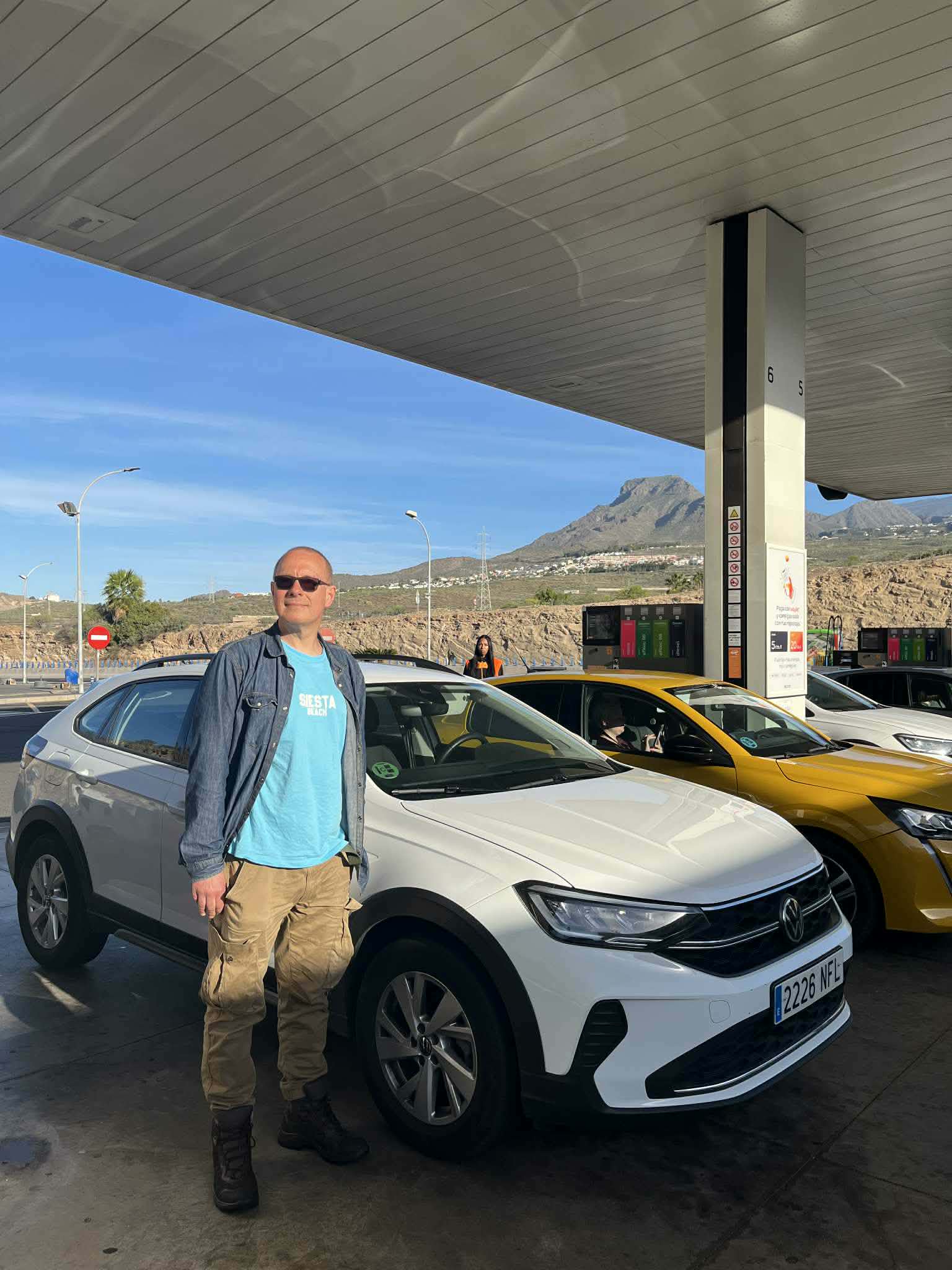
“I returned the ‘German’ without scratches. Photo by the author.
Sitting behind the wheel with my favorite "gas-manual" setup, I immediately Russified the menu, and we hit the road. A Russian driver, a German car, and a free navigator created in Israel, speaking for some reason in the language of Rainis and Langa.
At first, everything went very smoothly. After navigating a few roundabouts (in Tenerife, you can only encounter intersections in the capital, Santa Cruz) onto the TF-1 highway, I felt like I was in driver’s paradise. Perhaps for the first time, I was speeding along such a quality, safe, well-constructed road. The dashboard regularly lit up with numbers indicating the recommended speed limit, but there was no point in speeding. I just wanted to enjoy the sun, the ocean flying to my left, and the soft passages of Spanish music on the audio system.
Lessons in Mountain Driving
But too much of a good thing is not good. The highway ended at a roundabout with a sign for "Santiago del Teide." We entered the halls of the formidable volcano, 3718 meters above sea level. Suddenly finding myself at an altitude of about a kilometer, I began to receive a voluntary-compulsory course in mountain driving.
Yes, it’s one thing to look at the serpentine TF-82 on Google Maps, and quite another to be first in line among several cars when there’s a cliff on the right, separated by flimsy logs – and on the left, buses and local nobles pop out from around the corner, literally doing the indicated 90. Meanwhile, I was fiddling in second gear, happy with the relatively straight sections where I could safely "floor it" at 30. The hateful gazes of the gathered caballeros were staring at my back. I understand them – but, excuse me, I arrived from the country of Gaizinkalns. I had no opportunity to be trained.
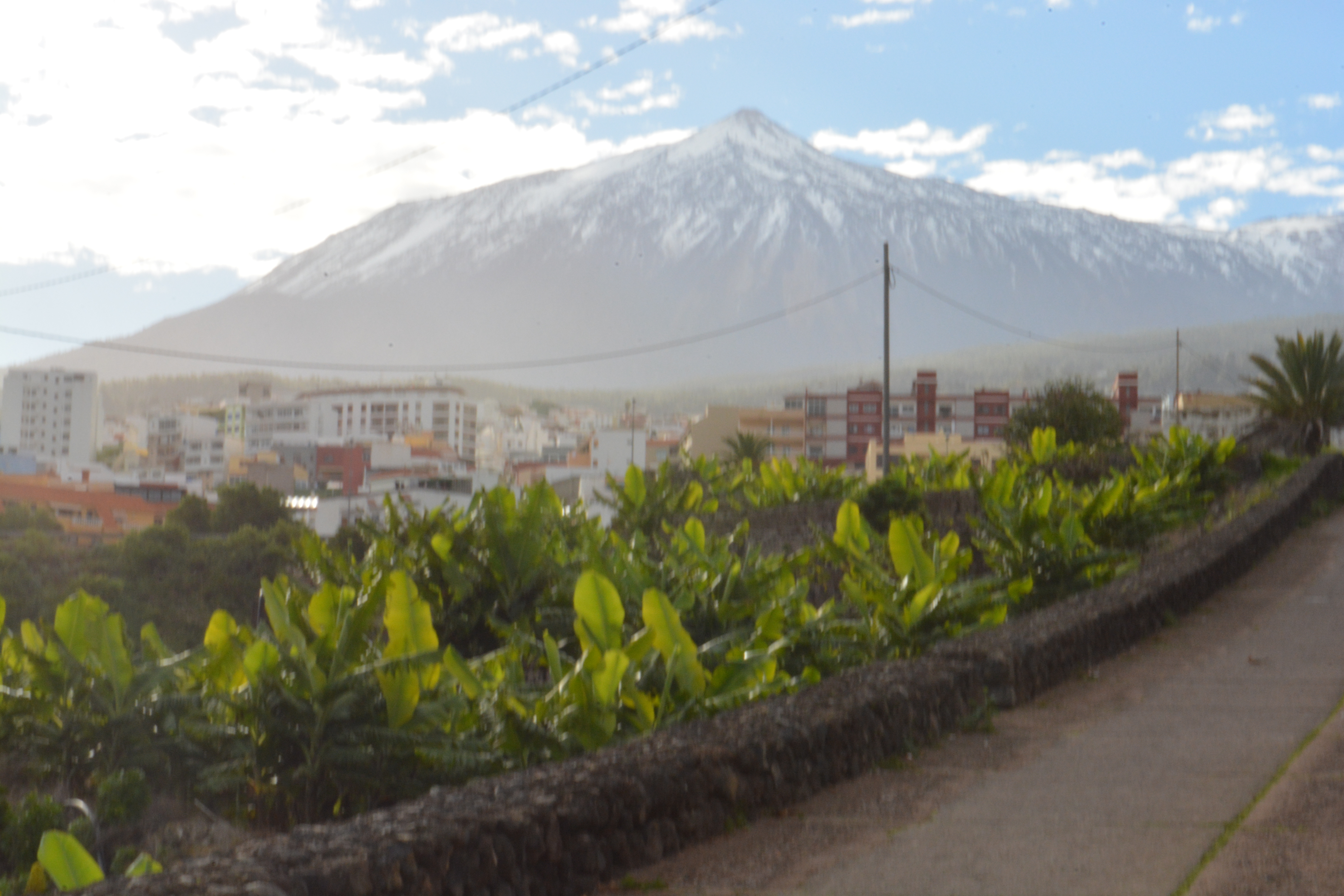
The Teide Father. Photo by the author.
Accommodation Available. Affordable
But the goal of my trip was a refuge for budget-minded amateurs in Northern Tenerife. The thing is, this is not a hotel, but a guesthouse run by a family, with three generations of which I quickly got acquainted. In our republic, such basic foreign language skills are rarely found even at the supermarket checkout, while these sons and daughters of Cervantes and Lorca were seriously convinced that everyone in the world knows Spanish.
In any case, we somehow communicated with gestures, and instead of meaningless calls to the reception door, I soon began simply walking to their living quarters, explaining that I needed a new "bolsa." That is, a trash bag. You can understand how unobtrusive the service was.
On the other hand, there was a full analogue of a modest working-class apartment – a hallway, a combined bathroom, a bedroom, and, most importantly, a grand kitchen, which had everything necessary to prepare and consume, say, a unit of large cattle.
Marble floors and countertops were combined with two gas stoves (presumably for traveling families of different generations, with señora and señorita), a microwave, a toaster, a refrigerator… Only Spanish channels were available on TV, and the internet would connect and disconnect intermittently.
Santa Cruz – the main city of the island. Photo by the author.
Icod, Inflow and Outflow
First of all, of course, I headed to the beach. And here I realized that I was not even in Icod de los Vinos, but in the nearby village of El Amparo. And the shortest road to the ocean was blocked, forcing me to urgently tackle the second stage of mountain driving – urban.
Since the heights in Icod hovered around 400 m, the distance marked on the map as 1 km required descending at quite a sharp angle. At first, I couldn’t bring myself to let go of the clutch, then I was finally going down in first gear, holding the brake. I encountered carefree cars parked on both sides, leisurely crossing the street were old folks and playing children. They had no idea that this might be the riskiest day of their lives!
Some "streets," marked as such by Israeli developers of the info product for travelers, turned out to be dead-end gutters of large volcanic stones, winding without a clear perspective, and twice I was very upset to find myself literally at the edge of a cliff. I turned too early. It’s no coincidence that one of the most famous Hollywood horror franchises is called Wrong Turn.
But all tests and exams in extreme – for a Latvian – driving are behind me. And a black beach with pebbles and volcanic sand opens up, and a white fishing church that is always open – unlike the city cathedral of San Marco, which only rings regularly. And the exits to the water are cordoned off with yellow Policia tape.
Did Someone Die?
In reality, local authorities fear killer waves, and thus protect careless vacationers, many of whom are swept away by the elements every year. So at Playa San Marco, which was closest to my residence, I only swam once when the red forbidden flag was changed to a yellow warning one. Even then, I felt the power of the exhilarating outgoing wave. Ideally, I should also check another mobile app that displays all ocean stages for the day.
But in Puerto de la Cruz, a northern coastal city, near the bastions of the 16th century, there were also not random people engaged in paragliding – right in front of me when I got there. Yet a person was still swept away into the ocean. I noticed a helicopter with a rescue team buzzing overhead the whole time. The body was discovered only three days later, the all-knowing social networks helpfully reported, as they always manage to lift the mood.
Nevertheless, it was useful to visit Puerto. Because it is an outstanding, authentic, ancient maritime city – reminiscent of the times when Spain rightfully ruled half the world (the other half – Portugal). And there, in the fishing port area, was a cozy harbor without any warning flags, where I indulged in unrestricted swimming in the heavenly ratio of 20-20, air-water.
The Last Atlanteans
The capital of the province of Tenerife – Santa Cruz, located at the northeastern tip of the island, is already a completely modern city. Its symbol is the huge Auditorio, a music theater that looks like a cool wave with a sharp crest. Nearby stands a pair of skyscrapers, a modern "city hall" (here – the parliament of all the Canaries!), and all sorts of concrete temples of consumption.
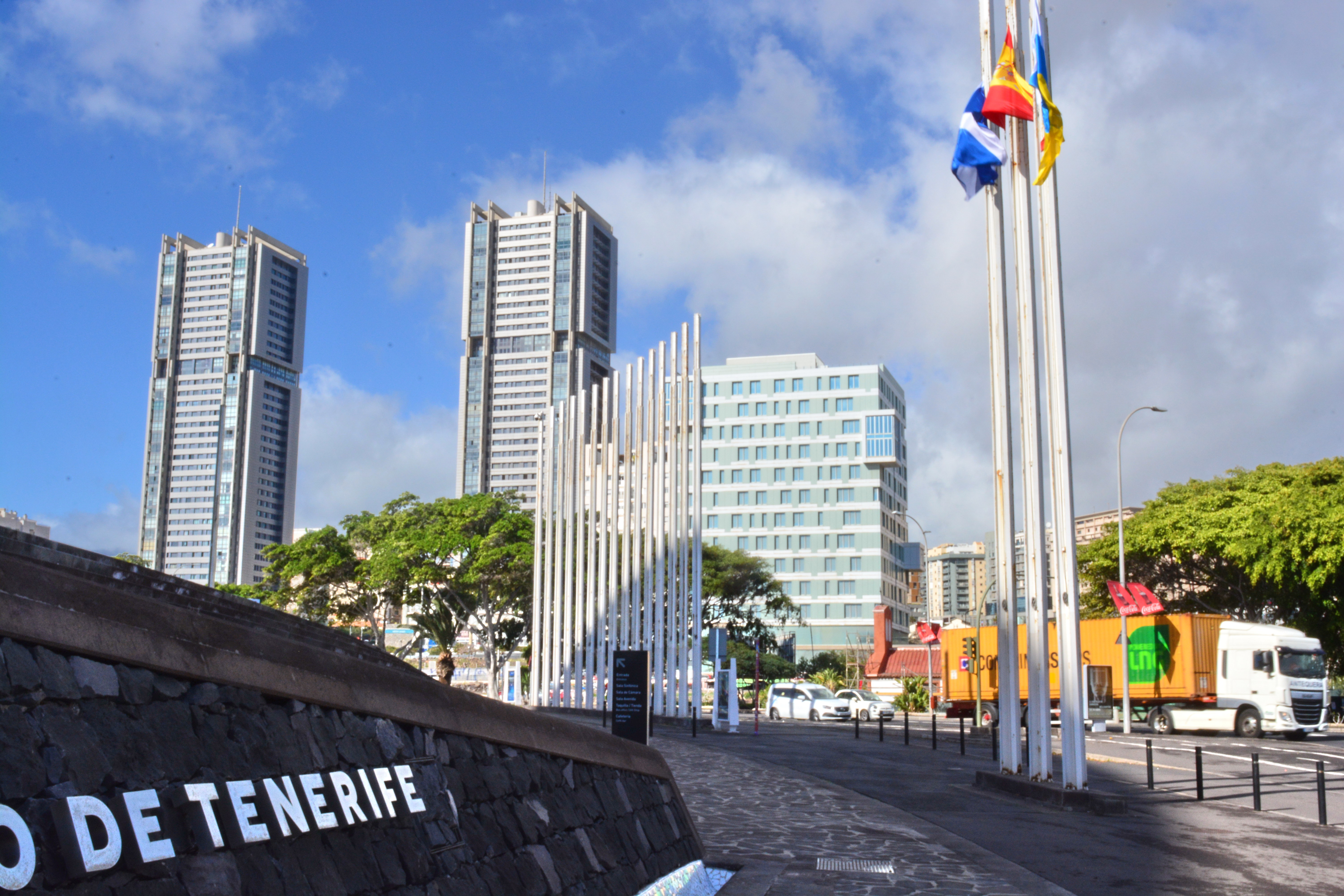
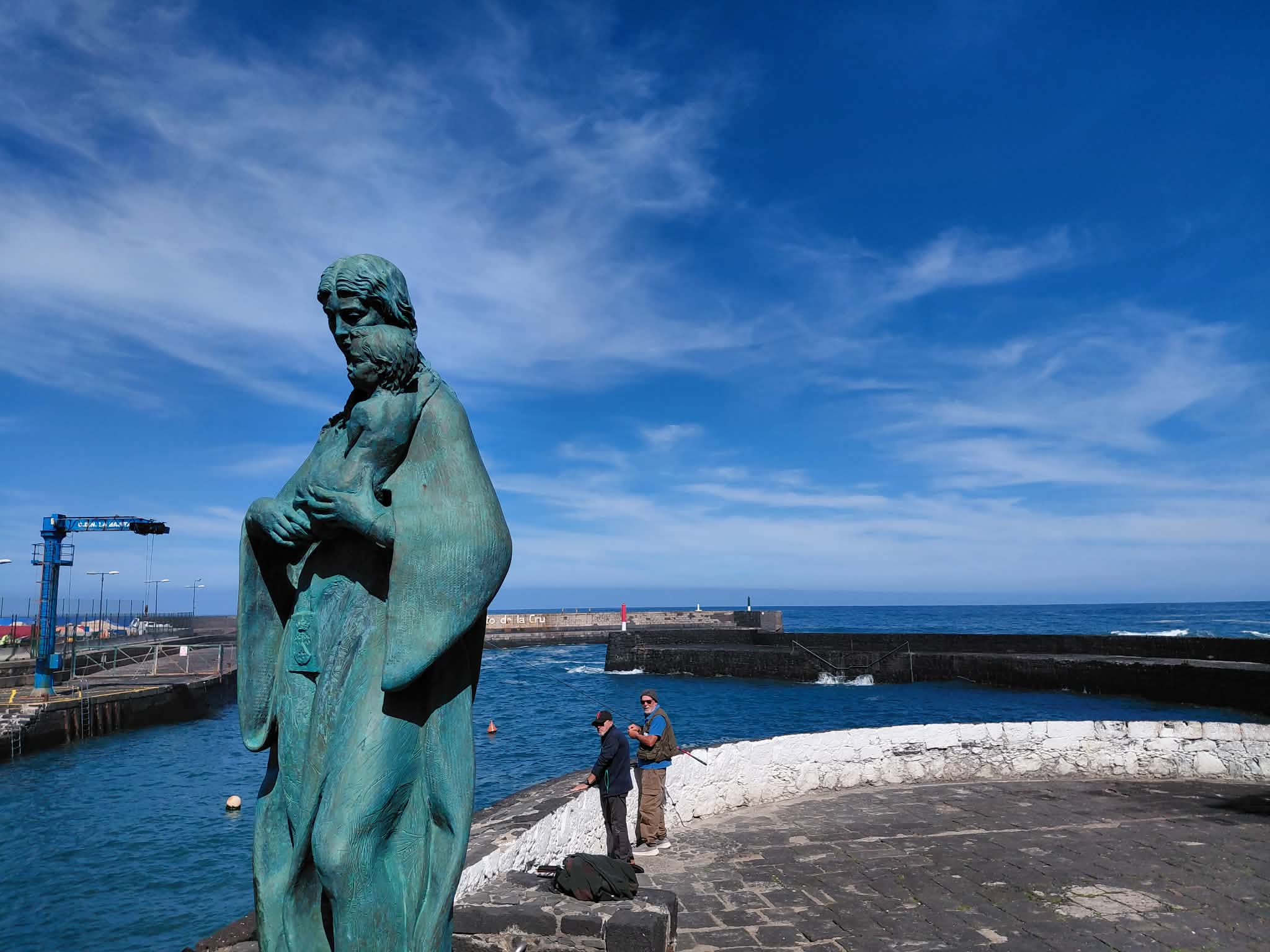
Always ready for battle, the bastions of Puerto de la Cruz. Photo by the author.
I had been to Santa Cruz several times before, but this was my first time in the Museum of Nature and Archaeology. It turned out that the archipelago was inhabited by the ancestors of modern Homo Sapiens over 5 million years ago – and the youngest island, El Hierro, emerged from the ocean surface only about 1 million years ago. One can imagine how the inhabitants of that time were astonished. The ancestors of the legendary Guanches!
When in the 15th century, the conquistadors stumbled upon the Canaries on their way to America, light-skinned Europeans with blue eyes already lived here. Mahoreros, bimbaches, auritas, the Guanches themselves, and others spoke related, though not identical languages, which are most likely close to the Berber languages (Afro-Asiatic family) of neighboring Africa. The first to notice them, however, was the Arab geographer Al-Idrisi in 1150. And when the Spaniards conquered the resistance of the mountain and proud Menseys – princes, the Guanches largely died out. Only in modern times did they realize – yes, those were Atlanteans, remnants of the population of the sunken continent!
In any case, the long, good memory, the Guanches left us a huge collection of their dear deceased. Mummies, carefully wrapped in goat skins, were kept in inaccessible caves with a dry and cold climate. The latter I confirmed myself in practice – the car thermometer in the vicinity of the Teide volcano showed +4.
Now the remains of the Guanches serve as objects of intense scientific interest. They are scanned, analyzed. Researchers find out what they ate, what diseases they had. It must be said, their medicine in the early feudal stage was quite decent – well, until Europeans arrived with their ailments.
Señor Dmitrios’ Finca
This is not a sharp knife – but, translated from Spanish, it means estate. A resident of Riga, one of the best journalists of "Soviet Youth" in the 1980s, Dmitry Albertovich Belyaev, has been in Tenerife since the beginning of the 21st century. He dealt with real estate, sea tours, obtained a yacht captain's diploma – and now also has the qualification of a port wine master. Therefore, next to his house in the five-thousand-strong town with an agricultural name, Los Silos, the permanent resident of the island has two hectares, with variously decorated "houses for shovels."
The wandering artist Otto Ozols painted the whitewashed walls of the summer houses; antique furniture made of Canarian pine from all over the archipelago appeared here, and a unique world was formed. Here Señor Dmitrios, as his neighbors call him, grows grapes and guavas, lemons and peaches, and makes drinks of varying strengths from all this harvest – from juice to 90% strong spirits: "The grapes didn’t turn out well, so I had to distill them into alcohol, which will later be used for making port wine."
Who’s Last for the Treats?
The protein part of the menu is provided by several dozen well-mannered hens and roosters, as well as visiting partridges and wandering mountain rabbits, which the diligent owner has the legal right to shoot. What else is needed for happiness?
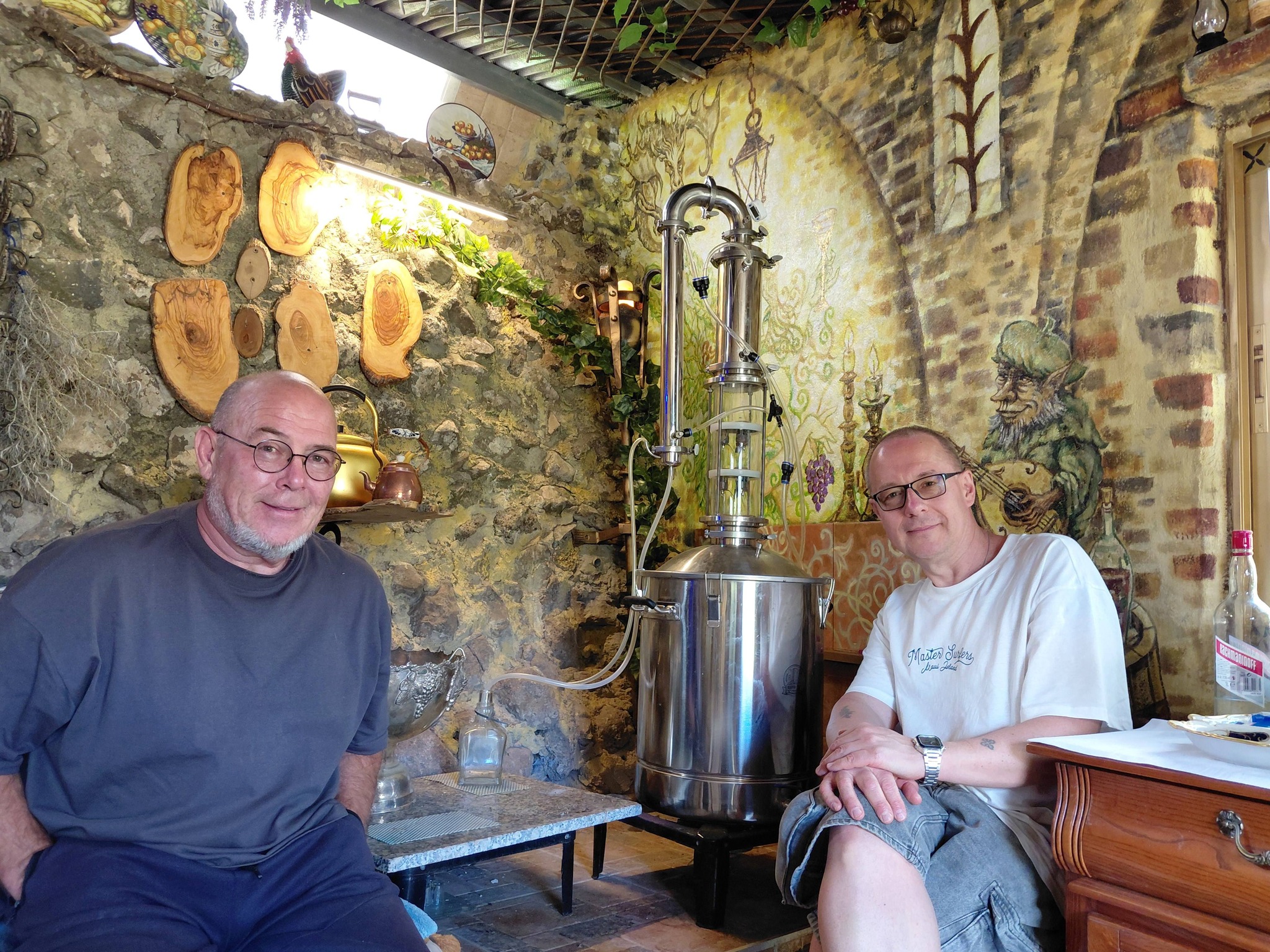
With colleague Dmitry Belyaev, who has retrained as a winemaker. Photo by the author.
The socio-economic structure of modern Spain is perceived philosophically by our former compatriot:
– Sanchez, he’s not about business. (Pedro Sanchez – the Prime Minister of Spain. – "TODAY"). He distributes benefits, treats. Everyone likes this. Well, let’s say, just like that, you get 620 euros because you live in Tenerife. Or here are airline tickets all over Spain – at half price. As for our finca, an agronomist comes here, analyzes the soil, the grapes, advises what to plant and how to grow. All at the government’s expense.
Yes, with such market socialism, it’s clear why the quiet grandfather in the Mercadona supermarket fills an entire cart with food for one hundred and fifty euros. And it’s no surprise, as the VAT here is 7% on everything. And gasoline is 1 euro per liter. You can live like this!







Leave a comment