These places were loved by Emperor Nicholas II.
The story of this place can begin like a fairy tale: beyond the mountains, beyond the forests, where unseen beasts and birds live, where large but gentle bison roam, lies Białowieża. Now, seriously — Valentina Petrouchuk, chairwoman of the Local Tourist Organization "Białowieża Forest Region."
Valentina Petrouchuk: Białowieża is a village located in the clearing of Białowieża Forest. You can only reach us by a single paved road from Hajnówka, the capital of the district, and from the village of Narewka — by a forest road. From Białowieża to the border with Belarus is 3 kilometers. Previously, there was a small visa-free border crossing for pedestrians and cyclists, but it is currently suspended. Białowieża is essentially the capital of that part of Białowieża Forest that is located in Poland. It is a very popular area among tourists. The local residents practically live off tourism. We have a good accommodation base: two large hotels with 450 beds, and well-developed green tourism — 100 local hosts rent out rooms or entire houses.
The popularity of Białowieża is certainly due to the attractiveness of the Białowieża Forest region.
Valentina Petrouchuk: First of all, this is a region rich in the natural resources of Białowieża Forest itself, as well as the rivers Narew and Narewka. These are different rivers, but they are closely connected: Narewka is a left tributary of the main river — Narew. Both rivers flow through the territory of Poland and Belarus, and the Narew flows into the Western Bug. Moreover, this is a region with a very rich cultural heritage, as these are border territories, and as is known, border areas, just like ours, exhibit cultural and religious diversity. In our area, Poles, Belarusians, Ukrainians, as well as representatives of other nationalities live. We have both Catholic and Orthodox Christian denominations, as well as other religions, which makes this area very, very diverse. There is also culinary diversity, although the most popular dishes are made from potatoes, flour, using herbs, forest gifts, and game. Due to such a wealth of culinary diversity and significant culinary traditions, we applied for the "European Destinations of Excellence (EDEN)" competition, and we were recognized — we received an honorary award in the category "Hospitality and Flavors of the Białowieża Forest Region." In their reviews, tourists often say that the residents of our region are very hospitable, and they are eager to talk to tourists. We are very pleased with this award and strive to use it to promote the region: we go to fairs, take local products with us, treat guests and visitors, and want everyone to try — to encourage people to come to the Białowieża Forest region in this way.
The love of tourists for Białowieża and its surroundings is confirmed by statistical data.
Valentina Petrouchuk: Our statistics are based on data from Białowieża National Park, which is visited by about 130,000 to 140,000 tourists each year. Please note that these are only tourists who visit the park's facilities (they buy tickets, register). If they come again, they do not visit these facilities. So, in reality, there are many more tourists, including foreigners.
Białowieża National Park is the oldest national park in Poland. Its area is more than 5,000 hectares, 94% of which is preserved in an untouched state. Since 1979, it has been on the UNESCO World Heritage List. There is a Nature and Forest Museum within the park.
Ewa Moroz-Kęcińska: This nature museum is one of the largest in Poland in terms of area. It is essentially Białowieża Forest transferred into a building. Tourists, when it rains or when they cannot — for various reasons — wander around the forest for long, come to us and, I must say, are amazed. Thematic blocks are presented in 26 innovative scenes that showcase Białowieża Forest in the context of zoology, botany, and ecology. There are exhibitions related to history and culture that show how the forest has been used over the centuries. Our museum is visited not by a few tourists, but by a very, very large number — about 90,000 people a year. For comparison, the best museums in Warsaw are visited by 2,000 to 3,000 people a month, while ours sees over 10,000. The museum also hosts temporary exhibitions, but one of them has generated such great interest among tourists that it has become practically permanent. These are archival photographs — from the 19th century — of the imperial palace, which no longer exists. The only thing left from it is the palace park. The photographs are unique, showing what made Białowieża what tourists see today. Here, by order of Tsar Alexander III, a palace was built in 1894 in eclectic style with 139 rooms — there was even a room for samovars and a room for stamps. Monarchs stayed there when they came to hunt in Białowieża Forest. In 1944, the main building of the palace was set on fire by retreating German troops. The last house belonging to the palace complex burned down under unclear circumstances just hours before Khrushchev's arrival for secret negotiations in the 1960s.
There is another historical site in Białowieża.
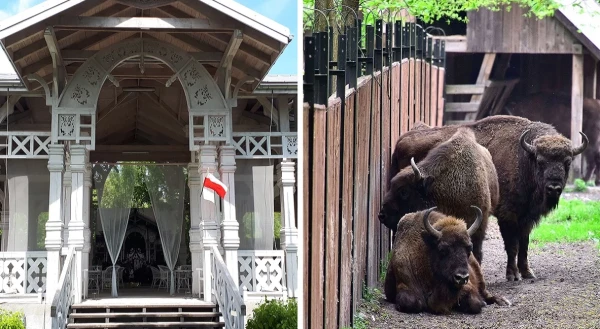
Katarzyna Kubicka: We are located at the Białowieża-Palace railway station. Its reconstruction began in 2014. The first building was constructed in 1897 on the occasion of Tsar Nicholas II's visit to Białowieża, who wanted to see his new palace. Within 4 months — manually, without the use of machinery — one of the most beautiful railway stations in Podlasie was built. It was wooden, decorated with carvings, light blue and white. In front of the station, there was a flowerbed where the Romanov coat of arms was laid out with flowers. Since the station was the only object in Białowieża with a stone floor, after the tsar's visit, local residents held weddings and dance evenings here. After World War I, the station was dismantled, and in 1993, the railway connection between Hajnówka and Białowieża was discontinued.
For the reconstruction of the Białowieża-Palace railway station in 2014, 70 one-hundred-twenty-year-old pines were used; the entire project connects the history of the region.
Katarzyna Kubicka: We tried to show how beautifully things were built once. Around the station, a flowerbed in the English style has been created. The building now houses a summer café "Tea House" and several cultural zones: there is a "Book and Deckchair" zone, where in good weather you can lie down and read a book about the history of Białowieża; there is a gallery where photo exhibitions take place, and starting in the fall, a project "Cinema Under the Stars" will be launched, featuring films about nature. Next is a retro games zone: here you can play rubber bands, hopscotch, and jump rope. There is also an "Insect Hotel," where pollinator insects live in honeycomb-like places, and a star alley of Białowieża Forest, where the footprints of animals are depicted — in life size. Here we conduct educational activities for groups of schoolchildren.
The footprints of the king, the master of Białowieża Forest — the bison — as well as the bison themselves can be seen in the demonstration reserve in Białowieża. But there they live behind a fence, cared for by humans, while if you visit the establishment "Bison Glade," which is located 4 kilometers from Białowieża, you can see bison in their natural habitat.
Owner: "Bison Glade" is a place where you can eat deliciously and healthily and relax — for example, have a bonfire for a group of schoolchildren or adults. We serve dishes from the regional cuisine, such as soup made from honey mushrooms that grow in Białowieża Forest; potato babka (casserole) — a traditional dish of Podlasie cuisine; freshly roasted pork with onions and cucumbers from our garden, homemade Białowieża bread… And for dessert — the owner's pie, which my mother bakes. We tell tourists about the local nature and the history of the region. The two most popular topics are the animals and birds of Białowieża Forest and the imperial palace. We have many books and materials on these topics. We are happy to suggest what is worth seeing here. But first and foremost, we talk about the bison, who often visit us. Our guests can see live bison, which often come to the glade in front of the house, lie down on the grass, and rest. You cannot approach them to pet them; you can only observe them from a distance and admire them.
I think that no one would refuse such an opportunity — to see a real bison in natural conditions. And for this, you need to come to Białowieża.