
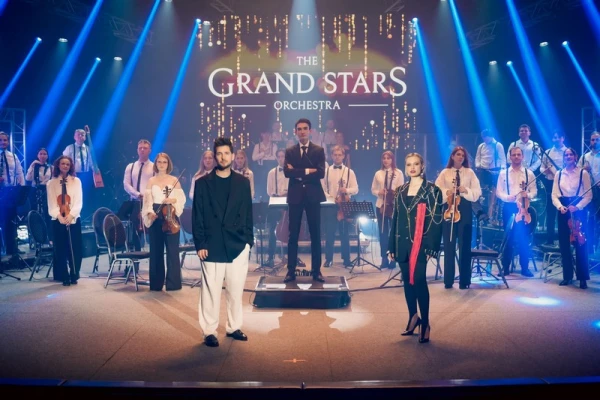
"Thank you, Latvians, for remaining strong, principled, and humane — despite fatigue, propaganda, and the passage of time," says Ukrainian singer Margarita Meleshko, who will perform in Latvia in February with The Grand Stars Orchestra.
In an open interview, the soloist talks about her journey in music, the tense everyday life in Kyiv, and performances at the front line.
Margarita, well-known in Ukraine, was born in the city of Merefa in the Kharkiv region and began singing at the age of six. As a teenager, she performed at a local restaurant, later graduated from a music university, participated in television projects "The Voice of Ukraine" and "X-Factor," and her voice is familiar to many Ukrainians from the animated film "Moana," where she voiced the main character.
Previously, Margarita was also a soloist of the National Brass Band of Ukraine and the Song and Dance Ensemble of the Armed Forces of Ukraine. Therefore, after the full-scale war began, she repeatedly traveled with concerts to Ukrainian soldiers at the front line, trying to support them and give them hope.
Today, the singer is part of The Grand Stars Orchestra, which will present a new program, Hollywood Music Experience, in seven countries and 36 cities at the beginning of next year. As part of the tour, the ensemble will perform in Riga — the concert will take place on February 12 at Xiaomi Arena.
Margarita Meleshko, who is not visiting Latvia for the first time, emphasizes that music for her is a tool of goodness and hope, which is especially important now, in wartime. She speaks warmly of the Latvian group Tautumeitas and feels sincere gratitude towards the people of Latvia for their unwavering support of Ukraine over the past four years.
In an open conversation, Margarita spoke about the beginning of her creative journey, the behind-the-scenes of famous television projects, concerts at the front line, the tense reality in Kyiv, a missile that recently fell very close to her home, and how the war has changed her understanding of the mission of music.
— Margarita, how did your musical journey begin?
— I fell in love with singing and the stage very early. My parents noticed my inclination for performances at family celebrations when I was only five or six years old. At that time, our neighbor worked as a vocal teacher at the local music school, so my parents asked him whether I should develop my talent. That’s how I started studying music. When I was fifteen, my teacher introduced me to his colleague, who was looking for a singer for duet performances in a restaurant. This gave me the opportunity to gain stage experience, as there were hardly any such opportunities in the small town where I lived. And it was there that my love for the stage, vocal art, and performances was born.
– Which artists inspired you the most?
– My everlasting love for Whitney Houston, Celine Dion, Mariah Carey, Christina Aguilera, Beyoncé, Lara Fabian, and many other pop divas was born back when I was performing in the restaurant. By performing their hits, I formed my vocal base, which later helped me get into the best music university in Ukraine and graduate as one of the top students. It’s also essential to mention Jessie J, Jennifer Hudson, Chaka Khan, as well as jazz legends Natalie Cole and Rachelle Ferrell.
I am a big fan of Eurovision and have always admired the Laima Rendezvous festival. Therefore, of course, I was enchanted by its magnificent music, especially the melodies of Raimonds Pauls. Since childhood, I have sincerely admired the sophisticated and charismatic Laima Vaikule, who inspired me in shaping my stage image — minimalist, restrained, yet stylish and unique. I must also mention the group Tautumeitas, which completely captured my heart at this year’s Eurovision. I think they captivated me by turning to folk motifs — this is very close to us, Ukrainians, as folk music is the heart of Ukraine's musical art. I vividly remember Aminata's performance — her vocals are simply incredible.
— You became famous thanks to the television projects "The Voice" and "X Factor." How did you decide to participate in them, and what did this experience teach you?
— I always felt that such projects are a kind of small model of the real show business, a rehearsal before the real path. Therefore, when I decided to participate, I sincerely believed that this was a chance to find a team that would help me grow — just as it has happened with many famous artists. This belief was so strong that I returned again and again: I participated in auditions five times, and in one season of "The Voice," I worked as a backing vocalist. But only by becoming a participant did I realize that here, the voice is far from the main thing. Such a project is a huge organism with countless invisible components and rules, and I was just a small part of it. This is not an ordinary vocal competition where you go on stage, sing well, and win — everything is arranged differently here. However, this experience helped me understand that the entertainment industry is much more complex than it seems, and being recognizable does not mean that a path strewn with roses awaits you.
– Many people in Ukraine know your voice not from music but from films like "Moana," where you voiced the main character. How did you get into this field?
– I participated in the national selection for a well-known singing competition, and I was noticed by the director of vocal dubbing. I really love this work because it is completely different from the stage.
On stage, I do what I have learned and developed — I improvise, play with emotions. Dubbing is entirely different. Here, you need to ensure that the character sounds as natural as possible with your voice and your language. Usually, the material is not given in advance, so the creative process happens right in the studio, strictly according to the melody indicated in the score. You listen to the original, check the notes, read the translated text, and then sing, taking into account the rhythm, character of the hero, and emotion.
– And how did you end up in The Grand Stars Orchestra?
– Singing with an orchestra was my childhood dream, and it has been successfully fulfilled for over ten years. Probably nothing compares to the feeling of being part of such a powerful musical mechanism — its dynamics, energy, and the strength of each musician and conductor. You become part of a living musical canvas.
Although this project is still relatively new, I have known the team of The Grand Stars Orchestra for a long time because the orchestra consists of people who have worked in the entertainment industry for many years and know each other well. We have talented musicians, vocalists, an incredibly experienced organizer, a strong technical team… We all previously worked in a similar project and understood what we wanted to create. Therefore, The Grand Stars Orchestra is a combination of all the best that each of us can do.
– Margarita, you were a soloist of the Song and Dance Ensemble of the Armed Forces of Ukraine for several years. Tell us more about this experience.
– This was my first experience performing with more than 90 artists: an orchestra, a choir, and a ballet troupe. When I joined the ensemble, it was experiencing its golden age, so many young Ukrainian singers dreamed of performing here one day — just like Tina Karol or Zlata Ognevich once did. People adored the ensemble, and its artistic director was not afraid to combine military discipline with creative boldness. He could see talent and allow it to unfold. I joined the ensemble while still a student and had the opportunity to perform on the largest stages in Ukraine and go on extensive tours abroad. It was an invaluable experience.
– When the war began in Ukraine, you had to perform at the front line several times. How did you prepare for this emotionally?
– To be honest, sometimes performing at the front line was even safer than being at home in Kyiv. Life in Ukraine is a terrifying lottery, as a missile or drone can strike anywhere. We did not specifically prepare for such performances — we just believed, trusted the military, and supported each other. In cities near the front, we spent two to three days, after which we went to perform in front of the soldiers. Everything was planned to ensure maximum safety for everyone.
– What did the soldiers say to you after such performances?
– Most often, they simply thanked us for helping them forget, even for a minute. Many said that the songs reminded them of home and peace. These concerts became a kind of creative therapy: we sang, danced, talked together, and sometimes cried. I will never forget all those beautiful cities and corners that are now destroyed — seeing this reality breaks my heart. And I will never forget the empty eyes of the soldiers when they return from missions and can no longer react.
– Recently, a missile fell near your home in Kyiv. How did you experience that moment?
– My cat helped me. Half-jokingly, half-seriously. In such moments, you don’t understand whether a missile is flying nearby or directly at your home — you only hear the frightening approaching sound. But I was lucky: I heard an explosion nearby and felt the windows tremble. The nights become the hardest when drones or missiles are flying over Kyiv, which are intercepted by air defense. In the morning, you walk like a zombie and feel immense gratitude just for being alive. Now I appreciate the simplest things much more — like morning coffee. I am supported by a healthy lifestyle, the support of loved ones, and creativity. But four years of constant tension leave a mark. This is our reality in which we have learned to live.
– Has the war changed your view of music and your mission as an artist?
– Absolutely, yes. Music has become a way to speak, persuade — or remain silent. For popular performers, it turns into a powerful tool capable of influencing society. Recently, I performed at an event in France dedicated to supporting Ukraine, where I sang two of my original songs written at the very beginning of the invasion: one for Ukrainians forced to leave their homes, and the other for women serving in the armed forces. If my voice inspires even a few people abroad to help Ukraine — that will be incredibly important to me. The more voices we have, the stronger we are.
– What message would you like to convey to the people of Latvia?
– Nothing touches as deeply as personal experience. I understand that Europe is tired — news fades over time, life goes on, and everyone has their own concerns. Even we ourselves, in calmer moments, stop thinking about the war for a while — it’s a self-preservation instinct. But the war continues. Missiles still kill civilians and soldiers every day. I feel this on my own skin every time the windows shake in Kyiv from the shock wave.
I sincerely hope that the people of Latvia will never, ever have to experience anything like this. Thank you, Latvians, for remaining strong, principled, and humane — despite fatigue, propaganda, and the passage of time. At our concerts with The Grand Stars Orchestra, we will not talk about war but about life — its beauty and fragility. We are young and full of passion for life. Therefore, I warmly invite you to an elegant evening filled with emotions and the music of Hollywood.
– Margarita, thank you for your openness. See you in Latvia
This winter, The Grand Stars Orchestra, together with Margarita Meleshko, will present their new program "Hollywood Music Experience" at the Xiaomi Arena in Riga.
The concert will take place on February 12, 2026, and tickets for the event can be purchased on the Bilesuserviss.lv website.





Leave a comment