
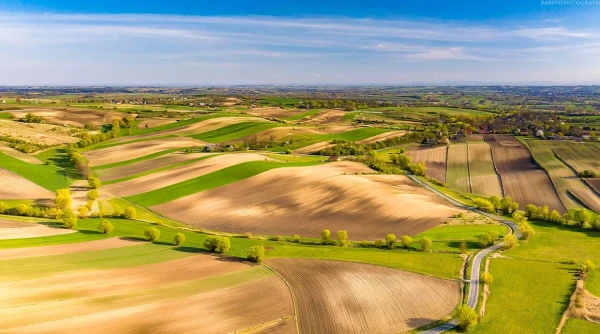
Here is a true paradise for ornithologists, fishermen, and all nature lovers.
In southern Poland lies a region that captivates at first glance: hills, the Nida Valley, colorful meadows, and traces of ancient cultures intertwine here so closely that the boundary between history and legend blurs. Ponidzie — the "Polish Tuscany" — invites you on a journey through pristine valleys, karst mysteries, ancient towns, and the fates of people for whom this region has become not only a homeland but also a living museum of the past.
Ponidzie is a region in the Świętokrzyskie Voivodeship, known as the "Polish Tuscany." It is characterized by a hilly landscape, the Nida River valley, as well as a wealth of nature and numerous monuments. It is said that anyone who has visited here once will never forget its charm.
It is into such a wonderful, layered reality that we will embark today with local guides — a local historian, a priest, an artist, and a craftsman, for whom Ponidzie is not just a point on the map, but a part of their own history.
We will start with a story from guide Piotr Szumilas:
-Ponidzie is a very picturesque, hospitable region with rich natural resources. It is renowned for its natural beauty. Traveling through it, one can get acquainted with interesting geological formations and the extraordinary and diverse flora and fauna that thrive on limestone and gypsum soils in several local nature reserves and landscape parks. The name "Ponidzie" comes from the name of the Nida River. It is a typical lowland river that flows into the Vistula near Nowy Korczyn. Flowing through flat terrain, it creates numerous oxbows and bends — a true paradise for ornithologists, fishermen, and all nature lovers. From a historical perspective, this is a Lesser Poland region where the so-called Eastern Krakowiaks lived. This region flourished and developed not only thanks to the Piast dynasty and Mieszko's baptism in 966.
Mieszko was the first historically verified Polish prince from the Piast dynasty, the founder of the early Polish state, who adopted Latin Christianity as the state religion. However, the history of our region indicates that Christianity arrived in Polish territories earlier than the official baptism of Poland in 966. In the Slavic version of the life of the enlighteners Cyril and Methodius, known as the Pannonian legend, there is mention of a baptism in the Vistula in these local areas of a local nobleman, most likely according to the Byzantine rite. And baptism in the Byzantine rite also meant that the liturgy was conducted not in Latin but in Old Church Slavonic. All of this lives among the people, among these fields. You just need to search a little, and the Ponidzie region invites you to seek traces of the ancient history of these places.
Almost every locality in Ponidzie is unique or holds its own distinctive history, our guide assures.
Piotr Szumilas: This is a tourist-cultural area shaped by unique small localities and their inhabitants. In ancient times, cities were divided — depending on who owned them — into royal, spiritual (i.e., belonging to the Church or a monastic order), and noble, owned by counts and princes. They were the ones who invited Jewish bankers to their cities, who always had cash on hand to lend. One such city that developed dynamically was, for example, Chmielnik. It was a private city. Just like the royal cities, it invited the Jewish community, which had capital. Therefore, in such towns, the Jewish community thrived well.
The list of places worth attention and visiting for tourists in the Nida River valley is extensive. One of them — the most unusual on the map of Poland — is Szydłów, often referred to as the Polish Carcassonne. This small settlement in the Świętokrzyskie Voivodeship has a history and atmosphere that make a truly strong impression. Szydłów is primarily known for its monumental, well-preserved defensive walls from the 14th century. Although they were damaged during World War II when the front line passed through Szydłów.
It is thanks to them that it is compared to the French Carcassonne. Walking through the town, one can feel as if time has slowed down: the stone gates, medieval streets, and the ruins of the royal castle transport us to the era of Casimir the Great, who granted Szydłów municipal rights and erected powerful fortifications here. Also noteworthy is one of the most valuable architectural monuments — the 16th-century synagogue, one of the oldest and best-preserved in Poland. Today, it houses a museum that reminds us of the multicultural history of the region. But Szydłów is not just about the past. It is also the capital of the Polish plum. Every year, the Plum Festival takes place here — fragrant, rich in fruits, homemade preserves, and local color. It is the perfect place to slow down a bit, stroll among the monuments, and feel the atmosphere of past centuries.













Leave a comment