The first-century historian Josephus Flavius claimed that this wall was impregnable, adding that it was protected by 60 towers.
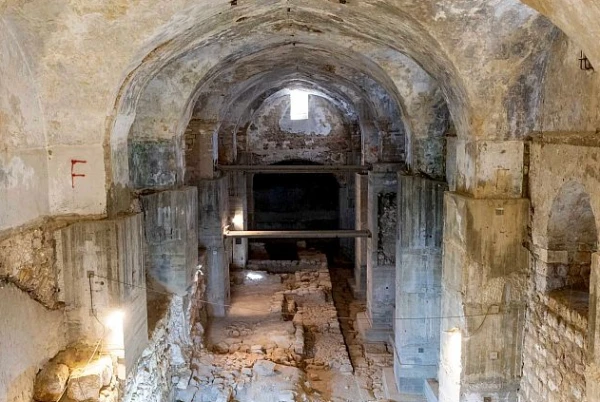
Excavations of a fragment of a fortress wall built in the second half of the second century BC – during the reign of the Hasmonean dynasty – are nearing completion in Jerusalem. It is located near the Tower of David in the Old City, within the territory of the 19th-century administrative complex "Kishle." The find was made during work on creating a department of archaeology, arts, and innovations at the Museum of the History of Jerusalem.
"In historical sources, this area is known as the 'first wall.' Its dimensions and degree of preservation are impressive. The length of the section is 40 meters, and the width of the wall is five meters. Large stones were used in its construction, carefully fitted together and hewn in a style characteristic of the period," said excavation leaders Amit Re'em and Marion Zindel.
They note that the height of the fortifications was ten meters. To this day, only the foundation has survived. During the Hasmonean period, it surrounded Mount Zion. Sections of it have been discovered there, in the City of David, in the courtyard of the Tower of David, and near the western part of the current Old City wall.
The first-century historian Josephus Flavius claimed that this wall was impregnable, adding that it was protected by 60 towers. Archaeologists note that it did not fall into decay due to the passage of time – its demolition was intentional. However, the question of who ordered this remains open.
According to one hypothesis, it was the Hasmoneans themselves who did this by agreement with the Syrian king Antiochus VII Sidetes, who managed to return Judea under the control of the Seleucid Empire after the siege of Jerusalem in 134-132 BC. According to Josephus Flavius, the ruler of Judea, John Hyrcanus, used treasures hidden in the tomb of King David as tribute and fulfilled the conqueror's demand for the demolition of the wall.
The second version is that it was done by King Herod, who demolished the buildings of his predecessors to assert his superiority over the Hasmoneans and to make way for his own monumental architecture.
Artifacts related to the siege of Jerusalem by Antiochus Sidetes were discovered during excavations conducted in the 1980s. These include stones for catapults, arrowheads, and sling bullets. It is also worth noting that despite all efforts, the army of the Syrian king was unable to breach the city wall.
<iframe width="560" height="315" src="https://www.youtube.com/embed/f1_QLjWWDZM?si=BFSk1lh7mz9FN4Tb" title="YouTube video player" frameborder="0" allow="accelerometer; autoplay; clipboard-write; encrypted-media; gyroscope; picture-in-picture; web-share" referrerpolicy="strict-origin-when-cross-origin" allowfullscreen></iframe>