
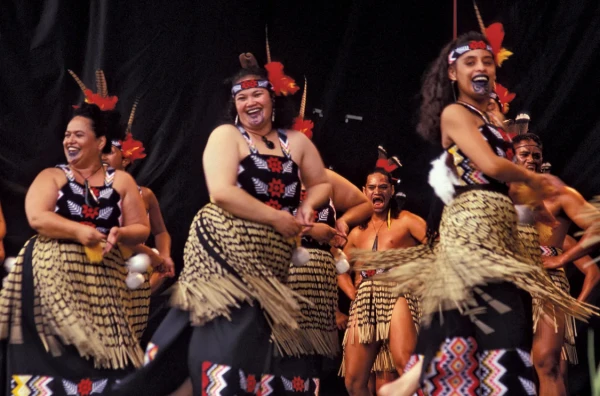
Players performing these movements reached an elevated heart rate.
The New Zealand haka is a traditional ritual dance of the Māori people, used to greet guests or express strength, pride, and unity of the tribe. It is most often performed at sporting events as a means of intimidating the opponent.
However, the haka remains a controversial topic: some love it, while others believe it has outlived its usefulness.
Even on Māori land, where this dance is taught in schools, such forms of protest are not always welcomed. For example, last year, it caused a scandal in the New Zealand Parliament. Three Māori MPs performed the haka in protest against amendments to the Treaty of Waitangi — an agreement between the British Crown and the Māori, signed 184 years ago. Two MPs were suspended from work for 21 days, and another for a week.
With a similar message, current England national team player Joe Marler found himself at the center of the scandal. On the eve of the match against New Zealand, he called the dance "ridiculous" and urged to "send it to the scrap heap." This is the second time the rugby player has broached this topic: he also criticized the haka in last year's match against New Zealand.
On the social network X (formerly Twitter), the athlete wrote: "The haka should be banned. It’s just ridiculous." These words sparked outrage among New Zealand fans, who demanded an apology from the athlete. The head coach of the New Zealand team, Scott Robertson, soon joined the discussion, advising Marler to be more careful with his words. A few days later, the English player published an apology: "I wanted to apologize to all the fans of New Zealand whom I offended with my poorly worded tweet. I meant no harm, I just wanted the restrictions on responses to be lifted without sanctions."
But really, why not use such ritual performances for good, especially considering the current trend towards traditionalism and various support for the culture of small nations? Each national team could find or create its unique image, a ritual inspired by local customs. This would add even more spectacle to the sport, and the athletes themselves would receive a powerful boost of energy before the game. Fans would go wild — just imagine the Russian national team performing "Black Raven" in unison with deep voices.
At the University of Queensland, a study was even conducted showing that players performing these war dances reached an elevated heart rate a couple of minutes before the match began. These movements are equivalent to a warm-up, while opponents stand still, often in the cold. Of course, this is a slight advantage, but at a professional level, it can be a decisive factor in whether or not a goal is scored in the first five minutes.
"If it gave them a boost of energy, then it gave me a moral one," shared Victor Matfield, a former player for the South African rugby team, in a conversation with The Guardian. "I knew a battle awaited me, and it made me act. I looked at them and accepted the challenge. That’s a wonderful thing about rugby."
Any fan will remember the moment they first see this with their own eyes, Matfield noted. According to him, it is the haka that makes matches against New Zealand unique.














Leave a comment