
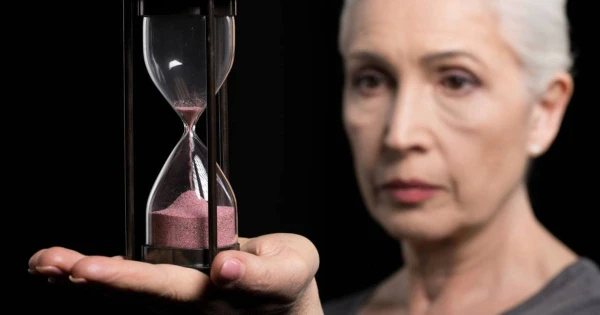
Many women who look stunning at any age attribute eternal youth to three main companions: proper nutrition, absence of bad habits, and a positive attitude. But modern science confirms that appearance does not always match biological age. Scientists from Stanford University have learned to determine a person's age by the level of proteins in the blood with high accuracy—and have discovered the points at which aging becomes irreversible.
In Australia, a popular fair game is to guess a person's age by their appearance. If you guess wrong, you win a stuffed toy. Stanford scientists, of course, would not be guessing—they took blood samples for analysis. The concentration of 373 proteins allowed for an accurate determination of biological age. This showed that aging is not a uniform process, but rather a series of jumps.
The Phenomenon of Aging
In a Stanford article published in 2019, Dr. Tony Wyss-Coray, a neurologist and director of the Alzheimer's Disease Research Center, emphasized that proteins in the blood tell a lot about health. Proteins are the main building material of the body, part of the immune system, involved in tissue regeneration, hormone production, and metabolism. Lipoproteins affect the heart and blood vessels, hemoglobin reflects the risk of anemia, and total protein is included in standard tests during pregnancy.
Professor Wyss-Coray noted that about one-third of all proteins change significantly with age, and sharp fluctuations in some of them signal irreversible changes. The scientists studied the plasma of 4,263 people aged 18 to 95 and confirmed that the concentration of proteins changes significantly three times over a lifetime.
Points of No Return
These sharp changes occur on average at ages 34, 60, and 78—three "points of no return" that reflect the main stages of physiological aging. In fact, a 25-year-old and a 33-year-old may be biologically the same age. The jumps correspond to youth, late middle age, and old age.
The study also showed gender differences. Male proteins more often correspond to chronological age, while female indicators are more unpredictable: a fifty-year-old woman may be biologically as young as 45 or as old as 55.
Biological Age vs. Chronological Age
The LonGenity Institute for Aging Research studied groups of people whose biological age did not match their calendar age. Of particular interest were Ashkenazi Jews who lived to be 95. Elderly individuals with clear minds and strong grips were biologically younger than their peers. Scientists still need to determine the role of genetics, lifestyle, and healthcare.
The Elixir of Eternal Youth
A discovery by American researchers in 2019 showed that activating the thymus gland with medications reduced biological age by an average of 2.5 years, with some effects lasting for six months. The thymus gland is active until the onset of puberty, after which it shrinks, affecting aging.
Modern Scientific Opportunities
Professor Wyss-Coray emphasized that protein analysis helps to understand why different organs age at different rates, predict the risk of early Alzheimer's and cardiovascular diseases, and search for methods to slow aging. Experiments with mice showed that young blood can prevent the development of diseases or reverse them.
While scientists search for a "cure for aging," everyone can follow the principles of longevity from the "blue zones": proper nutrition, physical activity, a positive attitude, and health care—and manage their own aging type starting today.
Source: Myhandbook
















Leave a comment