
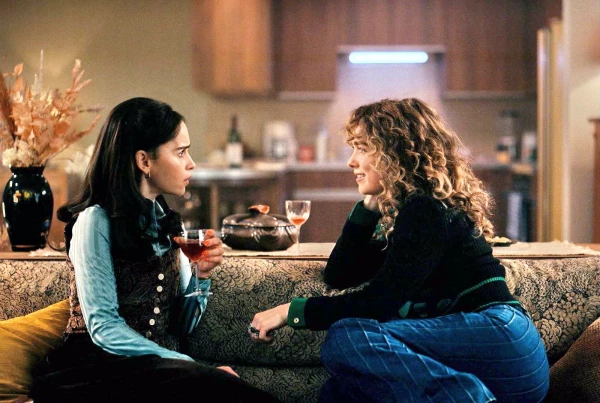
"Ponies" (Ponies). Creators Suzanna Fogel and David Iserson, starring Emilia Clarke, Hailee Lou Richardson. USA, Peacock, 2026.
Oh, those Russians
The readiness to take offense is a sign of insecurity. In Russia, any film—whether feature-length or television—made about it in the West is met with offended indignation and derisive mockery. Even the extremely diligent in terms of facts and quite complimentary "Chernobyl."
What can be said about a series where a prostitute killer, a likely future head of the KGB, relaxes with colleagues in a Moscow casino adorned with golden palace stucco in 1977.
The clichés in "Ponies" are lush thickets, almost an Amazonian jungle. But it is telling that behind the mockery of Russian reviewers, there is not even a thin veil hiding the offended feelings of those who believe in the eternal Western desire to devalue Russia. And it seems that Moscow looks unimposing in the series (where could it, poor thing, look imposing if everything was filmed in the back alleys of Budapest), and the American characters on screen frequently make unflattering comments about the Union. One must either completely forget the Soviet seventies or know nothing about them to see lies and slander here: the reality of developed socialism was indeed quite unremarkable, and when it came to unflattering comments about it, no Western detractors could compare to loyal Soviet citizens.
The Trend for the Russian Federation
Honestly speaking, if anyone should be truly infuriated by the fresh product from Peacock, it should be Ukrainian activists who have tried to cancel any cultural content dedicated to Russia in any of its historical incarnations. They even scored a significant victory over writer Elizabeth Gilbert ("Eat, Pray, Love")—she canceled the publication of her novel set in a country that is forbidden to mention. However, overall, the activists' mission has been a resounding failure—the decade-long, at least, Western trend for Russia and Russians has only blossomed more than ever since the onset of the full-scale war.
That is precisely why it has flourished: the aggressor country has been in all the news—what is in the morning newspaper is inevitably in the evening's verse (in a film or series). In any case, the renaissance of the spy genre is an undeniable consequence of the new Cold War.
However, the spy is far from the only role in which the screen Russian (played by either a Hollywood star or actor Yura Borisov) is in demand by Western audiences. Princes from literary classics (the British series "War and Peace") and farcical emperors (the British "The Great"), sorceresses from the fantasy subgenre "tsar-punk" ("Shadow and Bone") and Chernobyl liquidators, sinister bandits ("McMafia") and soulful bandits ("Anora"), figure skaters ("Petrichor") and hockey players ("Fierce Rivalry")—the variety of ways in which Russians have amused, frightened, and charmed the Anglo-Saxons over the last decade is vast.
And even one "Ikarus"
With "Ponies," everything is simpler and clearer in this sense: we are presented with a relatively typical spy retro-detective (with a slight comedic tilt). And Russia, or rather the Soviet Union, with Russians, or rather Soviets, do not particularly interest the authors themselves.
Moscow is an exotic backdrop, recreated in places with mechanical precision (the props specialists honestly bought "Volgas," "Zhigulis," and even one "Ikarus"), and in places deliberately carelessly—with concern not for historical accuracy, but for conformity to stereotypes. Muscovites: babushkas, glamorous prostitutes, clear-eyed young men listening to American rock and betraying their homeland for ideological reasons, monstrous, though sometimes attractive in their monstrosity, KGB agents.
Here it’s funny, and here it’s not
In fact, the clichéd thickets are not the main problem of the series: if it were a full-fledged comedy or parody, no cliché would ruin it.
The problem is that the series itself cannot decide on the degree of its own seriousness. For a serious thriller, it is too lightweight, and sometimes just plain silly. For a comedy, it is not funny enough and sometimes too pretentious.
As for partisanship and ideological consciousness, it will outdo the cinematic socialist realism of the 70s: "Ponies" is yet another story about brave women breaking free from the roles imposed on them by patriarchy and humiliating self-satisfied men on their turf.
Not of Interest
...Bea (Clark) and Twyla (Richardson) are housewives, wives of American spies working in Moscow under diplomatic cover. On New Year's 1977, both CIA agents die on a secret mission. The widows are sent back to the States without any explanation.
And then the girls decide to find out what happened to their husbands themselves. They ask to be sent back to Moscow—to spy. The CIA leadership, after some thought, agrees: after all, the patriarchal KGB will surely not take women seriously.
In fact, "Ponies" is not about miniature horses, but PONI—Persons Of No Interest: individuals who do not represent operational interest...
At this point, any sane viewer has the right to ask: why continue watching this obvious nonsense? There are few substantial reasons, we admit. Well, for example, to listen to how the Mother of Dragons painfully, yet diligently speaks po-russki for eight episodes.






Leave a comment