
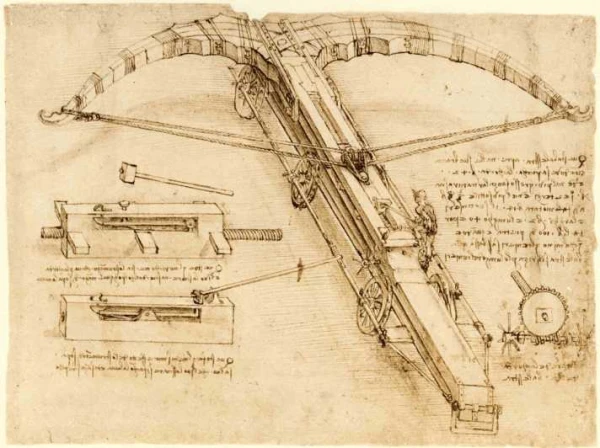
The National Library of Spain has presented a priceless gift to all humanity by completing a large-scale project to digitize the Madrid codices of the great Leonardo da Vinci. This event marks a new era in the accessibility of cultural heritage, as now anyone with a smartphone or computer can peek into the personal laboratory of thought of the most celebrated genius of the Renaissance.
This concerns two volumes that were considered irretrievably lost for several centuries and were only discovered in 1965 in the archives of a library by a fortunate coincidence. Today, these manuscripts, comprising hundreds of pages, have undergone a complex ultra-high-resolution scanning procedure, allowing for the examination of the smallest details of ink strokes and even the texture of the paper that the master's hand touched more than five hundred years ago.
The Madrid codices represent a unique blend of theoretical mechanics, engineering art, and profound philosophical reflections. Unlike many other manuscripts by Leonardo, which were fragmented and later bound into albums, these volumes have retained their original structure. The first volume is dedicated to mechanics and contains detailed diagrams of gear systems, screws, hydraulic systems, and even prototypes of modern bearings.
The master describes the laws of friction and statics in detail, anticipating discoveries that official science would make only centuries later. The second volume reveals another side of the genius: it contains his notes on geometry, cartography, as well as sketches for a grand monument to Francesco Sforza. His reflections on the flight of birds and attempts to construct wings for humans are of particular value, still astonishing with the precision of anatomical and aerodynamic observations.
Digitization has not just turned paper pages into pixels; it has created a full-fledged interactive environment. Users can not only flip through the codices but also study annotations that explain the context of each entry. Library specialists have done tremendous work deciphering Leonardo's famous mirror writing, making his thoughts comprehensible to the modern reader.
Interestingly, during the preparation of the project, scientists discovered previously unnoticed details hidden beneath layers of time, confirming the status of the manuscripts as an inexhaustible source of discoveries. Now that the Madrid codices are available online in impeccable quality, the mystery of Da Vinci's creative process becomes a little closer to each of us, affirming that true art and the thirst for knowledge know no boundaries and are not subject to time.














Leave a comment